
Technical Support & Resources
Information provided in the product description is from published literature. Due to the nature of scientific experimentation, your results (e.g., selectivity and effective concentrations) or specific application for this product may differ. If you have questions about how this product fits your application, please contact our technical support staff.
Visit our FAQ
Contact Us
Toll Free Phone (USA and Canada Only): (888) 526-5351
Direct Phone: (734) 975-3888
Product Categories
Research Area
Technical Information
- Desmethylbellidifolin
- DMB
- THX
- Xan
Shipping & Storage Information
Recommended Products
Certificates of Analysis & Batch Specific Data
Provide batch numbers separated by commas to download or request available product inserts, QC sheets, certificates of analysis, data packs, and GC-MS data.
Lipid Resource Center
Discover Products & Resources for Lipid Research
- High-purity lipid standards
- Lipid roles in biology
- Lipids in health & disease
- Lipids for pharmaceutical development
- Protocols, advice, & resources
Product Description
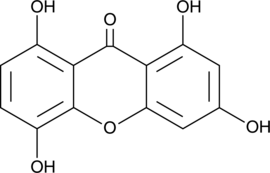
1,3,5,8-Tetrahydroxyxanthone (THX) is a xanthone that has been found in G. acuta that has diverse biological activities.1,2,3,4 It reduces PI3K, phosphorylated AKT, and phosphorylated mTOR levels in, and inhibits proliferation of, HT-29 and LoVo colorectal cancer cells (IC50s = 83.42 and 69.87 µM, respectively).1 THX decreases TNF-α, IL-6, inducible nitric oxide synthase (iNOS), and COX-2 levels in LPS-stimulated RAW 264.7 macrophages and reduces body weight loss, bloody stool, and diarrhea in a rat model of ulcerative colitis (UC).2 It inhibits α-glucosidase and aldose reductase 2 (IC50s = 5.2 and 0.09 µM, respectively) and prevents hydrogen peroxide-induced decreases in viability of INS-1 pancreatic β-cells.3 THX reduces plasma malondialdehyde (MDA) levels, lipid levels, and ketone bodies concentration and increases plasma glucose levels in a mouse model of ketosis.4
WARNING This product is not for human or veterinary use.
References & Product Citations
1. Xanthones from Gentianella acuta (Michx.) hulten ameliorate colorectal carcinoma via the PI3K/Akt/mTOR signaling pathway. Int. J. Mol. Sci. 24(3), 2279 (2023).
2. Desmethylbellidifolin from Gentianella acuta ameliorate TNBS-
3. Xanthones from Swertia mussotii as multitarget-
4. 1,3,5,8-
Contact Info
Cayman Chemical1180 East Ellsworth RoadAnn Arbor, Michigan 48108 USAToll Free: (800) 364-9897(USA and Canada only)Fax: (734) 971-3640


