
Technical Support & Resources
Information provided in the product description is from published literature. Due to the nature of scientific experimentation, your results (e.g., selectivity and effective concentrations) or specific application for this product may differ. If you have questions about how this product fits your application, please contact our technical support staff.
Visit our FAQ
Contact Us
Toll Free Phone (USA and Canada Only): (888) 526-5351
Direct Phone: (734) 975-3888
Technical Information
Shipping & Storage Information
Recommended Products
Certificates of Analysis & Batch Specific Data
Provide batch numbers separated by commas to download or request available product inserts, QC sheets, certificates of analysis, data packs, and GC-MS data.

Visit Our Cancer Resource Center
Find Tools & Resources to Study the Hallmarks of Cancer
- Cancer cell signaling & regulation
- Cancer metabolism
- Tumor microenvironment
Product Description
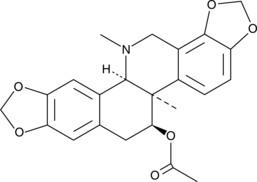
Acetylcorynoline is an alkaloid that has been found in C. bungeana and has diverse biological activities.1,2,3 It reduces the half-life of c-Myc, inhibits proliferation, induces apoptosis, and induces cell cycle arrest at the G2/M phase in HCT116 colon carcinoma cells expressing or not expressing p53.1 Acetylcorynoline (10 and 20 µM) reduces the secretion of TNF-α, IL-6, and IL-12 p70 by mouse bone marrow-derived dendritic cells (BMDCs) stimulated with LPS. It also reduces delayed-type hypersensitivity in mice sensitized with 2,4-dinitro-1-fluorobenzene (DNFB) when administered at a dose of 100 µg/animal.2 It has anti-parkinsonism effects in Parkinson’s disease models using various strains of C. elegans, including reducing dopaminergic cell degeneration, preventing α-synuclein aggregation, and increasing dopamine levels and lifespan.3
WARNING This product is not for human or veterinary use.
References & Product Citations
1. Acetylcorynoline induces apoptosis and G2/M phase arrest through the c-
2. Acetylcorynoline impairs the maturation of mouse bone marrow-
3. Acetylcorynoline attenuates dopaminergic neuron degeneration and α-
Contact Info
Cayman Chemical1180 East Ellsworth RoadAnn Arbor, Michigan 48108 USAToll Free: (800) 364-9897(USA and Canada only)Fax: (734) 971-3640


