
Technical Support & Resources
Information provided in the product description is from published literature. Due to the nature of scientific experimentation, your results (e.g., selectivity and effective concentrations) or specific application for this product may differ. If you have questions about how this product fits your application, please contact our technical support staff.
Visit our FAQ
Contact Us
Toll Free Phone (USA and Canada Only): (888) 526-5351
Direct Phone: (734) 975-3888
Product Categories
Application
Technical Information
- EITC
- Eosin-ITC
Shipping & Storage Information
Recommended Products
Certificates of Analysis & Batch Specific Data
Provide batch numbers separated by commas to download or request available product inserts, QC sheets, certificates of analysis, data packs, and GC-MS data.

Visit Our Cancer Resource Center
Find Tools & Resources to Study the Hallmarks of Cancer
- Cancer cell signaling & regulation
- Cancer metabolism
- Tumor microenvironment
Product Description
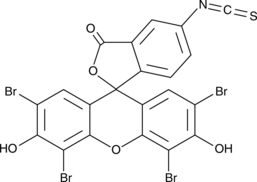
Eosin 5-isothiocyanate (EITC) is an amine- and thiol-reactive fluorescent probe and photosensitizer.1,2 It displays an absorption maximum at 518 nm and conjugate-dependent excitation and emission maxima; for ovalbumin-conjugated EITC, the excitation and emission maxima are 524 and 551 nm, respectively.3,4 EITC has been conjugated to proteins, antibodies, and neoglycoconjugates for detection in a variety of fluorescence-based applications.3,4,5,6 It has also been used as a photosensitizing agent when conjugated or complexed to antibodies targeting programmed cell death 1 ligand 1 (PD-L1) or bacteria via generation of singlet oxygen following exposure to light.2,5,7
WARNING This product is not for human or veterinary use.
References & Product Citations
1. The reaction of fluorescein isothiocyanate with thiols: A method for assay of isothiocyanates. Anal. Biochem. 132(2), 449-455 (1983).
2. Fluorescence photooxidation with eosin: A method for high resolution immunolocalization and in situ hybridization detection for light and electron microscopy. J. Cell Biol. 126(4), 901-910 (1994).
3. Avidin-
4. Atlas of fluorescence spectra and lifetimes of dyes attached to protein. Anal. Lett. 18(4), 393-421 (1985).
5. A photoactive supramolecular complex targeting PD-
6. A simple synthesis of 8-
7. Versatile supramolecular complex for targeted antimicrobial photodynamic inactivation. Bioconjug. Chem. 33(4), 666-676 (2022).
Contact Info
Cayman Chemical1180 East Ellsworth RoadAnn Arbor, Michigan 48108 USAToll Free: (800) 364-9897(USA and Canada only)Fax: (734) 971-3640


