
Technical Support & Resources
Information provided in the product description is from published literature. Due to the nature of scientific experimentation, your results (e.g., selectivity and effective concentrations) or specific application for this product may differ. If you have questions about how this product fits your application, please contact our technical support staff.
Visit our FAQ
Contact Us
Toll Free Phone (USA and Canada Only): (888) 526-5351
Direct Phone: (734) 975-3888
Technical Information
- E-0646
Shipping & Storage Information
Recommended Products
Certificates of Analysis & Batch Specific Data
Provide batch numbers separated by commas to download or request available product inserts, QC sheets, certificates of analysis, data packs, and GC-MS data.
Product Description
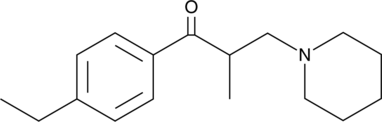
Eperisone is an antagonist of the purinergic P2X7 receptor (IC50 = 12.59 nM for the human receptor), an antispasmodic agent, and a muscle relaxant.1,2,3 It is selective for the P2X7 receptor over the P2X1-5 receptors (IC50s = >10,000, >10,000, 7,158, >10,000, and >10,000 nM, respectively).1 Eperisone also inhibits step depolarization-evoked peak sodium currents in a whole-cell patch-clamp assay using dorsal root ganglion (DRG) neurons (IC50 = 250 µM) and step depolarization-evoked calcium currents by 36% in a whole-cell patch-clamp assay using DRG neurons at 320 µM.3 It reduces contractions induced by potassium or serotonin (5-HT; Item No. 14332) in guinea pig basilar artery rings at 10 and 50 µM.2 Eperisone (10 mg/kg) inhibits dorsal root stimulation-induced ventral root reflexes in spinal rats.3 It also decreases collagen levels and total and tissue elastance and increases forced vital capacity in a mouse model of pulmonary fibrosis.4 Formulations containing eperisone have been used in the treatment of cervical syndrome, shoulder periarthritis, low back pain, and spastic paralysis but have been associated with immediate hypersensitivity and anaphylaxis.
WARNING This product is not for human or veterinary use.
References & Product Citations
1. Eperisone hydrochloride, a muscle relaxant, is a potent P2X7 receptor antagonist. Chem. Pharm. Bull. (Tokyo) 72(3), 345-348 (2024).
2. Eperisone, an antispastic agent, possesses vasodilating actions on the guinea-
3. Tolperisone-
4. Therapeutic effects of eperisone on pulmonary fibrosis via preferential suppression of fibroblast activity. Cell Death Discov. 8(1), 52 (2022).
Contact Info
Cayman Chemical1180 East Ellsworth RoadAnn Arbor, Michigan 48108 USAToll Free: (800) 364-9897(USA and Canada only)Fax: (734) 971-3640


