A peptide fragment of fibronectin
Technical Support & Resources

Information provided in the product description is from published literature. Due to the nature of scientific experimentation, your results (e.g., selectivity and effective concentrations) or specific application for this product may differ. If you have questions about how this product fits your application, please contact our technical support staff.

Visit our FAQ

Contact Us

Toll Free Phone (USA and Canada Only): (888) 526-5351
Direct Phone: (734) 975-3888

Request Technical Support

Technical Support Request

To streamline the process attach the appropriate questionnaire to your inquiry.

Download IHC QuestionnaireDownload WB Questionnaire

View Our Privacy Statement for details on how we use and protect your data. In addition, this site is protected by hCaptcha and its Privacy Policy and Terms of Service apply.

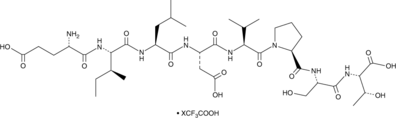
Fibronectin CS1 Peptide Fragment (human, mouse, rat, bovine) (trifluoroacetate salt)

Item No. 46339
Technical Information
Formal Name
(3S,6S,9S,12S,15S)-15-amino-12-((S)-sec-butyl)-3-((S)-2-(((S)-1-(((1S,2R)-1-carboxy-2-hydroxypropyl)amino)-3-hydroxy-1-oxopropan-2-yl)carbamoyl)pyrrolidine-1-carbonyl)-6-(carboxymethyl)-9-isobutyl-2-methyl-5,8,11,14-tetraoxo-4,7,10,13-tetraazaoctadecan-18-oic acid, trifluoroacetate
Synonyms
  • CS1-A
  • Fibronectin Connecting Segment 1 Peptide Fragment
  • Fibronectin CS1 Peptide (1,978-1,985) (human, mouse)
  • Glu-Ile-Leu-Asp-Val-Pro-Ser-Thr-OH
Molecular Formula
C38H64N8O15 • XCF3COOH
Formula Weight
Purity
≥98%
A solid
Peptide Sequence
EILDVPST-OH
DMSO: Sparingly soluble: 1-10 mg/mlPBS (pH 7.2): Sparingly soluble: 1-10 mg/ml
SMILES
C[C@@H](O)[C@@H](C(O)=O)NC([C@H](CO)NC([C@@H]1CCCN1C([C@@H](NC([C@@H](NC([C@@H](NC([C@@H](NC([C@H](CCC(O)=O)N)=O)[C@H](CC)C)=O)CC(C)C)=O)CC(O)=O)=O)C(C)C)=O)=O)=O.O=C(O)C(F)(F)F
InChi Code
InChI=1S/C38H64N8O15.C2HF3O2/c1-8-19(6)29(44-31(53)21(39)11-12-26(49)50)36(58)41-22(14-17(2)3)32(54)40-23(15-27(51)52)33(55)43-28(18(4)5)37(59)46-13-9-10-25(46)35(57)42-24(16-47)34(56)45-30(20(7)48)38(60)61;3-2(4,5)1(6)7/h17-25,28-30,47-48H,8-16,39H2,1-7H3,(H,40,54)(H,41,58)(H,42,57)(H,43,55)(H,44,53)(H,45,56)(H,49,50)(H,51,52)(H,60,61);(H,6,7)/t19-,20+,21-,22-,23-,24-,25-,28-,29-,30-;/m0./s1
InChi Key
DEXBWXUWBITICL-XZKCEHIXSA-N
Shipping & Storage Information
Storage
-20°C
Shipping
Room temperature in continental US; may vary elsewhere
Recommended Products

Certificates of Analysis & Batch Specific Data

Provide batch numbers separated by commas to download or request available product inserts, QC sheets, certificates of analysis, data packs, and GC-MS data.

    Add

    Add

    Add

    Add

    Cayman Chemical
    Visit Our Cancer Resource Center
    Find Tools & Resources to Study the Hallmarks of Cancer
    • Cancer cell signaling & regulation
    • Cancer metabolism
    • Tumor microenvironment
    EXPLORE NOW
    Product Description

    Fibronectin CS1 peptide fragment is a peptide that corresponds to amino acids in the C-terminal region of connecting segment 1 (CS1) of fibronectin.1 It inhibits cytokine-induced transendothelial migration of isolated human mononuclear leukocytes at 50 µg/well.2 Fibronectin CS1 peptide fragment also inhibits the adhesion of B16/F10 melanoma cells to fibronectin.3

    WARNING This product is not for human or veterinary use.

    References & Product Citations
    Product Description References

    1. Humphries, M.J., Komoriya, A., Akiyama, S.K., et al. Identification of two distinct regions of the type III connecting segment of human plasma fibronectin that promote cell type-specific adhesion. The Journal of Biological Chemisty 262(14), 6886-6892 (1987).

    2. Jørgensen, H.G., Remes, M.J., Elliott, M.A., et al. ɑ1-Acid glycoprotein functions in cytokine-induced leukocyte transendothelial migration quantitated by image analysis. Pharm. Pharmacol. Commun. 5, 625-629 (1999).

    3. Komoriya, A., Green, L.J., Mervic, M., et al. The minimal essential sequence for a major cell type-specific adhesion site (CS1) within the alternatively spliced type III connecting segment domain of fibronectin is leucine-aspartic acid-valine. The Journal of Biological Chemisty 266(23), 15075-15079 (1991).