
Technical Support & Resources
Information provided in the product description is from published literature. Due to the nature of scientific experimentation, your results (e.g., selectivity and effective concentrations) or specific application for this product may differ. If you have questions about how this product fits your application, please contact our technical support staff.
Visit our FAQ
Contact Us
Toll Free Phone (USA and Canada Only): (888) 526-5351
Direct Phone: (734) 975-3888
Product Categories
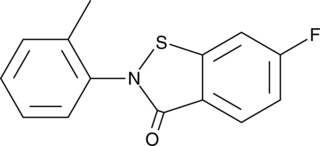
Technical Information
- NADPH Oxidase Inhibitor VII
- Thr101
Shipping & Storage Information
Recommended Products
Certificates of Analysis & Batch Specific Data
Provide batch numbers separated by commas to download or request available product inserts, QC sheets, certificates of analysis, data packs, and GC-MS data.

Visit Our Cancer Resource Center
Find Tools & Resources to Study the Hallmarks of Cancer
- Cancer cell signaling & regulation
- Cancer metabolism
- Tumor microenvironment
Product Description
NOX inhibitor VII is an inhibitor of NADPH oxidase 2 (NOX2; EC50 = 0.3 µM in PMA-stimulated neutrophils) and RNase H2 (IC50 = 0.01 µM).1,2 It is selective for NOX2 over NOX1, NOX4, and NOX5 (EC50s = 3, 8, and 8 µM, respectively, in cell-based assays) and for RNase H2 over RNase H1 (IC50 = 2 µM). However, NOX inhibitor VII also inhibits phosphomannose isomerase and several histone deacetylases (HDACs; IC50s = 2.9 and 0.66-6.07 µM, respectively) and, to a lesser extent, the tautomerase activity of macrophage migration inhibitory factor (MIF; IC50 = 62 µM).3,4,5 NOX inhibitor VII (2.5 µM) is selectively cytotoxic to MDA-MB-231 and BT-549 breast cancer cells over non-cancerous MCF-10A breast epithelial cells, and it induces apoptosis and DNA damage in MDA-MB-231 cells.6 It enhances programmed cell death protein 1 (PD-1) antibody-induced decreases in tumor volume and increases in intratumoral T cell infiltration in an immunocompetent syngeneic T11 murine model of triple-negative breast cancer (TNBC).
WARNING This product is not for human or veterinary use.
References & Product Citations
1. Ebselen and congeners inhibit NADPH oxidase 2-
2. Identification of small-
3. Potent, selective, and orally available benzoisothiazolone phosphomannose isomerase inhibitors as probes for congenital disorder of glycosylation Ia. J. Med. Chem. 54(10), 3661-3668 (2011).
4. Developing selective histone deacetylases (HDACs) inhibitors through ebselen and analogs. Drug Des. Devel. Ther. 11, 1369-1382 (2017).
5. Anti-
6. Targeting RNase H2: A dual-
Contact Info
Cayman Chemical1180 East Ellsworth RoadAnn Arbor, Michigan 48108 USAToll Free: (800) 364-9897(USA and Canada only)Fax: (734) 971-3640


