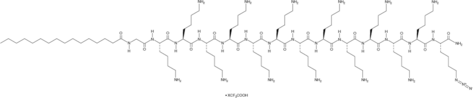
A membrane-labeling probe
Technical Support & Resources

Information provided in the product description is from published literature. Due to the nature of scientific experimentation, your results (e.g., selectivity and effective concentrations) or specific application for this product may differ. If you have questions about how this product fits your application, please contact our technical support staff.

Visit our FAQ

Contact Us

Toll Free Phone (USA and Canada Only): (888) 526-5351
Direct Phone: (734) 975-3888

Request Technical Support

Technical Support Request

To streamline the process attach the appropriate questionnaire to your inquiry.

Download IHC QuestionnaireDownload WB Questionnaire

View Our Privacy Statement for details on how we use and protect your data. In addition, this site is protected by hCaptcha and its Privacy Policy and Terms of Service apply.

pGk13a (trifluoroacetate salt)

Item No. 46578

Technical Information
Formal Name
N-((4S,7S,10S,13S,16S,19S,22S,25S,28S,31S,34S,37S,40S)-4,7,10,13,16,19,22,25,28,31,34,37-dodecakis(4-aminobutyl)-44-azido-40-carbamoyl-2,5,8,11,14,17,20,23,26,29,32,35,38-tridecaoxo-3,6,9,12,15,18,21,24,27,30,33,36,39-tridecaazatetratetracontyl)palmitamide, trifluoroacetate salt
Synonyms
  • Palmitoyl-glycine-(D-lysine)13-azide
Molecular Formula
C96H190N30O15 • XCF3COOH
Formula Weight
Purity
≥95%
A solid
Peptide Sequence
palmitoyl-Gkkkkkkkkkkkk-(k-azide)-NH2
DMSO: Sparingly soluble: 1-10 mg/mlWater: Sparingly soluble: 1-10 mg/ml
SMILES
CCCCCCCCCCCCCCCC(NCC(N[C@@H](CCCCN)C(N[C@@H](CCCCN)C(N[C@@H](CCCCN)C(N[C@@H](CCCCN)C(N[C@@H](CCCCN)C(N[C@@H](CCCCN)C(N[C@@H](CCCCN)C(N[C@@H](CCCCN)C(N[C@@H](CCCCN)C(N[C@@H](CCCCN)C(N[C@@H](CCCCN)C(N[C@@H](CCCCN)C(N[C@@H](CCCCN=[N+]=[N-])C(N)=O)=O)=O)=O)=O)=O)=O)=O)=O)=O)=O)=O)=O)=O)=O.O=C(O)C(F)(F)F
InChi Code
InChI=1S/C96H190N30O15.C2HF3O2/c1-2-3-4-5-6-7-8-9-10-11-12-13-14-54-82(127)111-68-83(128)113-70(42-15-28-55-97)85(130)115-72(44-17-30-57-99)87(132)117-74(46-19-32-59-101)89(134)119-76(48-21-34-61-103)91(136)121-78(50-23-36-63-105)93(138)123-80(52-25-38-65-107)95(140)125-81(53-26-39-66-108)96(141)124-79(51-24-37-64-106)94(139)122-77(49-22-35-62-104)92(137)120-75(47-20-33-60-102)90(135)118-73(45-18-31-58-100)88(133)116-71(43-16-29-56-98)86(131)114-69(84(109)129)41-27-40-67-112-126-110;3-2(4,5)1(6)7/h69-81H,2-68,97-108H2,1H3,(H2,109,129)(H,111,127)(H,113,128)(H,114,131)(H,115,130)(H,116,133)(H,117,132)(H,118,135)(H,119,134)(H,120,137)(H,121,136)(H,122,139)(H,123,138)(H,124,141)(H,125,140);(H,6,7)/t69-,70-,71-,72-,73-,74-,75-,76-,77-,78-,79-,80-,81-;/m0./s1
InChi Key
VYUNPNVNBSHREE-KBEXUQNBSA-N
Shipping & Storage Information
Storage
-20°C
Shipping
Room temperature in continental US; may vary elsewhere
Recommended Products

Certificates of Analysis & Batch Specific Data

Provide batch numbers separated by commas to download or request available product inserts, QC sheets, certificates of analysis, data packs, and GC-MS data.

    Add

    Add

    Add

    Product Description

    pGk13a is a membrane-labeling probe.1 It contains palmitic acid (Item Nos. 10006627 | 43561), which acts as a membrane anchor, conjugated to a poly-D-lysine peptide, which acts as a hydrogel anchor during chemical softening, and an azide group that can be conjugated to fluorophores via click chemistry. It has been used in ultrastructural membrane expansion microscopy (umExM) to increase the resolution of confocal microscopy to approximately 60 nm, allowing for the visualization of membranous structures, proteins, and RNA, segmentation of neuronal compartments, and tracing of axons in mouse brain slices.

    WARNING This product is not for human or veterinary use.

    References & Product Citations
    Product Description References

    1. Shin, T.W., Wang, H., Zhang, C., et al. Dense, continuous membrane labeling and expansion microscopy visualization of ultrastructure in tissues. Nat. Commun. 16(1), 1579 (2025).