
Technical Support & Resources
Information provided in the product description is from published literature. Due to the nature of scientific experimentation, your results (e.g., selectivity and effective concentrations) or specific application for this product may differ. If you have questions about how this product fits your application, please contact our technical support staff.
Visit our FAQ
Contact Us
Toll Free Phone (USA and Canada Only): (888) 526-5351
Direct Phone: (734) 975-3888
Product Categories
Technical Information
- NLX 101
Shipping & Storage Information
Recommended Products
Certificates of Analysis & Batch Specific Data
Provide batch numbers separated by commas to download or request available product inserts, QC sheets, certificates of analysis, data packs, and GC-MS data.
Product Description
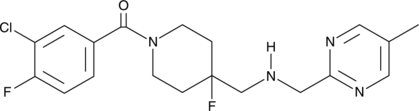
F-15599 is a post-synaptic-selective agonist of the serotonin (5-HT) receptor subtype 5-HT1A.1 It more potently stimulates [35S]GTPγS binding to the Gαi subunit in HeLa cell membranes expressing the human 5-HT1A receptor than to the Gαo subunit in rat hippocampal cell membranes (EC50s = 109.7 and 851.1 nM, respectively).2 F-15599 also more potently stimulates [35S]GTPγS binding in rat prefrontal cortex membranes containing postsynaptic 5-HT1A receptors than in rat dorsal raphe nucleus membranes containing presynaptic 5-HT1A receptors (EC50s = 63.1 and 380.2 nM, respectively). It reduces immobility in the forced swim test in rats at a minimal effective dose (MED) of 0.08 mg/kg but induces hypothermia, a sign of serotonin syndrome, at a MED of 0.63 mg/kg.3 F-15599 reduces the incidence of apneas in a transgenic mouse model of Rett syndrome at 0.1 mg/kg and decreases the probability of audiogenic seizure-induced death in a transgenic mouse model of fragile X syndrome at 1.2-2.4 mg/kg.4,5
WARNING This product is not for human or veterinary use.
References & Product Citations
1. High-
2. Signal transduction and functional selectivity of F15599, a preferential post-
3. 15599, a highly selective post-
4. A selective 5-
5. Acute and repeated administration of NLX-
Contact Info
Cayman Chemical1180 East Ellsworth RoadAnn Arbor, Michigan 48108 USAToll Free: (800) 364-9897(USA and Canada only)Fax: (734) 971-3640


