
Technical Support & Resources
Visit our FAQ
Contact Us
Toll Free Phone (USA and Canada Only): (888) 526-5351
Direct Phone: (734) 975-3888
Product Categories
Product Type
Research Area


Technical Information
- Adenosine 3',5'-cyclic monophosphate
- Adenosine 3',5'-cyclic mononucleotide
- Cyclic AMP
Shipping & Storage Information
Recommended Products
Certificates of Analysis & Batch Specific Data
Provide batch numbers separated by commas to download or request available product inserts, QC sheets, certificates of analysis, data packs, and GC-MS data.

Bioanalysis & Assay Development Services
Your Vision. Our Expertise.
- Bioanalysis and compound screening using Cayman or qualified commercial assay kits
- Development and qualification of fit-for-purpose assays in a variety of formats and platforms
- Experienced scientists dedicated to developing the best strategy for your project
Product Description
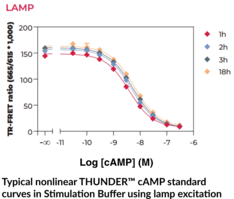
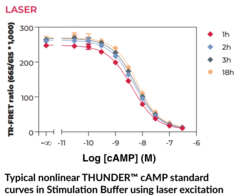
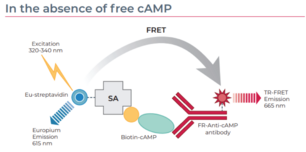
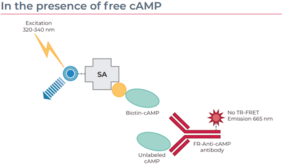
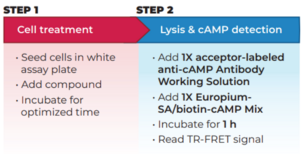
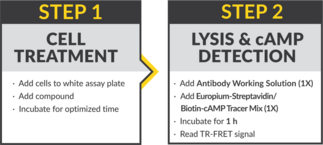
The cAMP assay kit is a homogeneous time-resolved Förster resonance energy transfer (TR-FRET) competitive immunoassay designed to measure cAMP produced by cells, following treatment with GPCRs agonists or antagonists. GPCRs that couple with adenylate cyclase will increase or decrease intracellular cAMP levels. The THUNDER™ cAMP assay workflow consists of 2 steps. Cells are first stimulated to either increase or decrease the cAMP levels. cAMP is then detected during the lysis step in a simple "add-incubate-measure" format (two-step reagent addition; no wash steps). The assay is based on the competition between a europium-labeled cAMP tracer complex and sample cAMP for binding to a cAMP-specific monoclonal antibody labeled with a far-red acceptor fluorophore (FR-anti-cAMP antibody). The tracer complex is formed by the tight interaction between biotinylated cAMP (biotin-cAMP) and streptavidin labeled with a europium chelate donor (Eu-SA). In the absence of free cAMP, the FR-anti-cAMP antibody is bound to the Eu-SA/biotin-cAMP tracer, which brings the two dyes into close proximity. Excitation of the donor Europium chelate molecules with a flash lamp (320 or 340 nm) or a laser (337 nm) triggers a FRET from the donor to the acceptor molecules, which in turn emit a maximal TR-FRET signal at 665 nm. Residual energy from the Eu chelate generates light at 615 nm. Free cAMP from test samples (standard or cell lysate) competes with the Eu-SA/biotin-cAMP tracer for the binding to the FR-anti-cAMP antibody, causing a decrease in TR-FRET signal. As a result, the specific signal at 665 nm will be inversely proportional to the cAMP concentration in the sample. Data can be expressed as either the signal at 665 nm or the 665 nm/615 nm ratio.
WARNING This product is not for human or veterinary use.
Contact Info
Cayman Chemical1180 East Ellsworth RoadAnn Arbor, Michigan 48108 USAToll Free: (800) 364-9897(USA and Canada only)Fax: (734) 971-3640


