
Features
- Measures estrone-3-glucuronide, the predominant metabolite of estradiol in biological matrices
- Assay 24 samples in triplicate or 36 samples in duplicate
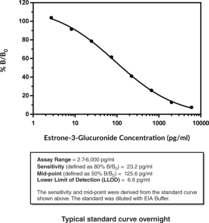
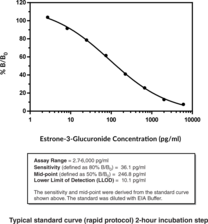
- Lower limit of detection (LLOD) is 6.6 pg/ml
- Rapid 2-hour or overnight incubation options
Technical Support & Resources
Visit our FAQ
Contact Us
Toll Free Phone (USA and Canada Only): (888) 526-5351
Direct Phone: (734) 975-3888
Product Categories
Product Type
Application


Technical Information
- E1G
- Estrone Glucuronide
- Estrone β-D-Glucuronide
- Estrone-3-Glucuronide EIA Kit
Shipping & Storage Information
Recommended Products
Certificates of Analysis & Batch Specific Data
Provide batch numbers separated by commas to download or request available product inserts, QC sheets, certificates of analysis, data packs, and GC-MS data.
Bioanalysis & Assay Development Services
Your Vision. Our Expertise.
- Bioanalysis and compound screening using Cayman or qualified commercial assay kits
- Development and qualification of fit-for-purpose assays in a variety of formats and platforms
- Experienced scientists dedicated to developing the best strategy for your project
Product Description
Estrone-3-glucuronide is the predominant metabolite of estradiol in urine and a urinary marker for the fertile window in women.1 Measurement of urinary glucuronides is a convenient, non-invasive method for detecting reproductive hormone levels compared to measuring plasma levels.2 Estrone-3-glucuronide, along with pregnanediol-3-glucuronide, are indicators of female reproductive health.2
Literature has shown high serum estrone levels, which directly correlate to urinary estrone-3-glucuronide levels, are associated with estrogen receptor-positive breast cancers.3 Hormone receptor status is the main factor in planning treatment and can be treated with hormone therapies, including tamoxifen and aromatase inhibitors.4 In addition to its role in breast cancer, circulating estrogens, including estrone metabolized from oral hormone replacement therapy, have been shown to increase thrombin generation leading to higher risk for blood clots, myocardial infarctions, deep vein thrombosis and strokes.5,6
Needed but not supplied: Please download the kit booklet to verify if UltraPure Water (Milli-Q or equivalent) or any other components are needed for this assay.
WARNING This product is not for human or veterinary use.
References & Product Citations
1. Urinary-
2. Urinary estrone conjugate and pregnanediol 3-
3. Association of serum estrone levels with estrogen receptor-
4. The effect of estrone on thrombin generation may explain the different thrombotic risk between oral and transdermal hormone replacement therapyexa. J. Thromb. Haemost. 8(8), 1736-1744 (2010).
5. Influence of age and obesity on serum estradiol, estrone, and sex hormone binding globulin concentrations following oral estrogen administration in postmenopausal women. J. Clin. Endocrinol. Metab. 94(11), 4136-4143 (2009).
6. Prospective study of effects of endogenous estrogens on myocardial no-
Contact Info
Cayman Chemical1180 East Ellsworth RoadAnn Arbor, Michigan 48108 USAToll Free: (800) 364-9897(USA and Canada only)Fax: (734) 971-3640


