
Features
- Measure sPLA2 levels in plasma, synovial fluid, and other sample matrices
- Assay 24 samples in triplicate or 36 samples in duplicate
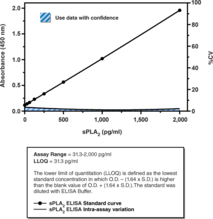
- Assay Range: 31.3-2,000 pg/ml with an LLOQ of 31.3 pg/ml
- Rapid assay; get results in under 4 hours
Technical Support & Resources
Visit our FAQ
Contact Us
Toll Free Phone (USA and Canada Only): (888) 526-5351
Direct Phone: (734) 975-3888
Product Categories
Product Type
Application
Technical Information
- Secretory Phospholipase A2 (human synovial) EIA Kit
Shipping & Storage Information
Recommended Products
Certificates of Analysis & Batch Specific Data
Provide batch numbers separated by commas to download or request available product inserts, QC sheets, certificates of analysis, data packs, and GC-MS data.
Lipid Resource Center
Discover Products & Resources for Lipid Research
- High-purity lipid standards
- Lipid roles in biology
- Lipids in health & disease
- Lipids for pharmaceutical development
- Protocols, advice, & resources
Product Description
sPLA2s are found in the venom of certain snakes (Types IA, IIA, and IIB from vipers, cobras, rattlesnakes, and kraits), in pancreatic juices (Type IB), in rat and murine testes (Type IIC), in placenta, synovial fluids and platelets (Type IIA), and in heart, placenta, lung, mast cells, and P388D1 macrophages (Type V).1 Until 1994, the sPLA2 responsible for the release of arachidonic acid in inflammation was believed to be Type IIA. Although recently discovered isoforms of PLA2 clearly contribute to the release of arachidonic acid, sPLA2 (Type IIA) continues to be a protein of interest in the field of inflammation. This ELISA is specific for Type IIA sPLA2, and does not cross react with Type I, Type IV, Type V PLA2, inflammatory mediators such as tumor necrosis factor, interleukin-
Needed but not supplied: Please download the kit booklet to verify if UltraPure Water (Milli-Q or equivalent) or any other components are needed for this assay.
WARNING This product is not for human or veterinary use.
References & Product Citations
1. The growing phospholipase A2 superfamily of signal transduction enzymes. Trends Biochem. Sci. 22(1), 1-2 (1997).
CD64 and group II secretory phospholipase A2 (sPLA2-
Anti-
Heterogeneous models for an early discrimination between sepsis and non-
Tagging SNP haplotype analysis of the secretory PLA2-
Contact Info
Cayman Chemical1180 East Ellsworth RoadAnn Arbor, Michigan 48108 USAToll Free: (800) 364-9897(USA and Canada only)Fax: (734) 971-3640


