
Features
- Measure testosterone glucuronide, the predominant urinary metabolite of testosterone, in biological samples
- Assay 24 samples in triplicate or 36 samples in duplicate
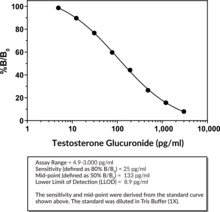
- Lower limit of detection (LLOD) is 8.9 pg/ml
- Incubation: 18 hours | Development: 90 minutes | Read: Colorimetric at 405 nm
Technical Support & Resources
Visit our FAQ
Contact Us
Toll Free Phone (USA and Canada Only): (888) 526-5351
Direct Phone: (734) 975-3888
Product Categories
Product Type
Application
Technical Information
- Testosterone Glucuronide EIA Kit
Shipping & Storage Information
Recommended Products
Certificates of Analysis & Batch Specific Data
Provide batch numbers separated by commas to download or request available product inserts, QC sheets, certificates of analysis, data packs, and GC-MS data.
Bioanalysis & Assay Development Services
Your Vision. Our Expertise.
- Bioanalysis and compound screening using Cayman or qualified commercial assay kits
- Development and qualification of fit-for-purpose assays in a variety of formats and platforms
- Experienced scientists dedicated to developing the best strategy for your project
Product Description
Testosterone glucuronide is a urinary metabolite of the endogenous steroid hormone testosterone.1 It is formed by glucuronide conjugation of testosterone primarily by the UDP-glucuronosyltransferase (UGT) isoform UGT2B17, which is found in the small intestine, colon, and liver.1,2,3
Testosterone glucuronide levels are lower in individuals with mutations in the UGT2B17 gene.4 Glucuronidation of testosterone is decreased by the NSAIDs diclofenac and ibuprofen in vitro, but not in vivo.5,6
Needed but not supplied: Please download the kit booklet to verify if UltraPure Water (Milli-Q or equivalent) or any other components are needed for this assay.
WARNING This product is not for human or veterinary use.
References & Product Citations
1. Studies on testosterone metabolism. The Journal of Biological Chemisty 239(5), 1569-1577 (1964).
2. Quantitative characterization of UDP-
3. Analysis of the human tissue-
4. Doping test results dependent on genotype of uridine diphospho-
5. Non-
6. Non-
Contact Info
Cayman Chemical1180 East Ellsworth RoadAnn Arbor, Michigan 48108 USAToll Free: (800) 364-9897(USA and Canada only)Fax: (734) 971-3640


