
Features
- Screen for inhibitors of spike RBD-ACE2 interaction
- Run up to 44 samples in duplicate
- Rapid assay; get results in <3 hours
- Plate-based colorimetric readout (450 nm)
Technical Support & Resources
Visit our FAQ
Contact Us
Toll Free Phone (USA and Canada Only): (888) 526-5351
Direct Phone: (734) 975-3888
Product Categories
Product Type
Application



Technical Information
- Severe Acute Respiratory Syndrome Coronavirus 2 Spike-ACE2 Interaction Inhibitor Screening
Shipping & Storage Information
Recommended Products
Certificates of Analysis & Batch Specific Data
Provide batch numbers separated by commas to download or request available product inserts, QC sheets, certificates of analysis, data packs, and GC-MS data.
Bioanalysis & Assay Development Services
Your Vision. Our Expertise.
- Bioanalysis and compound screening using Cayman or qualified commercial assay kits
- Development and qualification of fit-for-purpose assays in a variety of formats and platforms
- Experienced scientists dedicated to developing the best strategy for your project
Product Description
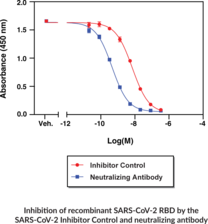
Cayman’s SARS-CoV-2 Spike-ACE2 Interaction Inhibitor Screening Assay Kit provides a robust and easy-to-use platform for identifying novel inhibitors of the SARS-CoV-2 spike and ACE2 interaction. The assay uses a recombinant rabbit Fc-tagged SARS-CoV-2 spike S1 RBD that binds to a plate precoated with a mouse anti-rabbit antibody. A recombinant His-tagged ACE2 protein binds the spike RBD and the complex is detected with an HRP-conjugated anti-His antibody, which is easily quantified by reading the absorbance at 450 nm. A control is included for competition of the SARS-CoV-2 spike RBD-ACE2 interaction.
Needed but not supplied: Please download the kit booklet to verify if UltraPure Water (Milli-Q or equivalent) or any other components are needed for this assay.
WARNING This product is not for human or veterinary use.
References & Product Citations
Chemical compositions of Scutellaria baicalensis Georgi. (Huangqin) extracts and their effects on ACE2 binding of SARS-
Chemical compositions of lianqiao (Forsythia suspensa) extracts and their potential health benefits. Pharmaceuticals (Basel) 17(6), 740 (2024).
Chemical compositions of dill (Anethum graveolens L.) water and ethanol extracts and their potential in blocking the SARS-
Chemical compositions of clove (Syzygium aromaticum (L.) Merr. & L.) extracts and their potentials in suppressing SARS-
Chemical composition of thyme (Thymus vulgaris) extracts, potential inhibition of SARS-
Chemical composition of rosemary (Rosmarinus officinalis L.) extract and its inhibitory effects on SARS-
Targeting SARS-
Plant metabolites as SARS-
Phytochemical profiling of Salsola tetragona Delile by LC-
Chemical constituents of parsley (Petroselinum crispum) leaf extract and its potential in mitigating the effects of viral infections. ACS Food Sci Technol. 3(12), 2108-2116 (2023).
Contact Info
Cayman Chemical1180 East Ellsworth RoadAnn Arbor, Michigan 48108 USAToll Free: (800) 364-9897(USA and Canada only)Fax: (734) 971-3640


