
Technical Support & Resources
Visit our FAQ
Contact Us
Toll Free Phone (USA and Canada Only): (888) 526-5351
Direct Phone: (734) 975-3888
Product Categories
Product Type
Research Area
Technical Information
Shipping & Storage Information
Recommended Products
Certificates of Analysis & Batch Specific Data
Provide batch numbers separated by commas to download or request available product inserts, QC sheets, certificates of analysis, data packs, and GC-MS data.
Product Description
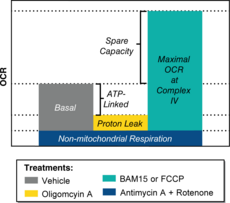
The components of this kit enable controlled modulation of mitochondrial function across the electron transport chain (ETC) in cultured cells. The reagents can be used for mitochondrial stress testing, bioenergetic profiling, and mechanistic studies of oxidative phosphorylation.1 Each component in this kit is provided separately, and instructions are included to reconstitute these reagents for direct dilution into cell culture medium. Some reagents may be provided in excess and may be properly disposed of after cell medium preparation.
Oligomycin A is an inhibitor of mitochondrial complex V, also known as F1Fo-ATP synthase.2,3 It can be used to quantify ATP-linked oxygen consumption.
FCCP is a mitochondrial uncoupler that collapses the mitochondrial proton gradient, causing the ETC to operate at maximal capacity.4,5 FCCP can be used to determine respiratory capacity.
BAM15 is a next-generation mitochondrial uncoupler.6 Compared with FCCP, BAM15 does not depolarize the plasma membrane and exhibits reduced cytotoxicity and off-target effects, making it useful for longer or more sustained studies of mitochondrial function.
Antimycin A complex is a bacterial metabolite complex that contains several antimycins, including antimycin A3, which is an inhibitor of mitochondrial complex III, also known as cytochrome bc1 complex.7,8 High concentrations of antimycin A complex, in combination with rotenone, can be used to fully inhibit mitochondrial respiration.
Rotenone is an inhibitor of mitochondrial complex I, also known as NADH dehydrogenase.9 It can be used together with antimycin A complex to determine non-mitochondrial oxygen consumption.10
WARNING This product is not for human or veterinary use.
References & Product Citations
1. Assessing bioenergetic function in response to oxidative stress by metabolic profiling. Free Rad. Biol. Med. 51, 1621-1635 (2011).
2. Apoptolidin, a selective cytotoxic agent, is an inhibitor of F0F1-
3. Oligomycin frames a common drug-
4. Uncouplers of rat-
5. The molecular mechanism of action of the proton ionophore FCCP (carbonylcyanide p-
6. Identification of a novel mitochondrial uncoupler that does not depolarize the plasma membrane. Mol. Metab. 3(2), 114-123 (2013).
7. Antimycin A components. I. Isolation and biological activity. J. Antibiot. (Tokyo) 23(2), 75-80 (1970).
8. Inhibition of electron transport of rat liver mitochondria by unnatural (−)-
9. Inhibitory effects on mitochondrial complex I of semisynthetic mono-
10. A practical guide for the analysis, standardization, and interpretation of oxygen consumption measurements. Nat. Metab. 4(8), 978-994 (2022).
Contact Info
Cayman Chemical1180 East Ellsworth RoadAnn Arbor, Michigan 48108 USAToll Free: (800) 364-9897(USA and Canada only)Fax: (734) 971-3640


