
Features
- Converts major urinary and plasma metabolites of PGE2 to a single, stable derivative that is easily quantified
- Assay 24 samples in triplicate or 36 samples in duplicate
- Measure PGEM levels down to 2 pg/ml
- Incubation: 18 hours | Development: 60-90 minutes | Read: Colorimetric at 405-420 nm
Technical Support & Resources
Visit our FAQ
Contact Us
Toll Free Phone (USA and Canada Only): (888) 526-5351
Direct Phone: (734) 975-3888
Product Categories
Product Type
Application



Technical Information
- PGEM
- PGEM EIA
- PGE Metabolite
- PGE Metabolite EIA
Shipping & Storage Information
Recommended Products
Certificates of Analysis & Batch Specific Data
Provide batch numbers separated by commas to download or request available product inserts, QC sheets, certificates of analysis, data packs, and GC-MS data.
Lipid Resource Center
Discover Products & Resources for Lipid Research
- High-purity lipid standards
- Lipid roles in biology
- Lipids in health & disease
- Lipids for pharmaceutical development
- Protocols, advice, & resources
Product Description
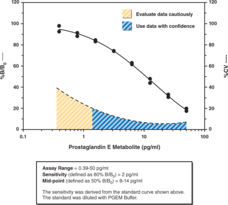
Cayman’s Prostaglandin E Metabolite (PGEM) assay converts downstream metabolites of PGE2, such as 13,14-dihydro-15-keto PGE2 and 13,14-dihydro-15-keto PGA2, to stable derivatives that can be easily quantified in a competitive ELISA format. This assay is the method of choice for analysis of samples, such as plasma, serum and urine, in which PGE2 has undergone extensive metabolism prior to collection. The assay has a range from 0.39-50 pg/ml and an average sensitivity (80% B/B0) of 2 pg/ml.
Needed but not supplied: Please download the kit booklet to verify if UltraPure Water (Milli-Q or equivalent) or any other components are needed for this assay.
WARNING This product is not for human or veterinary use.
References & Product Citations
Plasma prostaglandin E2 metabolite levels predict type 2 diabetes status and one-
Discovery and characterization of the potent and selective P2X4 inhibitor N-
Immunoregulatory potential of mesenchymal stem cells following activation by macrophage-
Enzymatic activity of HPGD in Treg cells suppresses Tconv cells to maintain adipose tissue homeostasis and prevent metabolic dysfunction. Immunity 50(5), 1232-1248 (2019).
Des-
Loss of PPARcexpression in mammary secretory epithelial cellscreates a pro-
The effects of dietary omega fatty acids on pregnancy rate, plasma prostaglandin metabolite levels, serum progesterone levels, and milk fatty-
Healing properties of malabaricone B and malabaricone C, against indomethacin-
Effects of flaxseed supplementation on endometrial expression of ISG17 and intrauterine prostaglandin concentrations in primiparous dairy cows submitted to GnRH-
Chronic dDAVP infusion in rats decreases the expression of P2Y2 receptor in inner medulla and P2Y2 receptor-
Contact Info
Cayman Chemical1180 East Ellsworth RoadAnn Arbor, Michigan 48108 USAToll Free: (800) 364-9897(USA and Canada only)Fax: (734) 971-3640


