For the quantification of 6-keto PGF in various samples
Features
  • Detect 6-keto PGF, a surrogate for prostacyclin synthesis in multiple sample types
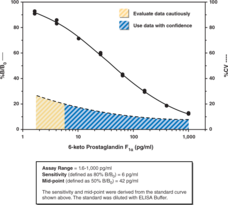
  • Assay 24 samples in triplicate or 36 samples in duplicate
  • Measure 6-keto PGF levels down to 6 pg/ml
  • Incubation: 18 hours | Development: 90-120 minutes | Read: Colorimetric at 405-420 nm
Technical Support & Resources

Visit our FAQ

Contact Us

Toll Free Phone (USA and Canada Only): (888) 526-5351
Direct Phone: (734) 975-3888

Request Technical Support

Technical Support Request

To streamline the process attach the appropriate questionnaire to your inquiry.

Download IHC QuestionnaireDownload WB Questionnaire

View Our Privacy Statement for details on how we use and protect your data. In addition, this site is protected by hCaptcha and its Privacy Policy and Terms of Service apply.

6-keto Prostaglandin F ELISA Kit

Item No. 515211

Technical Information
Synonyms
  • 6-keto PGF EIA Kit
Assay Range
1.6-1,000 pg/ml
Sensitivity
80% B/B0: 6 pg/ml
Cross Reactivity
(6-keto Prostaglandin F) 100%(6-keto Prostaglandin E1) 33.9%(Prostaglandin F) 28%(Prostaglandin F) 11%(2,3-dinor-6-keto Prostaglandin F) 4.9%(Prostaglandin E2) 1.5%(6,15-diketo-13,14-dihydro Prostaglandin F) 0.33%(13,14-dihydro-15-keto Prostaglandin F) 0.05%(Thromboxane B2) 0.05%(tetranor-PGEM) <0.01%(tetranor-PGFM) <0.01%(Prostaglandin D2) <0.01%
Origin
Animal/Bovine, Animal/Eel, Animal/Mouse, Animal/Rabbit
Shipping & Storage Information
Storage
-20°C
Shipping
Wet ice in continental US; may vary elsewhere
Recommended Products

Certificates of Analysis & Batch Specific Data

Provide batch numbers separated by commas to download or request available product inserts, QC sheets, certificates of analysis, data packs, and GC-MS data.

    Add

    Add

    Add

    Add

    Lipid Resource Center
    Discover Products & Resources for Lipid Research
    • High-purity lipid standards
    • Lipid roles in biology
    • Lipids in health & disease
    • Lipids for pharmaceutical development
    • Protocols, advice, & resources
    EXPLORE NOW
    Product Description

    Prostacyclin (Prostaglandin I2; PGI2) is formed from arachidonic acid primarily by the vascular endothelium and renal cortex.1,2 It is a potent vasodilator and inhibitor of platelet aggregation.2 PGI2 is non-enzymatically hydrated to 6-keto PGF (t½ = 2-3 minutes), and then quickly converted to the major metabolite, 2,3-dinor-6-keto PGF (t½ = 30 minutes).3,4,5 Prostacyclin was once thought to be a circulating hormone that regulated platelet-vasculature interactions, but the rate of secretion into circulation coupled with the short half-life indicate that prostacyclin functions locally.6 Although 6-keto PGF is commonly measured in plasma and urine as an estimate of prostacyclin synthesis, it should be noted that there may be more than one source of PGI2 in these samples. For instance, venipuncture may cause the release of prostacyclin which will artifactually increase the 6-keto PGF concentration in plasma.7 Urinary concentrations of 6-keto PGF are confounded by the fact that some plasma prostacyclin (~14%) is excreted into urine as 6-keto PGF and the remainder is of renal origin.6,7 Therefore, it is important to take these factors into account when analyzing data.

    Needed but not supplied: Please download the kit booklet to verify if UltraPure Water (Milli-Q or equivalent) or any other components are needed for this assay.

    WARNING This product is not for human or veterinary use.

    References & Product Citations
    Product Description References

    1. Moncada, S., Gryglewski, R., Bunting, S., et alAn enzyme isolated from arteries transforms prostaglandin endoperoxides to an unstable substance that inhibits platelet aggregation. Nature 263(5579), 663-665 (1976).

    2. Navamani, M., Morgan, M., and Williams, R.J. Ethanol modulates N-methyl-D-aspartate-evoked arachidonic acid release from neurones. Eur. J. Pharmacol. 340, 27-34 (1997).

    3. Samuelsson, B., Goldyne, M., Granström, E., et alProstaglandins and thromboxanes. Annu. Rev. Biochem. 47, 997-1029 (1978).

    4. Dusting, G.J., Moncada, S., and Vane, J.R. Prostacyclin (PGX) is the endogenous metabolite responsible for relaxation of coronary arteries induced by arachidonic acid. Prostaglandins 13, 3-15 (1977).

    5. Rosenkranz, B., Fischer, C., Reimann, I., et alIdentification of the major metabolite of prostacyclin and 6-ketoprostaglandin F in man. Biochim. Biophys. Acta 619(2), 207-213 (1980).

    6. Frolich, J.C. Measurement of eicosanoids. Prostaglandins 27, 349-369 (1984).

    7. Catella, F., Nowak, J., and Fitzgerald, G.A. Measurement of renal and non-renal eicosanoid synthesis. Am. J. Med. 81, 23-29 (1986).

    Product Citations

    Letite, L.N., Gonzafa, N.A., Tirapelli, D.P.C., et alPharmacological characterization of the relaxant effect induced by adrenomedullin in rat cavernosal smooth muscle. Braz. J. Med. Biol. Res. 47(10), 876-885 (2014).

    Sobrino, A., Mata, M., Laguna-Fernandez, A., et alEstradiol stimulates vasodilatory and metabolic pathways in cultured human endothelial cells. PLoS One 4(12), e8242 (2009).

    Herrerias, A., Torres, R., Serra, M., et alActivity of the cyclooxygenase 2-prostaglandin-E prostanoid receptor pathway in mice exposed to house dust mite aeroallergens, and impact of exogenous prostaglandin E2. J. Inflamm. (Lond) 6, 30 (2009).