For the measurement of 13,14-dihydro-15-keto PGF in plasma
Features
  • Detect 13,14-dihydro-15-keto PGF, a stable metabolite of PGF
  • Assay 24 samples in triplicate or 36 samples in duplicate
  • Measure 13,14-dihydro-15-keto PGF levels down to 16.3 pg/ml
  • Incubation: 18 hours | Development: 90-120 minutes | Read: Colorimetric at 405-420 nm
Technical Support & Resources

Visit our FAQ

Contact Us

Toll Free Phone (USA and Canada Only): (888) 526-5351
Direct Phone: (734) 975-3888

Request Technical Support

Technical Support Request

To streamline the process attach the appropriate questionnaire to your inquiry.

Download IHC QuestionnaireDownload WB Questionnaire

View Our Privacy Statement for details on how we use and protect your data. In addition, this site is protected by hCaptcha and its Privacy Policy and Terms of Service apply.

13,14-dihydro-15-keto Prostaglandin F ELISA Kit

Item No. 516671

Technical Information
Synonyms
  • 13,14-dihydro-15-keto PGF EIA Kit
  • PGFM EIA Kit
Assay Range
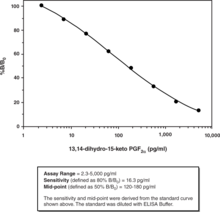
2.3-5,000 pg/ml
Sensitivity
80% B/B0: 15 pg/ml
Cross Reactivity
(13,14-dihydro-15-keto Prostaglandin F) 100%(13,14-dihydro-15-keto Prostaglandin E2) 2.7%(15-keto Prostaglandin F) 1.8%(Prostaglandin D2) <0.01%(Prostaglandin E2) <0.01%(Prostaglandin F) <0.01%(2,3-dinor-6-keto Prostaglandin F) <0.01%(6-keto Prostaglandin F) <0.01%(Prostaglandin F) <0.01%(8-iso Prostaglandin F) <0.01%(8-iso-13,14-dihydro-15-keto Prostaglandin F) <0.01%(8-iso-15-keto Prostaglandin F) <0.01%(Prostaglandin F) <0.01%(8-iso Prostaglandin F) <0.01%(Thromboxane B2) <0.01%
Origin
Animal/Bovine, Animal/Eel, Animal/Mouse, Animal/Rabbit
Shipping & Storage Information
Storage
-20°C
Shipping
Wet ice in continental US; may vary elsewhere
Recommended Products

Certificates of Analysis & Batch Specific Data

Provide batch numbers separated by commas to download or request available product inserts, QC sheets, certificates of analysis, data packs, and GC-MS data.

    Add

    Add

    Add

    Add

    Lipid Resource Center
    Discover Products & Resources for Lipid Research
    • High-purity lipid standards
    • Lipid roles in biology
    • Lipids in health & disease
    • Lipids for pharmaceutical development
    • Protocols, advice, & resources
    EXPLORE NOW
    Product Description

    Prostaglandin F (PGF) is one of the five primary prostaglandins derived enzymatically directly from the endoperoxide PGH2. PGF was initially discovered in seminal fluid, and to date the majority of the functional roles ascribed to it relate to fertility, pregnancy, and parturition. PGF is a potent luteolytic agent and is used to induce ovulation in domestic livestock. It is also a potent uterine stimulant, and is part of the cascade of myometrial stimulants which induce and sustain labor. PGF is rapidly metabolized to 13,14-dihydro-15-keto PGF in vivo, by the enzymes 15-hydroxy prostaglandin dehydrogenase and Δ13-reductucase.1,2,3,4 Measurement of 13,14-dihydro-15-keto PGF in plasma can be used as a marker of the in vivo production of PGF.5,6 The Cayman Chemical 13,14-dihydro-15-keto PGF Enzyme Immunoassay is a competitive assay that provides measurements of 13,14-dihydro-15-keto PGF within the range of 2.3-5,000 pg/ml, typically with a detection limit (80% B/B0) of approximately 15 pg/ml. Although the tracer and antiserum for this assay have been sold separately for many years, the reagents are now combined with an accurate standard and packaged together in a convenient assay kit. The assay has been validated for the measurement of 13,14-dihydro-15-keto PGF in plasma, a common matrix for measurement of this PGF metabolite.5

    Needed but not supplied: Please download the kit booklet to verify if UltraPure Water (Milli-Q or equivalent) or any other components are needed for this assay.

    WARNING This product is not for human or veterinary use.

    References & Product Citations
    Product Description References

    1. Samuelsson, B., Granström, E., Green, K., et alProstaglandins. Annu. Rev. Biochem. 44, 669-695 (1975).

    2. Keirse, M.J.N.C., and Turnbull, A.C. Metabolism of prostaglandins within the pregnant uterus. Br. J. Obstet. Gynaecol. 82, 887-893 (1975).

    3. Basu, S., and Stjernschantz, J. Δ13-reductase dependent metabolism of prostaglandins in the mammalian brain and eye. Prostaglandins Leukot. Essent. Fatty Acids 57(3), 305-310 (1997).

    4. Ensor, C.M., Yang, J.Y., Okita, R.T., et alCloning and sequence analysis of the cDNA for human placental NAD+-dependent 15-hydroxyprostaglandin dehydrogenase. The Journal of Biological Chemisty 265, 14888-14891 (1990).

    5. Del Vecchio, R.P., Maxey, K.M., and Lewis, G.S. A quantitative solid-phase enzymeimmunoassay for 13,14-dihydro-15-keto-prostaglandin F in plasma. Prostaglandins 43(4), 321-330 (1992).

    6. Meyer, H.H.D., Eisele, K., and Osaso, J. A biotin-streptavidin amplified enzyme immunoassay for 13,14-dihydro-15-keto-PGF. Prostaglandins 38(3), 375-383 (1989).

    Product Citations

    Richardson, G.F., McNiven, M.A., Petit, H.V., et alThe effects of dietary omega fatty acids on pregnancy rate, plasma prostaglandin metabolite levels, serum progesterone levels, and milk fatty-acid profile in beef cows. Can. J. Vet. Res. 77(4), 314-318 (2013).

    Farhat, A., Philibert, P., Sultan, C., et alHematopoietic-Prostaglandin D2 synthase through PGD2 production is involved in the adult ovarian physiology. J. Ovarian Res. 4, 3 (2011).