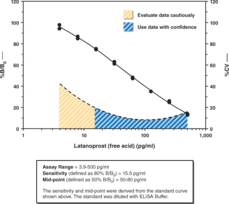
For the measurement of the free acid form of Latanoprost
Features
  • Measure the free acid form of latanoprost
  • Assay 24 samples in triplicate or 36 samples in duplicate
  • Measure latanoprost levels down to 15.5 pg/ml
  • Incubation: 2 hours | Development: 60-90 minutes | Read: Colorimetric at 405-420 nm
Technical Support & Resources

Visit our FAQ

Contact Us

Toll Free Phone (USA and Canada Only): (888) 526-5351
Direct Phone: (734) 975-3888

Request Technical Support

Technical Support Request

To streamline the process attach the appropriate questionnaire to your inquiry.

Download IHC QuestionnaireDownload WB Questionnaire

View Our Privacy Statement for details on how we use and protect your data. In addition, this site is protected by hCaptcha and its Privacy Policy and Terms of Service apply.

Latanoprost ELISA Kit

Item No. 516811

Technical Information
Synonyms
  • Latanoprost EIA Kit
  • 17-phenyl-13,14-dihydro trinor Prostaglandin F
  • 17-phenyl-13,14-dihydro trinor Prostaglandin F isopropyl ester
  • PhXA 85
Assay Range
3.9-500 pg/ml (free acid) and 15.6-2,000 pg/ml (ester)
Sensitivity
80% B/B0: 15.5 pg/ml (free acid) and 43 pg/ml (ester)
Cross Reactivity
(Latanoprost (free acid)) 100%(5-trans Latanoprost) 25.4%(Latanoprost) 25%(17-phenyl Prostaglandin F) 3%(17-phenyl Prostaglandin F ethyl amide) 0.70%(15-epi Latanoprost) 0.16%(15-keto Latanoprost) 0.10%(Fluprostenol) <0.01%(Fluprostenol isopropyl ester) <0.01%(2,3-dinor Fluprostenol) <0.01%(9-keto Fluprostenol) <0.01%(11-keto Fluprostenol) <0.01%(tetranor-PGEM) <0.01%(tetranor-PGFM) <0.01%(Prostaglandin D2) <0.01%(Prostaglandin E2) <0.01%(Prostaglandin E2 Ethanolamide) <0.01%(6-keto Prostaglandin F) <0.01%(Prostaglandin F) <0.01%(Prostaglandin F Ethanolamide) <0.01%(5-trans Prostaglandin F) <0.01%(Thromboxane B2) <0.01%(Unoprostone) <0.01%(Unoprostone isopropyl ester) <0.01%
Origin
Animal/Bovine, Animal/Eel, Animal/Mouse, Animal/Rabbit
Shipping & Storage Information
Storage
-20°C
Shipping
Wet ice in continental US; may vary elsewhere
Recommended Products

Certificates of Analysis & Batch Specific Data

Provide batch numbers separated by commas to download or request available product inserts, QC sheets, certificates of analysis, data packs, and GC-MS data.

    Add

    Add

    Lipid Resource Center
    Discover Products & Resources for Lipid Research
    • High-purity lipid standards
    • Lipid roles in biology
    • Lipids in health & disease
    • Lipids for pharmaceutical development
    • Protocols, advice, & resources
    EXPLORE NOW
    Product Description

    Latanoprost is 13,14-dihydro-17-phenyl-18,19,20-trinor prostaglandin F isopropyl ester (13,14-dihydro-17-phenyl-18,19,20-trinor PGF isopropyl ester), an F-series prostaglandin analog which has been approved for use as an ocular hypotensive drug.1,2,3 Prostaglandin esters and other similar derivatives act as prodrugs which are converted to the active free acid form by an esterase/amidase activity in ocular tissues. The free acid form of Latanoprost (Latanoprost free acid (Lat-FA), or PhXA 85) is 200 times more potent than the isopropyl ester as an FP receptor ligand tested using the recombinant human FP receptor.2 Although the exact mechanism of the intraocular hypotensive effect of prostaglandins is unknown, it correlates very closely with the FP receptor ligand binding affinity of FP receptor agonists.4 The Cayman Latanoprost ELISA is a sensitive detection method for measuring the free acid form of Latanoprost. It also detects the isopropyl ester form of Latanoprost, but with less sensitivity. The assay is most appropriate for use when only one of the two forms is present. Samples containing mixtures of both the isopropyl ester and free acid should be purified and the two compounds separated prior to ELISA analysis.

    Needed but not supplied: Please download the kit booklet to verify if UltraPure Water (Milli-Q or equivalent) or any other components are needed for this assay.

    WARNING This product is not for human or veterinary use.

    References & Product Citations
    Product Description References

    1. Stjernschantz, J., and Resul, B. Phenyl substituted prostaglandin analogs for glaucoma treatment. Drugs Future 17(8), 691-704 (1992).

    2. Abramovitz, M., Adam, M., Boie, Y., et alThe utilization of recombinant prostanoid receptors to determine the affinities and selectivities of prostaglandins and related analogs. Biochim. Biophys. Acta 1483(2), 285-293 (2000).

    3. Camras, C.B., Alm, A., Watson, P., et alLatanoprost, a prostaglandin analog, for glaucoma therapy. Efficacy and safety after 1 year of treatment in 198 patients. Ophthalmology 103(11), 1916-1924 (1996).

    4. Cravatt, B.F., Giang, D.K., Mayfield, S.P., et alMolecular characterization of an enzyme that degrades neuromodulatory fatty-acid amides. Nature 384(6604), 83-87 (1996).