
Features
- Measure major oxidative damage markers, 8-hydroxy-2’-deoxyguanosine, 8-hydroxyguanosine, and 8-hydroxyguanine in urine, cell culture medium, cell lysates, tissue samples, saliva, and plasma/serum samples
- Assay 24 samples in triplicate or 36 samples in duplicate
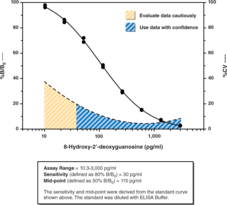
- Assay Range: 10.3-3,000 pg/ml
- Incubation: 18 hours | Development: 90-120 minutes | Read: Colorimetric at 405-420 nm
Technical Support & Resources
Visit our FAQ
Contact Us
Toll Free Phone (USA and Canada Only): (888) 526-5351
Direct Phone: (734) 975-3888
Product Categories
Product Type
Application

Technical Information
- DNA/RNA Oxidative Damage (High Sensitivity) EIA Kit
- 8-
hydroxy- 2'- Deoxyguanosine - 8-
OH- DG - 8-
OH- 2dG
Shipping & Storage Information
Recommended Products
Certificates of Analysis & Batch Specific Data
Provide batch numbers separated by commas to download or request available product inserts, QC sheets, certificates of analysis, data packs, and GC-MS data.

Visit Our Cancer Resource Center
Find Tools & Resources to Study the Hallmarks of Cancer
- Cancer cell signaling & regulation
- Cancer metabolism
- Tumor microenvironment
Product Description
DNA and RNA are damaged by oxidation during aging and in a variety of disease states including cancer.1,2,3 Guanine is the base is most prone to oxidation, and the repair processes initiated to correct the damage release multiple oxidized guanine species into the urine, including 8-hydroxyguanosine (8-OHG), 8-hydroxy-2’-deoxyguanosine (8-OHdG), and 8-hydroxyguanine. Some commercial vendors offer immunoassays that detect only 8-OHdG. Cayman's DNA/RNA Oxidative Damage (High Sensitivity) ELISA Kit is a competitive assay that can be used to measure 8-OHdG, 8-OHG, and 8-hydroxyguanine. Since the antibody used in the assay recognizes damaged nucleic acid species other than 8-OHdG, the value obtained with our assay will be higher than that obtained by competitor ELISAs or by LC/MS analysis that measure a single species. As such, caution is recommended when comparing results obtained from this kit to those obtained by other methods.
Needed but not supplied: Please download the kit booklet to verify if UltraPure Water (Milli-Q or equivalent) or any other components are needed for this assay.
WARNING This product is not for human or veterinary use.
References & Product Citations
1. Age-
2. Oxidative damage of DNA, RNA and their metabolites in leukocytes, plasma and urine of Macaca mulatta: 8-
3. Urinary 8-
In-
Preventing, treating, and predicting barbering: A fundamental role for biomarkers of oxidative stress in a mouse model of Trichotillomania. PLoS One 12(4), e0175222 (2017).
Effects of methylsulfonylmethane (MSM) on exercise-
Monitoring ZEO apoptotic potential in 2D and 3D cell cultures and associated spectroscopic evidence on mode of interaction with DNA. Sci. Rep. 7(1), 2553 (2017).
Preventing, treating, and predicting barbering: A fundamental role for biomarkers of oxidative stress in a mouse model of Trichotillomania. PLoS One 12(4), e0175222 (2017).
Protective effects of hydrogen gas on experimental acute pancreatitis. PLoS One 11(4), e0154483 (2016).
Evidence for an alternative fatty acid desaturation pathway increasing cancer plasticity. Nature 566(7744), 403-406 (2019).
Short-
A novel model of chronic wounds: Importance of redox imbalance and biofilm-
Cardiac energy dependence on glucose increases metabolites related to glutathione and activates metabolic genes controlled by mechanistic target of rapamycin. J. Am. Heart Assoc. 4(2), e001136 (2015).
Hepatoprotective effects of Panus giganteus (Berk.) corner against thioacetamide-
Contact Info
Cayman Chemical1180 East Ellsworth RoadAnn Arbor, Michigan 48108 USAToll Free: (800) 364-9897(USA and Canada only)Fax: (734) 971-3640


