
A convenient, fluorescence-based method for detecting sEH in whole cells
Features
  • A convenient 96-well fluorecence-based assay for detecting sEH activity in whole cells
  • Utilizes epoxy fluor 7, a sensitive fluorescent substrate for sEH
  • Quantifiable using the included 6-methoxy-2-naphthaldehyde standard
  • Includes AUDA, a selective epoxide hydrolase inhibitor, for checking specificity of the reaction
Technical Support & Resources

Visit our FAQ

Contact Us

Toll Free Phone (USA and Canada Only): (888) 526-5351
Direct Phone: (734) 975-3888

Request Technical Support

Technical Support Request

To streamline the process attach the appropriate questionnaire to your inquiry.

Download IHC QuestionnaireDownload WB Questionnaire

View Our Privacy Statement for details on how we use and protect your data. In addition, this site is protected by hCaptcha and its Privacy Policy and Terms of Service apply.

Soluble Epoxide Hydrolase Cell-Based Assay Kit

Item No. 600090
Technical Information
Synonyms
  • Cytosolic Epoxide Hydrolase (CEH)
  • EPHX2
  • Epoxide Hydrolase 2
  • sEH
Shipping & Storage Information
Storage
-80°C
Shipping
Dry ice in continental US; may vary elsewhere
Recommended Products

Certificates of Analysis & Batch Specific Data

Provide batch numbers separated by commas to download or request available product inserts, QC sheets, certificates of analysis, data packs, and GC-MS data.

    Add

    Lipid Resource Center
    Discover Products & Resources for Lipid Research
    • High-purity lipid standards
    • Lipid roles in biology
    • Lipids in health & disease
    • Lipids for pharmaceutical development
    • Protocols, advice, & resources
    EXPLORE NOW
    Product Description

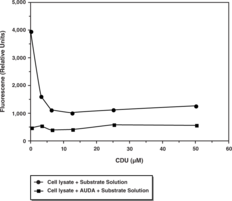
    Mammalian soluble epoxide hydrolase (sEH) is a member of the α/β-hydrolase fold family of enzymes that catalyze the hydrolysis of exogenous and endogenous epoxides to vicinal diols. sEH is a homodimer consisting of two domains.1 The C-terminal domain is responsible for the epoxide hydrolase activity while the N-terminal domain has a catalytic center with phosphatase activity. Endogenous substrates for sEH include epoxyeicosatrienoic acids (EETs) which exhibit vasodilatory and anti-inflammatory activity.2 Inhibition of sEH in animal models was shown to effectively treat hypertension and vascular inflammation as well as related syndromes.3 These studies demonstrate the value for targeting sEH for development of small molecule inhibitors as therapeutics. Cayman’s sEH Cell-Based Assay Kit provides a convenient 96-well plate, fluorescence-based method for detecting epoxide hydrolase activity in whole cells. The assay utilizes Epoxy Fluor 7, a sensitive fluorescent substrate for sEH that can be used to monitor the activity of both human and murine enzymes.4 Hydrolysis of the substrate epoxide yields a highly fluorescent product, 6-methoxy-2-Naphthaldehyde, that can be monitored at excitation and emission wavelengths of 330 and 465 nm, respectively. 6-Methoxy-2-Naphthaldehyde is included to quantify enzyme activity and a recombinant sEH is included as a positive control. An sEH inhibitor AUDA is also included for checking specificity of the reaction. This assay parallels Cayman’s Soluble Epoxide Hydrolase Inhibitor Screening Assay Kit (Catalog No. 10011671) which uses recombinant protein rather than whole cells for the assay. Together, both assays will help to identify whether or not an inhibitor/activator has a direct or indirect effect on the enzyme.

    Needed but not supplied: Please download the kit booklet to verify if UltraPure Water (Milli-Q or equivalent) or any other components are needed for this assay.

    WARNING This product is not for human or veterinary use.

    References & Product Citations
    Product Description References

    1. Chiamvimonvat, N., Ho, C.M., Tsai, H.J., et alThe soluble epoxide hydrolase as a pharmaceutical target for hypertension. J. Cardiovasc. Pharmacol. 50(3), 225-237 (2007).

    2. Yu, Z., Xu, F., Huse, L.M., et alSoluble epoxide hydrolase regulates hydrolysis of vasoactive epoxyeicosatrienoic acids. Circ. Res. 87(11), 992-998 (2000).

    3. Imig, J.D., Zhao, X., Zaharis, C.Z., et alAn orally active epoxide hydrolase inhibitor lowers blood pressure and provides renal protection in salt-sensitive hypertension. Hypertension 46(2), 975-981 (2005).

    4. Jones, P.D., Wolf, N.M., Morisseau, C., et alFluorescent substrates for soluble epoxide hydrolase and application to inhibition studies. Anal. Biochem. 343(1), 66-75 (2005).

    Product Citations

    Akhnokh, M.K., Yang, F.H., Samokhvalov, V., et alInhibition of soluble epoxide hydrolase limits mitochondrial damage and preserves function following ischemic injury. Front. Pharmacol. 7, 133 (2016).

    Talarico, C., Dattilo, V., D'Antona, L., et alSI113, a SGK1 inhibitor, potentiates the effects of radiotherapy, modulates the response to oxidative stress and induces cytotoxic autophagy in human glioblastoma multiforme cells. Oncotarget 7(13), 15868-1586884 (2016).

