
Features
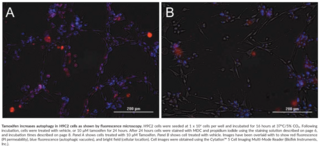
- Utilizes the fluorescent reagent monodansylcadaverine to label autophagic vacuoles
- Propidium iodide included for dead cell exclusion
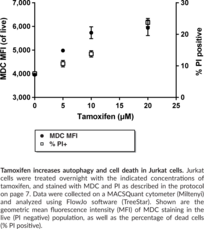
- Tamoxifen included as an autophagosome-inducing control
Technical Support & Resources
Visit our FAQ
Contact Us
Toll Free Phone (USA and Canada Only): (888) 526-5351
Direct Phone: (734) 975-3888
Product Categories
Product Type
Application
Technical Information
Shipping & Storage Information
Recommended Products
Certificates of Analysis & Batch Specific Data
Provide batch numbers separated by commas to download or request available product inserts, QC sheets, certificates of analysis, data packs, and GC-MS data.
Bioanalysis & Assay Development Services
Your Vision. Our Expertise.
- Bioanalysis and compound screening using Cayman or qualified commercial assay kits
- Development and qualification of fit-for-purpose assays in a variety of formats and platforms
- Experienced scientists dedicated to developing the best strategy for your project
Product Description
Autophagy is a critical cellular process that involves the degradation and digestion of intracellular components by the lysosome. This process not only enables cells to efficiently mobilize and recycle cellular constituents, but also prevents the accumulation of damaged organelles, misfolded proteins, and invading microorganisms.1 Autophagy is a multi-
Needed but not supplied: Please download the kit booklet to verify if UltraPure Water (Milli-Q or equivalent) or any other components are needed for this assay.
WARNING This product is not for human or veterinary use.
References & Product Citations
1. Tumor suppression by autophagy through the management of metabolic stress. Autophagy 4(5), 563-566 (2008).
2. Autophagy in the pathogenesis of disease. Cell 132, 27-42 (2008).
3. A novel assay to study autophagy: Regulation of autophagosome vacuole size by amino acid deprivation. J. Cell Sci. 114, 3619-3629 (2001).
4. Autophagy fights disease through cellular self-
5. The lysosomotropic agent monodansylcadaverine also acts as a solvent polarity probe. J. Histochem. Cytochem. 48(2), 251-258 (2000).
Contact Info
Cayman Chemical1180 East Ellsworth RoadAnn Arbor, Michigan 48108 USAToll Free: (800) 364-9897(USA and Canada only)Fax: (734) 971-3640


