
Features
- Reverse transfection reporter assay to screen for FXR agonists, antagonists, and modulators
- Use common and easy-to-culture HEK293T/17 cells; no handling of stable cell line required
- 96-Strip well format for flexible plate map or assay on a partial plate
- Positive control agonist included
- Allow multiple sampling with reagent sufficient for at least 3 time points
Technical Support & Resources
Visit our FAQ
Contact Us
Toll Free Phone (USA and Canada Only): (888) 526-5351
Direct Phone: (734) 975-3888
Product Categories
Product Type
Technical Information
Shipping & Storage Information
Recommended Products
Certificates of Analysis & Batch Specific Data
Provide batch numbers separated by commas to download or request available product inserts, QC sheets, certificates of analysis, data packs, and GC-MS data.
Bioanalysis & Assay Development Services
Your Vision. Our Expertise.
- Bioanalysis and compound screening using Cayman or qualified commercial assay kits
- Development and qualification of fit-for-purpose assays in a variety of formats and platforms
- Experienced scientists dedicated to developing the best strategy for your project
Product Description
Cayman’s reverse transfection reporter assays have overcome many of the disadvantages of other transfection approaches. In this method, a proprietary transfection complex containing DNA and an optimized mixture of lipids and proteins has been evenly immobilized on the culture surface of multi-well plates. Adherent cells, supplied by the user, are applied directly to the plate and allowed to grow in the coated wells. Using this method, the uptake of the DNA complex by the cell is increased dramatically compared to solution-phase transfection, enhancing both the transfection efficiency and co-transfection efficiency for multiple plasmids.
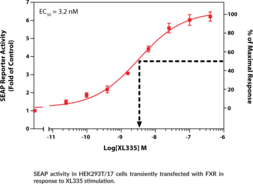
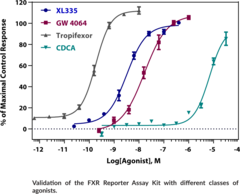
Cayman’s Bile Acid Nuclear Receptor FXR (NR1H4) Reporter Assay Kit consists of a 96-well plate coated with a transfection complex containing DNA constructs for expressing FXR and a BSEP promoter-regulated secreted alkaline phosphatase (SEAP) reporter (FXR Reverse Transfection Strip Plate). Cells grown on the transfection complex will express FXRα2 inside the cells within 24 hours from an engineered plasmid construct. Binding of agonists to FXR triggers its transcription factor activity. Activation of the BSEP promoter on the reporter construct by FXR results in the expression of SEAP, which is secreted into the cell culture medium. Aliquots of media are collected 6-24 hours after stimulation, and SEAP activity is measured following addition of a luminescence-based alkaline phosphatase substrate (SEAP Substrate (Luminescence)). The kit is easy to use and can be readily applied to high-throughput screening for therapeutic compounds regulating the activation of FXR. A selective synthetic agonist, XL335, is included in the kit for use as a positive control.1 The kit provides sufficient reagent to measure SEAP activity at three time points using the three included assay plates.
Needed but not supplied: Please download the kit booklet to verify if UltraPure Water (Milli-Q or equivalent) or any other components are needed for this assay.
WARNING This product is not for human or veterinary use.
References & Product Citations
1. Discovery of XL335 (WAY-
Contact Info
Cayman Chemical1180 East Ellsworth RoadAnn Arbor, Michigan 48108 USAToll Free: (800) 364-9897(USA and Canada only)Fax: (734) 971-3640


