
Features
- Reverse transfection reporter assay to screen for FP agonists and antagonists
- Use common and easy-to-culture HEK293T/17 cells; no handling of stable cell line required
- 96-Strip well format for flexible plate map or assay on a partial plate
- Positive control agonist included
- Allows multiple sampling with reagent sufficient for at least 3 time points
Technical Support & Resources
Visit our FAQ
Contact Us
Toll Free Phone (USA and Canada Only): (888) 526-5351
Direct Phone: (734) 975-3888
Product Categories

Technical Information
- FP
- PGF2α Receptor
- Prostglandin F2α Receptor
- PTGFR
Shipping & Storage Information
Recommended Products
Certificates of Analysis & Batch Specific Data
Provide batch numbers separated by commas to download or request available product inserts, QC sheets, certificates of analysis, data packs, and GC-MS data.
Lipid Resource Center
Discover Products & Resources for Lipid Research
- High-purity lipid standards
- Lipid roles in biology
- Lipids in health & disease
- Lipids for pharmaceutical development
- Protocols, advice, & resources
Product Description
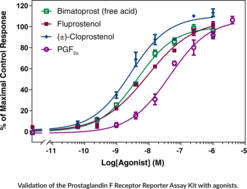
Prostaglandin F2α (PGF2α) is a biologically important prostanoid that exerts its actions through binding to the PGF2α receptor (FP).1 PGF2α is synthesized in many tissues, including the eye and organs of the female reproductive system. Activation of ocular FP receptors via agonists such as bimatoprost and travoprost reduces ocular hypertension.2,3 Antagonism of the FP receptor inhibits uterine contraction and delays parturition in rodent models, while knockout of the receptor inhibits parturition in mice, an effect that can be restored through ovariectomy during pregnancy.4,5 FP receptor antagonism also decreases endometriosis-like lesions and reduces cell proliferation and angiogenesis in a nude mouse endometrial xenograft model.6 In addition, FP receptor knockout increases neurological deficits and lesion volume in mice following intracerebral hemorrhagic stroke.7 These findings highlight the importance of the FP receptor in reproductive and neurological disorders and emphasize the need for continued research and drug discovery in these areas.
Needed but not supplied: Please download the kit booklet to verify if UltraPure Water (Milli-Q or equivalent) or any other components are needed for this assay.
WARNING This product is not for human or veterinary use.
References & Product Citations
1. Pharmacology and signaling of prostaglandin receptors: Multiple roles in inflammation and immune modulation. Pharmacol. Ther. 103(2), 147-166 (2004).
2. The hydrolysis of bimatoprost in corneal tissue generates a potent prostanoid FP receptor agonist. Surv. Ophthalmol. 47(Suppl. 1), S34-S40 (2002).
3. Travoprost. Drugs Future 25(1), 41-45 (2000).
4. OBE022, an oral and selective prostaglandin F2a receptor antagonist as an effective and safe modality for the treatment of preterm labor. J. Pharm. Exp. Ther. 366(2), 349-364 (2018).
5. Failure of parturition in mice lacking the prostaglandin F receptor. Science 277, 681-683 (1997).
6. Selective modulation of the prostaglandin F2a pathway markedly impacts on endometriosis progression in a xenograft mouse model. Mol. Hum. Reprod. 21(12), 905-916 (2015).
7. Genetic deletion of PGF2a-
Contact Info
Cayman Chemical1180 East Ellsworth RoadAnn Arbor, Michigan 48108 USAToll Free: (800) 364-9897(USA and Canada only)Fax: (734) 971-3640


