
Technical Support & Resources
Visit our FAQ
Contact Us
Toll Free Phone (USA and Canada Only): (888) 526-5351
Direct Phone: (734) 975-3888
Product Categories
Research Area
Technical Information
- Hepatocyte NOS
- Inducible Nitric Oxide Synthase
- Inducible NO Synthase
- Inducible NOS
- Nitric Oxide Synthase 2
- NOS II
- hep-NOS
Shipping & Storage Information
Recommended Products
Certificates of Analysis & Batch Specific Data
Provide batch numbers separated by commas to download or request available product inserts, QC sheets, certificates of analysis, data packs, and GC-MS data.

Visit Our Cancer Resource Center
Find Tools & Resources to Study the Hallmarks of Cancer
- Cancer cell signaling & regulation
- Cancer metabolism
- Tumor microenvironment
Product Description
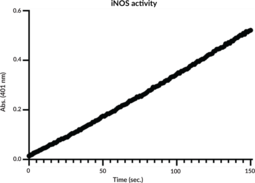
Inducible nitric oxide synthase (iNOS), also known as NOS2, converts arginine to citrulline and nitric oxide (NO) during the inflammatory response.1,2 It is composed of an N-terminal oxygenase domain that contains binding sites for its substrate L-arginine (Item No. 23703), heme, and the cofactor tetrahydrobiopterin (BH4), a hinge region that binds calmodulin, and a reductase domain with binding sites for NADPH, flavin mononucleotide (FMN), and FAD. Upon induction by various pro-inflammatory cytokines, including TNF-α, IL-1β, and IFN-γ, or by LPS, iNOS is expressed in macrophages, hepatocytes, smooth muscle cells, chondrocytes, glial cells, astrocytes, neurons, and cardiac myocytes.2 iNOS expression is induced via two main signaling pathways: NF-κB and JAK/STAT. It is involved in pathogen defense against bacteria, parasites, and viruses and its expression is associated with several disease states, including sepsis, cancer, pain, and Parkinson’s disease.2,3,4,5,6 Cayman’s iNOS (mouse, recombinant) protein can be used for enzyme activity assays and Western blot (WB) applications.
WARNING This product is not for human or veterinary use.
References & Product Citations
1. Nitric oxide synthases: Structure, function, and inhibition. Biochem. J. 357(Pt 3), 593-615 (2001).
2. Inducible nitric oxide synthase: Regulation, structure, and inhibition. Med. Res. Rev. 40(1), 158-189 (2020).
3. Inducible nitric oxide synthase (NOS2) expressed in septic patients is nitrated on selected tyrosine residues: Implications for enzymic activity. Biochem. J. 366(Pt 2), 399-404 (2002).
4. Frequent nitric oxide synthase-
5. Inhibition of inducible nitric oxide synthase in persistent pain. Life Sci. 66(4), 301-305 (2000).
6. Inducible nitric oxide synthase stimulates dopaminergic neurodegeneration in the MPTP model of Parkinson disease. Nat. Med. 5(12), 1403-1409 (1999).
iNOS modulates inflammatory responses in an NO-
Contact Info
Cayman Chemical1180 East Ellsworth RoadAnn Arbor, Michigan 48108 USAToll Free: (800) 364-9897(USA and Canada only)Fax: (734) 971-3640


