
Technical Support & Resources
Information provided in the product description is from published literature. Due to the nature of scientific experimentation, your results (e.g., selectivity and effective concentrations) or specific application for this product may differ. If you have questions about how this product fits your application, please contact our technical support staff.
Visit our FAQ
Contact Us
Toll Free Phone (USA and Canada Only): (888) 526-5351
Direct Phone: (734) 975-3888
Technical Information
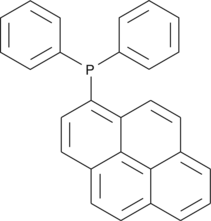
- Diphenyl-
1- pyrenylphosphine
Shipping & Storage Information
Recommended Products
Certificates of Analysis & Batch Specific Data
Provide batch numbers separated by commas to download or request available product inserts, QC sheets, certificates of analysis, data packs, and GC-MS data.
Product Description
DPPP is a probe that reacts stoichiometrically with hydroperoxides to yield the fluorescent molecule diphenyl-1-pyrenylphosphine oxide (DPPP-O).1 Plasma levels of lipid hydroperoxides of phosphatidylcholine, phosphatidylethanolamine, triglycerides, and cholesteryl esters have been measured by HPLC with a post column detection system using DPPP.2,3 DPPP has also been used as a fluorescent probe for the detection of low-density lipoprotein and cellular oxidation.4 Fluorescence of DPPP-O can be monitor using excitation and emission wavelengths of 351 nm and 380 nm, respectively.
WARNING This product is not for human or veterinary use.
References & Product Citations
1. A novel fluorescent probe diphenyl-
2. High-
3. Simultaneous determination of hydroperoxides of phosphotidylcholine, cholesterol esters and triglycerols by column-
4. A novel method of following oxidation of low-
Plasma lipid oxidation induced by peroxynitrite, hypochlorite, lipoxygenase and peroxyl radicals and its inhibition by antioxidants as assessed by diphenyl-
Contact Info
Cayman Chemical1180 East Ellsworth RoadAnn Arbor, Michigan 48108 USAToll Free: (800) 364-9897(USA and Canada only)Fax: (734) 971-3640


