
Features
- Measure protease activity in samples
- Assay 30 samples in triplicate
- Includes Trypsin as a positive control
- Plate-based fluorescence polarization measurement (ex 485 nm, em 538 nm)
Technical Support & Resources
Visit our FAQ
Contact Us
Toll Free Phone (USA and Canada Only): (888) 526-5351
Direct Phone: (734) 975-3888
Product Categories
Research Area
Technical Information
Shipping & Storage Information
Recommended Products
Certificates of Analysis & Batch Specific Data
Provide batch numbers separated by commas to download or request available product inserts, QC sheets, certificates of analysis, data packs, and GC-MS data.
Bioanalysis & Assay Development Services
Your Vision. Our Expertise.
- Bioanalysis and compound screening using Cayman or qualified commercial assay kits
- Development and qualification of fit-for-purpose assays in a variety of formats and platforms
- Experienced scientists dedicated to developing the best strategy for your project
Product Description
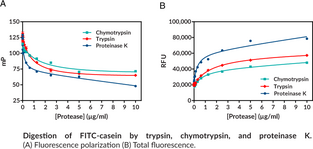
Cayman’s Protease Activity Assay Kit provides a convenient method for determining the activity of proteases in samples. Proteolytic digestion of the FITC-casein substrate can be monitored by changes in either fluorescence polarization (FP) or total fluorescence.1 Fluorescence is the ability of a molecule to absorb the energy of an incoming (excitation) photon and then re-emit this energy as a new, slightly less energetic (emission) photon. A small fluorescent molecule will rotate appreciably during the very small interval of time between absorption of a photon and emission of the fluorescence photon. If the excitation light is polarized, this rotation will result in randomization of the plane of the emitted light. Thus, small fluorescent molecules depolarize an excitation pulse of polarized light. Large fluorescent molecules, like FITC-casein, do not rotate as appreciably in the same small interval of time. They will, therefore, emit light that retains some of the polarization of the polarized excitation light. This polarization is quantified as millipolarization units, or mP. In this assay, the total FP decreases as the FITC-casein is digested into smaller, quicker rotating fluorescein-labeled fragments. If measuring FP is not available, the change in total fluorescence can also be measured to determine protease activity. The conjugation of FITC to casein results in moderate quenching of the total fluorescence. This fluorescence increases as the FITC-casein substrate is digested into smaller fluorescein-labeled fragments. Both assay formats use an excitation wavelength of 480-495 nm and an emission wavelength of 515-525 nm.
Needed but not supplied: Please download the kit booklet to verify if UltraPure Water (Milli-Q or equivalent) or any other components are needed for this assay.
WARNING This product is not for human or veterinary use.
References & Product Citations
1. .
Contact Info
Cayman Chemical1180 East Ellsworth RoadAnn Arbor, Michigan 48108 USAToll Free: (800) 364-9897(USA and Canada only)Fax: (734) 971-3640


