
A phenolic compound with antioxidant and anti-inflammatory properties
Related Products
Active Metabolite(s)
37236m-Coumaric Acid
Technical Support & Resources

Information provided in the product description is from published literature. Due to the nature of scientific experimentation, your results (e.g., selectivity and effective concentrations) or specific application for this product may differ. If you have questions about how this product fits your application, please contact our technical support staff.

Visit our FAQ

Contact Us

Toll Free Phone (USA and Canada Only): (888) 526-5351
Direct Phone: (734) 975-3888
Request Technical Support

Technical Support Request

To streamline the process attach the appropriate questionnaire to your inquiry.

Download IHC QuestionnaireDownload WB Questionnaire

View Our Privacy Statement for details on how we use and protect your data. In addition, this site is protected by hCaptcha and its Privacy Policy and Terms of Service apply.

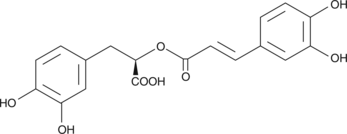
Rosmarinic Acid

Item No. 70900

Technical Information
Formal Name
αR-[[(2E)-3-(3,4-dihydroxyphenyl)-1-oxo-2-propen-1-yl]oxy]-3,4-dihydroxy-benzenepropanoic acid
CAS Number
20283-92-5
Molecular Formula
C18H16O8
Formula Weight
Purity
≥98%
A crystalline solid
DMF: >35 mg/mlDMSO: >25 mg/mlEthanol: >35 mg/mlPBS (pH 7.2): >15 mg/ml
λmax
221, 291, 332 nm
SMILES
OC1=C(O)C=CC(C[C@H](C(O)=O)OC(/C=C/C2=CC(O)=C(O)C=C2)=O)=C1
InChi Code
InChI=1S/C18H16O8/c19-12-4-1-10(7-14(12)21)3-6-17(23)26-16(18(24)25)9-11-2-5-13(20)15(22)8-11/h1-8,16,19-22H,9H2,(H,24,25)/b6-3+
InChi Key
DOUMFZQKYFQNTF-ZZXKWVIFSA-N
Shipping & Storage Information
Storage
Room temperature
Shipping
Room temperature in continental US; may vary elsewhere
Recommended Products

Certificates of Analysis & Batch Specific Data

Provide batch numbers separated by commas to download or request available product inserts, QC sheets, certificates of analysis, data packs, and GC-MS data.
    Add

    Add

    Add

    Add

    Cayman Chemical
    Neutrophil Biology Wall Poster

    Explore how neutrophils shape the immune response in health and disease. This poster highlights neutrophil pathogen defense mechanisms, including phagocytosis, degranulation, and NETosis, as well as neutrophil roles in inflammation and NET-associated pathologies.

    DOWNLOAD NOW
    Product Description

    Rosmarinic acid is a naturally-occurring phenolic compound with antioxidant and anti-inflammatory properties. This compound inhibits lipid peroxidation of rat liver microsomes by 90% at a concentration of 25 µg/ml.1 Rosmarinic acid suppresses endotoxin-induced activation of complement and concomitant formation of prostacyclin.2,3 Formation of 5-HETE and LTB4 from human PMNL is inhibited by rosmarinic acid at concentrations of 10-5 to 10-3 M.4

    WARNING This product is not for human or veterinary use.

    References & Product Citations
    Product Description References

    1. Liu, G.T., Zhang, T.M., Wang, B.e., et alProtective action of seven natural phenolic compounds against peroxidative damage to biomembranes. Biochem. Pharmacol. 43(2), 147-152 (1992).

    2. Bult, H., Herman, A.G., and Rampart, M. Modification of endotoxin-induced haemodynamic and haematological changes in the rabbit by methylprednisolone, F(ab')2 fragments and rosmarinic acid. Br. J. Pharmacol. 84(2), 317-327 (1985).

    3. Rampart, M., Beetens, J.R., Bult, H., et alComplement-dependent stimulation of prostacyclin biosynthesis: Inhibition by rosmarinic acid. Biochem. Pharmacol. 35(8), 1397-1400 (1986).

    4. Kimura, Y., Okuda, H., Okuda, T., et alStudies on the activities of tannins and related compounds, X. Effects of caffeetannins and related compounds on arachidonate metabolism in human polymorphonuclear leukocytes. J. Nat. Prod. 50(3), 392-399 (1987).

