
Features
- Measure the total antioxidant capacity of plasma, serum, urine, saliva, or cell lysates
- Assay 41 samples in duplicate
- Measure antioxidant capacity in Trolox equivalents down to 44 μM
- Plate-based colorimetric measurement (750 or 405 nm)
Technical Support & Resources
Visit our FAQ
Contact Us
Toll Free Phone (USA and Canada Only): (888) 526-5351
Direct Phone: (734) 975-3888

Technical Information
Shipping & Storage Information
Recommended Products
Certificates of Analysis & Batch Specific Data
Provide batch numbers separated by commas to download or request available product inserts, QC sheets, certificates of analysis, data packs, and GC-MS data.
Bioanalysis & Assay Development Services
Your Vision. Our Expertise.
- Bioanalysis and compound screening using Cayman or qualified commercial assay kits
- Development and qualification of fit-for-purpose assays in a variety of formats and platforms
- Experienced scientists dedicated to developing the best strategy for your project
Product Description
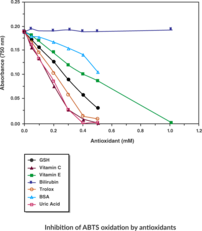
Cayman’s Antioxidant Assay can be used to measure the total antioxidant capacity of plasma, serum, urine, saliva, or cell lysates. Aqueous- and lipid-soluble antioxidants are not separated in this protocol, thus the combined antioxidant activities of all its constituents including vitamins, proteins, lipids, glutathione, uric acid, etc. are assessed. The assay relies on the ability of antioxidants in the sample to inhibit the oxidation of ABTS® (2,2’-Azino-di-[3-ethylbenzthiazoline sulphonate]) to ABTS®•+ by metmyoglobin. The amount of ABTS®•+ produced can be monitored by reading the absorbance at 750 nm or 405 nm. Under the reaction conditions used, the antioxidants in the sample cause suppression of the absorbance at 750 nm or 405 nm to a degree which is proportional to their concentration.1,2,3,4 The capacity of the antioxidants in the sample to prevent ABTS® oxidation is compared with that of Trolox, a water-soluble tocopherol analogue, and is quantified as millimolar Trolox equivalents.
Needed but not supplied: Please download the kit booklet to verify if UltraPure Water (Milli-Q or equivalent) or any other components are needed for this assay.
WARNING This product is not for human or veterinary use.
References & Product Citations
1. A novel method for measuring antioxidant capacity and its application to monitoring the antioxidant status in premature neonates. Clin. Sci. (Lond.) 84, 407-412 (1993).
2. Factors influencing the antioxidant activity determined by the ABTS + radical cation assay. Free Radic. Res. 26, 195-199 (1997).
3. A new method for measuring antioxidant activity. Biochem. Soc. Trans. 21, 95S-95S (1993).
4. Total antioxidant status in plasma and body fluids. Methods Enzymol. 234(24), 279-293 (1994).
Inert gas mild pressure action on healthy humans: The "IPA" study. Int. J. Mol. Sci. 25(22), 12067 (2024).
Melatonin and cortisol as components of the cutaneous stress response system in fish: Response to oxidative stress. Comp. Biochem. Physiol. Part A 268, 111207 (2022).
Differential manifestation of RONS and antioxidant enzymes in response to singular versus combinatorial stress in Chironomus ramosus. Stress Biol. 2(1), 56 (2022).
Oxidative stress, telomeresShortening, and apoptosis associated to sarcopenia and frailty in patients with multimorbidity. J. Clin. Med. 9(8), 2669 (2020).
PARP1 depletion improves mitochondrial and heart function in Chagas disease: Effects on POLG dependent mtDNA maintenance. PLoS Pathog. 14(5), e1007065 (2018).
Dysregulated expression of antioxidant enzymes in polyethylene particle-
Preventing, treating, and predicting barbering: A fundamental role for biomarkers of oxidative stress in a mouse model of Trichotillomania. PLoS One 12(4), e0175222 (2017).
The 1-
Preventing, treating, and predicting barbering: A fundamental role for biomarkers of oxidative stress in a mouse model of Trichotillomania. PLoS One 12(4), e0175222 (2017).
Total antioxidant capacity in Mediterranean β-
Relationship between advanced glycation end products and increased lipid peroxidation in semen of diabetic men. Oxid. Med. Cell. Longev. 5059043 (2016).
Repeated supramaximal exercise-
Prolactin protects retinal pigment epithelium by inhibiting sirtuin 2-
Dietary mannoheptulose increases fasting serum glucagon like peptide-
Changes in oxidative stress and inflammatory biomarkers in fragile adults over fifty years of age and in elderly people exclusively fed enteral nutrition. Oxid. Med. Cell. Longev. 5709312, (2015).
Plasma markers of oxidative stress are uncorrelated in a wild mammal. Ecol. Evol. 5(21), 5096-5108 (2015).
Oxidative stress parameters in saliva and its association with periodontal disease and types of bacteria. Dis. Markers 653537 (2015).
Cortisol levels and serum antioxidant status following chemotherapy. Sci. Res. 3(8), 512-517 (2011).
Exercise decreases plasma antioxidant capacity and increases urinary isoprostanes of IPF patients. Respir. Med. 104(12), 1919-1928 (2010).
Diagnostic value of the total antioxidant capacity (TAC) in human seminal plasma. Fertil. Steril. 91(3), 805-811 (2009).
Effects of radiofrequency electromagnetic waves (RF-
Contact Info
Cayman Chemical1180 East Ellsworth RoadAnn Arbor, Michigan 48108 USAToll Free: (800) 364-9897(USA and Canada only)Fax: (734) 971-3640


