
Technical Support & Resources
Visit our FAQ
Contact Us
Toll Free Phone (USA and Canada Only): (888) 526-5351
Direct Phone: (734) 975-3888
Product Categories
Product Type
Research Area
Application
Technical Information
- 3-Nitrotyrosine
- NT-BSA
- Peroxynitrite-
treated BSA
Shipping & Storage Information
Recommended Products
Certificates of Analysis & Batch Specific Data
Provide batch numbers separated by commas to download or request available product inserts, QC sheets, certificates of analysis, data packs, and GC-MS data.

Visit Our Cancer Resource Center
Find Tools & Resources to Study the Hallmarks of Cancer
- Cancer cell signaling & regulation
- Cancer metabolism
- Tumor microenvironment
Product Description
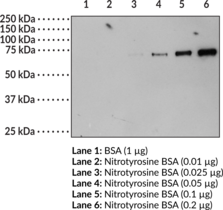
Nitrotyrosine is a post-translational modification that is formed by the nitration of tyrosine.1 Under conditions of oxidative stress, tyrosine is oxidized by reactive oxygen species (ROS) or, in the presence of hydrogen peroxide and nitrite, by myeloperoxidase (MPO) to yield a tyrosine radical that reacts with reactive nitrogen species (RNS), such as nitric oxide or peroxynitrite, to form nitrotyrosine. It exists in a free or protein-bound form and is commonly used as a marker of nitrosative or oxidative stress.2 Nitrotyrosine residues have been found in a variety of proteins, including LDL, surfactant protein A, angiotensin II, and human and bovine serum albumin.3 Free nitrotyrosine production induced by peroxynitrite is inhibited by the polyphenols epicatechin gallate, gallic acid, catechin, or epicatechin in cell-free assays, as well as in aortic rings isolated from normotensive and spontaneously hypertensive rats administered the antioxidant N-acetyl-cysteine (NAC; Item No. 20261).4,5 Nitrotyrosine levels are increased in the affected tissues of numerous pathological conditions, including atherosclerosis, cancer, ulcerative colitis, Alzheimer's disease, and Parkinson's disease.3 Autoantibodies that recognize nitrotyrosinated proteins are increased in the synovium of patients with rheumatoid arthritis and are positively correlated with joint and tendon inflammation.1 This product can be used as a positive control for immunoblotting experiments using Cayman's Nitrotyrosine Polyclonal Antibody (Item No. 10189540) and Nitrotyrosine Monoclonal Antibody (Item No. 189542).
WARNING This product is not for human or veterinary use.
References & Product Citations
1. Oxidative stress in autoimmune rheumatic diseases. Free Radic. Biol. Med. 125, 3-14 (2018).
2. 3-
3. The mechanisms for nitration and nitrotyrosine formation in vitro and in vivo: Impact of diet. Free Radic. Res. 35(3), 215-231 (2001).
4. Inhibition of peroxynitrite-
5. Effects of chronic N-
Induction of a feed forward pro-
Contact Info
Cayman Chemical1180 East Ellsworth RoadAnn Arbor, Michigan 48108 USAToll Free: (800) 364-9897(USA and Canada only)Fax: (734) 971-3640


