
Technical Support & Resources
Information provided in the product description is from published literature. Due to the nature of scientific experimentation, your results (e.g., selectivity and effective concentrations) or specific application for this product may differ. If you have questions about how this product fits your application, please contact our technical support staff.
Visit our FAQ
Contact Us
Toll Free Phone (USA and Canada Only): (888) 526-5351
Direct Phone: (734) 975-3888
Technical Information
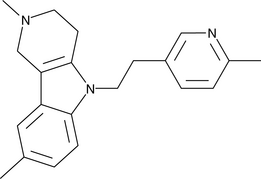
- Dimebon™
- Latrepirdine
Shipping & Storage Information
Recommended Products
Certificates of Analysis & Batch Specific Data
Provide batch numbers separated by commas to download or request available product inserts, QC sheets, certificates of analysis, data packs, and GC-MS data.
Product Description
Dimebolin is a neuroprotective agent.1,2,3 It binds to histamine H1 and H2 receptors (IC50s = 3.8 and 287 nM, respectively), as well as α1A-, α1B-, α1D-, and α2A-adrenergic receptors (ARs), imidazoline I2 receptors, and the serotonin (5-HT) receptor subtypes 5-HT2A, 5-HT2C, 5-HT6, and 5-HT7 (Kis = 8-313 nM).4 It also inhibits NMDA-evoked currents and voltage-gated calcium channels in mouse primary striatal neurons (IC50s = 10 and 50 μM, respectively).1 Dimebolin (50 μM) inhibits glutamate-induced apoptosis in primary striatal neurons derived from the YAC128 transgenic mouse model of Huntington’s disease. It inhibits cell death induced by amyloid-β (25-35) (Item No. 24155) in cerebellar granule cells when used at a concentration of 25 μM.2 Dimebolin (1 mg/kg) inhibits decreases in two-way active avoidance reaction (TWAA) acquisition in a rat model of Alzheimer’s disease induced by 1-ethyl-1-(2-hydroxyethyl) aziridinium (AF64A).3
WARNING This product is not for human or veterinary use.
References & Product Citations
1. Evaluation of dimebon in cellular model of Huntington’s disease. Mol. Neurodegener. 3, 15 (2008).
2. Dimebon and tacrine inhibit neurotoxic action of β-
3. Dimebon improves learning in animals with experimental Alzheimer’s disease. B. Exp. Biol. Med. 129(6), 640-642 (2000).
4. From anti-
Contact Info
Cayman Chemical1180 East Ellsworth RoadAnn Arbor, Michigan 48108 USAToll Free: (800) 364-9897(USA and Canada only)Fax: (734) 971-3640


