A synthetic, pure phosphoinositol for signal transduction research
Technical Support & Resources

Information provided in the product description is from published literature. Due to the nature of scientific experimentation, your results (e.g., selectivity and effective concentrations) or specific application for this product may differ. If you have questions about how this product fits your application, please contact our technical support staff.

Visit our FAQ

Contact Us

Toll Free Phone (USA and Canada Only): (888) 526-5351
Direct Phone: (734) 975-3888

Request Technical Support

Technical Support Request

To streamline the process attach the appropriate questionnaire to your inquiry.

Download IHC QuestionnaireDownload WB Questionnaire

View Our Privacy Statement for details on how we use and protect your data. In addition, this site is protected by hCaptcha and its Privacy Policy and Terms of Service apply.

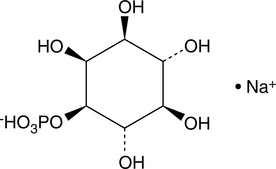
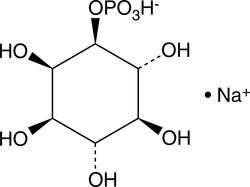
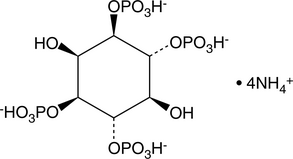
D-myo-Inositol-1-phosphate (cyclohexyl ammonium salt)

Item No. 9001248

Technical Information
Formal Name
cyclohexanaminium (1S)-2R,3R,4S,5S,6R-pentahydroxycyclohexyl phosphate
Synonyms
  • Ins(1)P1 (cyclohexyl ammonium salt)
  • 1-IP1 (cyclohexyl ammonium salt)
Molecular Formula
C6H11O9P • 2C6H14N
Formula Weight
Purity
≥95%
A lyophilized powder
Water: > 1mg/ml
SMILES
O[C@@H]1[C@H](O)[C@@H](O)[C@H](O)[C@@H](O)[C@@H]1OP([O-])([O-])=O.[NH3+]C2CCCCC2.[NH3+]C3CCCCC3
InChi Code
InChI=1S/2C6H13N.C6H13O9P/c2*7-6-4-2-1-3-5-6;7-1-2(8)4(10)6(5(11)3(1)9)15-16(12,13)14/h2*6H,1-5,7H2;1-11H,(H2,12,13,14)/t;;1-,2-,3+,4-,5-,6?/m..1/s1
InChi Key
IMIHZMWNWGIJKQ-FCBDNECJSA-N
Shipping & Storage Information
Storage
-20°C
Shipping
Wet ice in continental US; may vary elsewhere
Recommended Products

Certificates of Analysis & Batch Specific Data

Provide batch numbers separated by commas to download or request available product inserts, QC sheets, certificates of analysis, data packs, and GC-MS data.

    Add

    Add

    Add

    Add

    Product Description

    D-myo-Inositol-1-phosphate (Ins(1)P1) is a member of the inositol phosphate molecular family of second messengers that play critical roles in intracellular signaling.1,2 Ins(1)P1 can be formed by PLC hydrolysis of phosphatidylinositol or by dephosphorylation of polyphosphate inositols such as Ins(1,3)P2 by inositol polyphosphate 3-phosphatase.1 Changes in myo-inositol-1-phosphate synthase activity and inositol levels are induced by lithium and valproate and are associated with bipolar disorder.3,4 Also, cross-regulation occurs between the SUMO and inositol pathways.5

    WARNING This product is not for human or veterinary use.

    References & Product Citations
    Product Description References

    1. Majerus, P.W. Inositol phosphate biochemistry. Annu. Rev. Biochem. 61, 225-250 (1992).

    2. Berridge, M.J. Inositol trisphosphate and calcium signalling. Nature 361(6410), 315-325 (1993).

    3. Shamir, A., Shaltiel, G., Mark, S., et alHuman MIP synthase splice variants in bipolar disorder. Bipolar Disord. 9(7), 766-771 (2007).

    4. Hallcher, L.M., and Sherman, W.R. The effects of lithium ion and other agents on the activity of myo-inositol-1-phosphatase from bovine brain. The Journal of Biological Chemisty 255(22), 10896-10901 (1980).

    5. Felberbaum, R., Wilson, N.R., Cheng, D., et alDesumoylation of the endoplasmic reticulum membrane VAP family protein Scs2 by Ulp1 and SUMO regulation of the inositol synthesis pathway. Mol. Cell. Biol. 32(1), 64-75 (2012).