
Technical Support & Resources
Visit our FAQ
Contact Us
Toll Free Phone (USA and Canada Only): (888) 526-5351
Direct Phone: (734) 975-3888
Product Categories
Application
3-Bromotyrosine-13C9,15N (trifluoroacetate salt)
Item No. 9003007

Technical Information
- 3-bromo-Tyr-13C9,15N
Shipping & Storage Information
Recommended Products
Certificates of Analysis & Batch Specific Data
Provide batch numbers separated by commas to download or request available product inserts, QC sheets, certificates of analysis, data packs, and GC-MS data.
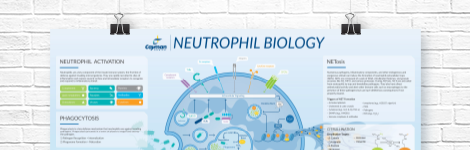
Neutrophil Biology Wall Poster
Explore how neutrophils shape the immune response in health and disease. This poster highlights neutrophil pathogen defense mechanisms, including phagocytosis, degranulation, and NETosis, as well as neutrophil roles in inflammation and NET-associated pathologies.
DOWNLOAD NOWProduct Description
3-Bromotyrosine-13C9,15N is intended for use as an internal standard for the quantification of 3-bromotyrosine (Item No. 22606) by GC- or LC-MS.1,2 3-Bromotyrosine is a product of protein oxidation found after activation of eosinophils during an allergic response.3,4,2 It has been used as a marker of eosinophil peroxidase-induced protein oxidation in vitro and in vivo.4,5 In addition to its production in eosinophils, 3-bromotyrosine is found at 5-fold higher levels in peritoneal exudate from mice infected with K. pneumoniae compared with uninfected animals, suggesting neutrophils release higher levels of oxidized products during inflammation.1 In a human study, 3-bromotyrosine was increased in allergen-challenged lung samples from subjects with allergen-induced asthma.
WARNING This product is not for human or veterinary use.
References & Product Citations
1. Vitamin C fails to protect amino acids and lipids from oxidation during acute inflammation. Free Radic. Biol. Med. 40(9), 1494-1501 (2006).
2. Eosinophils are a major source of nitric oxide-
3. Eosinophil-
4. Eosinophils generate brominating oxidants in allergen-
5. 3-
Contact Info
Cayman Chemical1180 East Ellsworth RoadAnn Arbor, Michigan 48108 USAToll Free: (800) 364-9897(USA and Canada only)Fax: (734) 971-3640


