
Technical Support & Resources
Information provided in the product description is from published literature. Due to the nature of scientific experimentation, your results (e.g., selectivity and effective concentrations) or specific application for this product may differ. If you have questions about how this product fits your application, please contact our technical support staff.
Visit our FAQ
Contact Us
Toll Free Phone (USA and Canada Only): (888) 526-5351
Direct Phone: (734) 975-3888
Product Categories
Technical Information
- C18 ω9 glycine
- OlGly
Shipping & Storage Information
Recommended Products
Certificates of Analysis & Batch Specific Data
Provide batch numbers separated by commas to download or request available product inserts, QC sheets, certificates of analysis, data packs, and GC-MS data.
Lipid Resource Center
Discover Products & Resources for Lipid Research
- High-purity lipid standards
- Lipid roles in biology
- Lipids in health & disease
- Lipids for pharmaceutical development
- Protocols, advice, & resources
Product Description
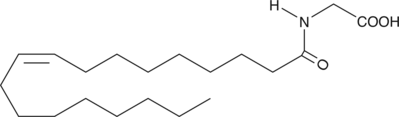
N-Oleoyl glycine is an endogenous lipoamino acid.1,2 It increases triglyceride levels in 3T3-L1 adipocytes, an effect that can be reversed by SR141716 (rimonabant; Item No. 9000484), and selectively induces the expression of mRNA encoding the cannabinoid 1 (CB1) receptor over mRNA encoding the CB2 receptor in the same cells when used at a concentration of 50 µM.2 N-Oleoyl glycine (1 µM) potentiates glycine-induced chloride currents in Xenopus oocytes expressing α1-, α1β-, α2-, α2β-, or α3 subunit-containing glycine receptors but not those expressing α3β subunit-containing glycine receptors.3 It increases c-Fos protein levels, intracellular calcium levels, and Agouti-related protein (AgRP) secretion in mHypoE-38 hypothalamic cells, effects that can be reversed by AM251 (Item No. 71670).4 N-Oleoyl glycine (60 mg/kg) reduces binge-like ethanol intake in alcohol-preferring mice without affecting total fluid intake and does not affect sucrose intake in the sucrose preference test in mice.5 It reduces balance impairments, thermal hyperalgesia, mechanical allodynia, aggressiveness, and immobility time in the tail suspension test, indicating antidepressant-like activity, in a mouse model of traumatic brain injury when administered at a dose of 50 mg/kg.6
WARNING This product is not for human or veterinary use.
References & Product Citations
1. Chapter 8 Novel endogenous N-
2. N-
3. Identification of N-
4. N-
5. N-
6. Protective effects of N-
Identification of N-
Contact Info
Cayman Chemical1180 East Ellsworth RoadAnn Arbor, Michigan 48108 USAToll Free: (800) 364-9897(USA and Canada only)Fax: (734) 971-3640


