
Log InRegister
XF Pro Analyzer for Drug Discovery Research
Case Study
In this case study, Dr. David Hoffman, Scientific Director of Cayman’s Contract Services division, discusses the key features and advantages of using the Agilent Seahorse XF Pro analyzer for cellular metabolism studies. According to Hoffman, "In my experience, XF technology is the best platform for measuring bioenergetics in a cellular system. The XF Pro improves upon the XFe96, offering better sensitivity and temperature control and improved software—giving the user more options and improved data reproducibility.”
Download Copy (PDF)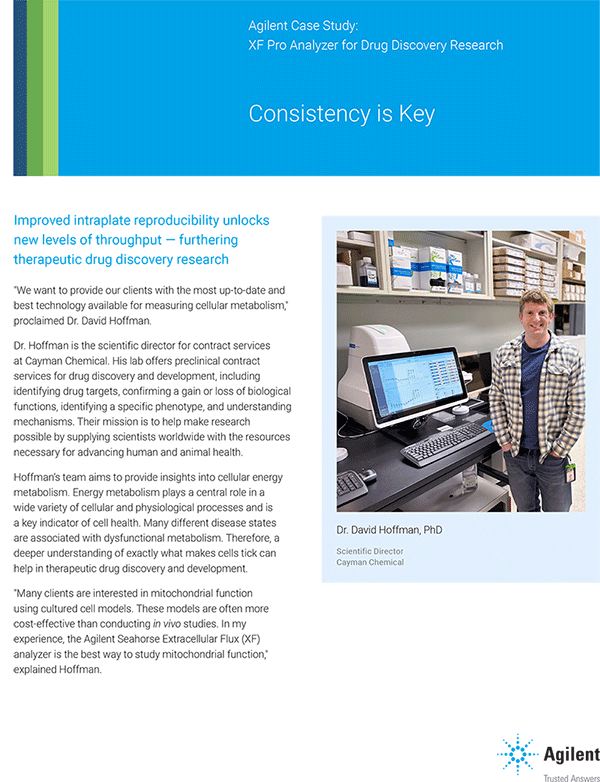
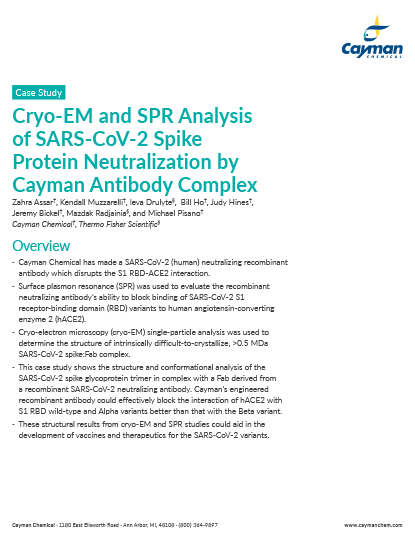
Cryo-EM and SPR Analysis of SARS-CoV-2 Spike Protein Neutralization by Cayman Antibody Complex
Case Study
Overview:
- Cayman has made a SARS-CoV-2 (human) neutralizing recombinant antibody which disrupts the S1 RBD-ACE2 interaction.
- Surface plasmon resonance (SPR) was used to evaluate the recombinant neutralizing antibody's ability to block binding of SARS-CoV-2 S1 receptor binding domain (RBD) variants to human angiotensin-converting enzyme 2 (hACE2).
- Cryo-electron microscopy (cryo-EM) single-particle analysis was used to determine the structure of intrinsically difficult-to-crystallize, >0.5 MDa SARS-CoV-2 spike:Fab complex.
- This case study shows the structure and conformational analysis of the SARS-CoV-2 spike glycoprotein trimer in complex with a Fab derived from a recombinant SARS-CoV-2 neutralizing antibody. Cayman's engineered recombinant antibody could effectively block the interaction of hACE2 with S1 RBD wild-type and Alpha variants better than that with the Beta variant.
- These structural results from cryo-EM and SPR studies could aid in the development of vaccines and therapeutics for the SARS-CoV-2 variants.
To cite this case study: Assar, Z., Muzzarelli, K., Drulyte, I., et al. Cryo-EM and SPR Analysis of SARS-CoV-2 Spike Protein Neutralization by Cayman Antibody Complex. Case Study: Structural Biology Services, Cayman Chemical (2021).
Driving Protein Crystallization and Rational Drug Design via Thermal Shift Assay
Case Study
Overview:
- Cayman’s Structural Biology service group worked with a client to perform crystallization studies that delivered multiple high-resolution crystal structures of LpxC, an enzyme involved in Gram-negative bacteria pathogenicity, bound with lead inhibitors.
- Thermal shift assay (TSA) protein formulation and cryoprotectant screening showed Mg2+ and tartrate to be effectively stabilizing for P. aeruginosa LpxC. Improved crystallization space and novel crystallization conditions were identified by TSA that enabled the co-crystallization of P. aeruginosa LpxC with inhibitor compounds.
- Crystal structures determined the key interactions of the inhibitors in the P. aeruginosa LpxC binding pocket. These findings led to the discovery of a prodrug with high solubility and rapid conversion to active drug upon i.v. administration to treat P. aeruginosa infections.
- The TSA-driven crystallization platform offered by Cayman enabled the client to rapidly advance their P. aeruginosa drug discovery program.
To cite this case study: Assar, Z., Holt, M.C., Schaub, J., et al. Driving protein crystallization and rational drug design via thermal shift assay. Case Study: Structural Biology Services, Cayman Chemical (2019).
Designing Small Molecule Inhibitors for Autotaxin
Case Study
PharmAkea, a startup biotechnology company located in San Diego, California, contacted Cayman Chemical to help determine the mode of binding for their small molecule autotaxin (ATX) inhibitors.
Download Copy (PDF)- Cayman Chemical’s structural biologists provided a drug discovery platform for the generation of small molecule autotaxin (ATX) inhibitors using their gene-to-structure pipeline.
- Crystal structures of mutant human ATX in complex with four structurally distinct ATX inhibitors are presented.
- Crystal structures confirm the unique mechanisms of inhibition displayed by ATX.
- A crystal structure with arachidonic acid (AA) represents the first ATX structure containing a substrate-bound secondary lysophosphatidic acid (LPA) binding site.
- This work enhanced our client’s drug discovery efforts, leading to a clinical candidate.
To cite this case study: Stein, A.J., Bain, G., Prodanovich, P., et al. Designing small molecule inhibitors for autotaxin. Case Study: Structural Biology Services, Cayman Chemical (2018).
Contact Info
Cayman Chemical1180 East Ellsworth RoadAnn Arbor, Michigan 48108 USAToll Free: (800) 364-9897(USA and Canada only)Fax: (734) 971-3640


