
News & Announcements
9(Z),11(E)-Conjugated Linoleic Acid Reduces Clinical Arthritis
9(Z),11(E)-Conjugated Linoleic Acid Reduces Clinical Arthritis
Article from 2016-10-03
This article was originally published in the October 2016 edition of Matreya’s Newsletter for Glyco/Sphingolipid Research (PDF).
Conjugated linoleic acids (CLAs) have been implicated in anticarcinogenic, anti-atherogenic, and anti-inflammatory activities.1 In addition, they have been shown to decrease low-density lipoprotein cholesterol and increase lean body mass. CLAs comprise several linoleic acid isomers with varying double bond positions and cis/trans configurations. The major natural CLA is 9(Z),11(E)-conjugated linoleic acid (9Z,11E-CLA), which comprises over 90% of the CLAs in ruminant fats. The other major natural CLA isomer, 10(E),12(Z)-conjugated linoleic acid (10E,12Z-CLA), has been implicated in anticarcinogenic activity, suppressing in vitro growth of human melanoma, colorectal, and breast cancer cells and exhibiting anti-atherogenic activity.2 When assimilated through the diet of animals, CLA is found in the intestinal mucosa, liver, and adipose tissue. Recently, the role of CLA in chronic inflammation has undergone renewed investigation.
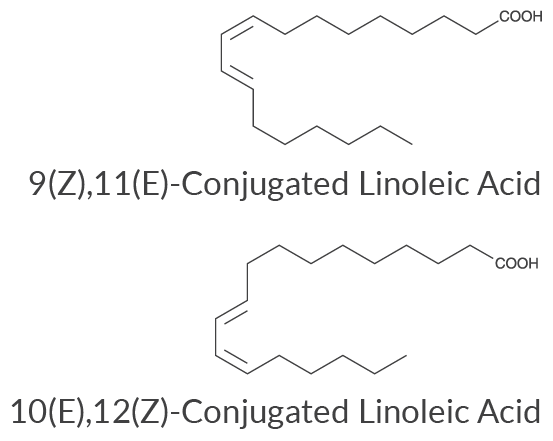
Chronic inflammation is a debilitating disorder affecting a large percentage of the population. There is increasing evidence that various lipids affect the progression of inflammation positively or negatively. The anti-inflammatory effect of 9Z,11E-CLA has been shown in dendritic cells, peripheral blood mononuclear cells, and splenic macrophages.3-5 Huebner and colleagues have demonstrated that as little as 0.125% (w/w) 9Z,11E-CLA in the diet maximized CLA's anti-inflammatory effects in a collagen-induced mouse model of arthritis.6 Although the anti-inflammatory mechanism is not fully understood, CLA appears to reduce TNF-α, IL-1β, and IL-6 expression. Additionally, when fed butter containing as little as 0.02% total dietary 9Z,11E-CLA, arthritic measurements were found to be as low as when fed 0.125% CLA supplements. These results offer exciting insights into the effectiveness of dairy products and CLA supplements in reducing inflammation.
Many studies have utilized mixtures of 9Z,11E-CLA and 10E,12Z-CLA, making it hard to demonstrate which isomer was responsible for specific effects and the potential competing mechanisms between the isomers. By using pure isomers, a more defined role of each CLA species can be measured. Cayman offers four highly purified CLA isomers for comparative research studies.
Purified CLA Isomers
9(Z),11(E)-Conjugated Linoleic Acid
9(Z),11(E)-Conjugated Linoleic Acid methyl ester
9(Z),11(E)-Conjugated Linoleic Acid (sodium salt)
9(E),11(E)-Conjugated Linoleic Acid
9(E),11(E)-Conjugated Linoleic Acid methyl ester
9(Z),11(Z)-Conjugated Linoleic Acid
9(Z),11(Z)-Conjugated Linoleic Acid methyl ester
10(E),12(Z)-Conjugated Linoleic Acid
10(E),12(Z)-Conjugated Linoleic Acid methyl ester
You May Also Be Interested In…
Potent Physiological Functions of Conjugated Linolenic Acids
References
1. Liew, C., Schut, H.A.J., Chin, S.F., et al. Protection of conjugated linoleic acids against 2-amino-3-methylimidazo[4,5-f] quinoline-induced colon carcinogenesis in the F344 rat: A study of inhibitory mechanisms. Carcinogenesis 16(12), 3037-3043 (1995).
2. MacDonald, H.B. Conjugated linoleic acid and disease prevention: A review of current knowledge. J. Am. Coll. Nutr. 19(2), 111S-118S (2000).
3. Loscher, C.E., Draper, E., Leavy, O., et al. Conjugated linoleic acid suppresses NF-κB activation and IL-12 production in dendritic cells through ERK-mediated IL-10 induction. J. Immunol. 175(8), 4990-4998 (2005).
4. Zhao, L., Yin, J., Li, D., et al. Conjugated linoleic acid can prevent tumor necrosis factor gene expression by inhibiting nuclear factor binding activity in peripheral blood mononuclear cells from weaned pigs challenged with lipopolysaccharide. Arch. Anim. Nutr. 59(6), 429-438 (2005).
5. Yang, M. and Cook, M.E. Dietary conjugated linoleic acid decreased cachexia, macrophage tumor necrosis factor-α production, and modifies splenocyte cytokines production. Exp. Biol. Med. (Maywood) 228(1), 51-58 (2003).
6. Huebner, S.M., Olson, J.M., Campbell, J.P., et al. Low dietary c9t11‐conjugated linoleic acid intake from dairy fat or supplements reduces inflammation in collagen‐induced arthritis. Lipids 51(7), 807-819 (2016).
Contact Info
Cayman Chemical1180 East Ellsworth RoadAnn Arbor, Michigan 48108 USAToll Free: (800) 364-9897(USA and Canada only)Fax: (734) 971-3640


