
News & Announcements
Potent Physiological Functions of Conjugated Linolenic Acids
Article from 2018-02-01
This article was originally published in the February 2018 edition of Matreya’s Newsletter for Glyco/Sphingolipid Research (PDF).
Conjugated linolenic acids (CLnAs) are plant-derived lipids that significantly affect lipid metabolism in humans and possess strong antidiabetic, anti-obesity, antiproliferative, and anticarcinogenic activities.1 CLnAs contain 3 double bonds in either the 9,11,13- or 8,10,12- positions of the C18 carbon chain and can be in any combination of cis or trans conformation. CLnAs are found in high amounts in several natural oils, including pomegranate, tung, and mimosifolia oils.
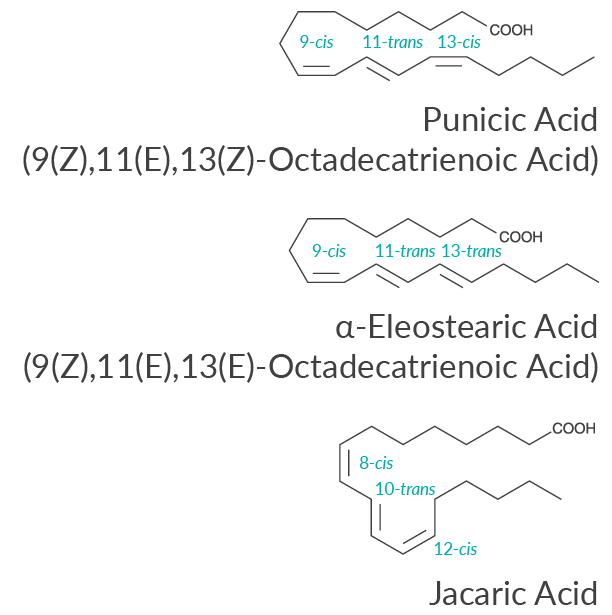
The potent physiological roles of CLnAs make them potential candidates as therapeutic and diabetic agents.2 Some studies suggest that punicic and α-eleostearic acids can reduce adipose tissue in ICR CD-1 mice, making it potentially useful as a weight-controlling lipid.3,4 CLnAs, including punicic, jacaric, and α-eleostearic acids, have been shown to suppress tumor cell growth through lipid peroxidation and apoptotic pathways and exhibit potent anti-inflammatory effects.5-8 Punicic acid also modulates mucosal immune responses and ameliorates gut inflammation through PPARγ- and PPARδ-dependent mechanisms.9 In addition, punicic and α-eleostearic acids from pomegranate oil have been shown to inhibit estrogen receptors α and β.10
Available Conjugated Linolenic Acids
9(Z),11(E),13(Z)-Octadecatrienoic Acid
9(Z),11(E),13(Z)-Octadecatrienoic Acid methyl ester
9(Z),11(E),13(E)-Octadecatrienoic Acid
9(Z),11(E),13(E)-Octadecatrienoic Acid methyl ester
References
1. Aruna, P., Venkataramanamma, D., Singh, A.K., et al. Health benefits of punicic acid: A review. Compr. Rev. Food Sci. F. 15(1), 16-27 (2016).
2. de Melo, I.L.P., Carvalho, E.B.T., Mancini-Filho, J. Pomegranate seed oil (Punica granatum L.): A source of punicic acid (conjugated α-linolenic acid). J. Hum. Nutr. Food Sci. 2(1), 1024 (2014).
3. Koba, K., Imamura, J., Akashoshi, A., et al. Genetically modified rapeseed oil containing cis-9, trans-11, cis-13-octadecatrienoic acid affects body fat mass and lipid metabolism in mice. J. Agric Food Chem. 55(9), 3741-3748 (2007).
4. Chen, G.-C., Chen, W.-H., Tseng, K.-T., et al. The anti-adiposity effect of bitter melon seed oil is solely attributed to its fatty acid components. Lipids Health Dis. 16(1), 186 (2017).
5. Tsuzuki, T., Tokuyama, Y., Igarashi, M., et al. Tumor growth suppression by α-eleostearic acid, a linolenic acid isomer with a conjugated triene system, via lipid peroxidation. Carcinogenesis 25(8), 1417-1425 (2004).
6. Gasmi, J. and Sanderson, J.T. Jacaric acid and its octadecatrienoic acid geoisomers induce apoptosis selectively in cancerous human prostate cells: A mechanistic and 3-D structure-activity study. Phytomedicine 20(8-9), 734-742 (2013).
7. Boussetta, T., Raad, H., Lettéron, P., et al. Punicic acid a conjugated linolenic acid inhibits TNFα-induced neutrophil hyperactivation and protects from experimental colon inflammation in rats. PLoS One 4(7), e6458 (2009).
8. Mashhadi, Z., Boeglin, W.E., and Brash, A.R. Robust inhibitory effects of conjugated linolenic acids on a cyclooxygenase-related linoleate 10S-dioxygenase: Comparison with COX-1 and COX-2. Biochim. Biophys. Acta 1851(10), 1346-1352 (2015).
9. Bassaganya-Riera, J., Diguardo, M., Climent, M., et al. Punicic acid modulates mucosal immune responses and prevents gut inflammation through PPAR γ and δ-dependent mechanisms. FASEB J. 24(1), 926 (2010).
10. Tran, H.N., Bae, S.-Y., Song, B.-H., et al. Pomegranate (Punica granatum) seed linolenic acid isomers: Concentration-dependent modulation of estrogen receptor activity. Endocr. Res. 35(1), 1-16 (2010).
Contact Info
Cayman Chemical1180 East Ellsworth RoadAnn Arbor, Michigan 48108 USAToll Free: (800) 364-9897(USA and Canada only)Fax: (734) 971-3640


