
News & Announcements
LSD and Its Structural Derivatives
from 2021-12-17
Lysergamide chemistry, pharmacology, metabolic fate, and analytical profile
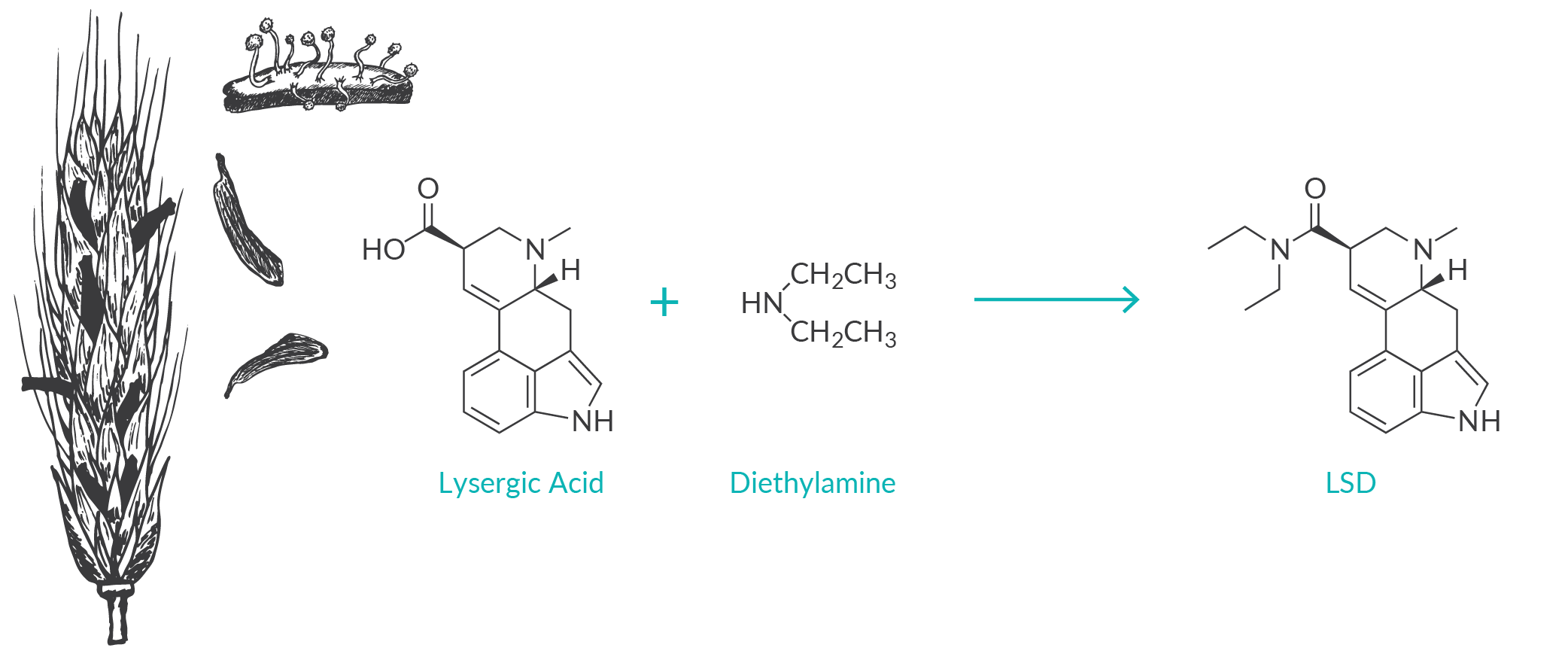
LSD (lyserg-säure-diäthylamid or lysergic acid diethylamide) was first synthesized in 1938 by Dr. Albert Hofmann, a natural products chemist at the Sandoz AG Pharmaceutical Company in Switzerland, as part of an exploration program that involved the systematic modification of the lysergamide scaffold. At that time, lysergamides were typically generated from lysergic acid purified from the ergot alkaloids produced by a parasitic rye fungus, Claviceps purpurea. The resulting lysergic acid would then be coupled with an alkylamine group (e.g., diethylamine, dimethylamine, dipropylamine, etc.) to produce the amide.
Chemistry
LSD was the twenty-fifth compound in the series that Dr. Hofmann had prepared in 1938 but initial screening failed to reveal any activity of interest. It would take five more years before the pharmacological significance of the compound was discovered, when he self-administered a small dose and then set off on a peculiar bike ride. Throughout the 1940s and 1950s, many modifications to the prototypical lysergamide structure were investigated but at that time none were revealed to be as potent as LSD. The diethylamide group and the double-bond in the D ring (see LSD structure below) appear to be key to the hallucinogenic activity of LSD, while the functional group in the C2 position, such as in 2-bromo LSD, also plays a role. Additional structural modifications to LSD have more recently started to appear in powder and blotter form on the new psychoactive substance (NPS) market such as those represented below.
Recent research has focused on the structure-activity relationships of these new lysergamide derivatives, examining the effects of alkyl substitution at the N6-position (LSD contains a methyl substituent at this position) and/or accompanying additions at the N1-position of the indole ring. Reports have indicated that LSD-like activity is either maintained or decreased with ethyl, n-propyl, or allyl substituents at the N6-position, whereas longer/bulkier substituents like isopropyl and n-butyl have been shown to reduce activity. In addition, dihydro-LSD, lacking the D-ring double bond, and 2-bromo LSD are non-hallucinogenic.
Pharmacology
The pharmacology of many of these substances has also been characterized. LSD and other lysergamide hallucinogens mediate behavioral responses through partial activation of serotonin (5-HT) receptors. Their actions are thought to be widely analogous to the hallucinogenic amphetamines, which are nearly full agonists at 5-HT2 receptors. Whereas activation of the post-synaptic 5-HT2A receptor is believed to play a role in mediating the psychedelic effects in humans, evidence indicates that the 5-HT1A receptor, localized pre- or postsynaptically, may also contribute to or potentiate the effects of LSD. LSD also has actions at many other receptors, including additional 5-HT receptor subtypes (5-HT2C, 5-HT5A, 5-HT6, 5-HT7), as well as dopamine receptors that may amplify or otherwise influence its overall effects. Relatively weaker affinities have been shown for adrenergic and histamine receptors.
Computer-based modeling of the 5-HT2A receptor (via the bovine rhodopsin structure) indicates that the diethylamide group of LSD binds within a small pocket of the receptor. Forcing alkyl groups larger than the diethylamide into the pocket distorts the receptor, while an alkyl group smaller than diethylamide causes a conformational rearrangement that is also unfavorable to receptor activation.
LSD is thought to interact with 5-HT receptors by inhibiting presynaptic neuron firing and serotonin release while sparing postsynaptic serotonergic receptors from up- or downregulation. Since serotonin is mainly an inhibitory neurotransmitter, the next neuron in the circuit is disinhibited and becomes active. Serotonergic signaling is critical in the control of sensation, sleep, attention, and mood, which helps explain why freeing these systems from inhibition leads to the behavioral responses associated with LSD. Activation of 5-HT2A also increases cortical glutamate levels, leading to stimulatory effects. Additional receptor interactions, including the formation of a heteromeric complex between 5-HT2A receptors and metabotropic glutamate receptor 2 (mGluR2), also modulate the range of psychoactive effects.
In 1966, the DEA restricted the use of LSD as a Schedule I controlled substance. Since human studies of the effects of LSD were limited, the head-twitch response assay has been widely adopted as a behavioral assessment to approximate human hallucinogen-like effects in rodents. This paroxysmal side-to-side head movement is one of the few behaviors that can reliably distinguish between hallucinogenic and non-hallucinogenic 5-HT2A receptor agonists. The head-twitch response is induced by LSD and a variety of LSD analogs, including 1P-LSD, AL-LAD, LSZ, 1B-LSD, 1V-LSD, and 1cP-LSD but not LSM-775 unless 5-HT1A receptor activity is blocked.
While currently designated as scheduled substances in many countries, psychedelics such as LSD, also known as psychoplastogens because they increase neuroplasticity, have antidepressant and anxiolytic, as well as pain reducing, activities. The Multidisciplinary Association for Psychedelic Studies (MAPS) sponsored the first study of the therapeutic use of LSD in humans in more than 40 years, which indicated that LSD can be safely administered and that LSD-assisted psychotherapy reduces anxiety. Non-hallucinogenic analogs of LSD, such as 2-bromo LSD (BOL-148) and lisuride, have shown promise in relieving depression and reducing the severity of cluster headaches, respectively. Methysergide, also devoid of hallucinogenic activity, was previously used in the prevention of severe treatment-resistant migraines and cluster headaches in the United States but was discontinued due to adverse effects. Interestingly, LSD and its analogs appear to act via a mechanism that provides efficacy that persists after the treatment period has ended. Together, these findings justify further research into utilizing psychedelics as therapeutics. In particular, there is a need for double-blind placebo-controlled trials.
Metabolism
In humans, LSD is rapidly metabolized by NADH-dependent liver microsomes to the major urinary metabolite 2-oxo-3-hydroxy LSD. Other metabolites found in urine include 2-oxo LSD, lysergic acid ethylamide (LAE, which originates from enzymatic N-dealkylation), nor-LSD (an N-demethylated degradation product of LSD), 13- and 14-hydroxy LSD as glucuronides, and lysergic acid ethyl-2-hydroxyethylamide (LEO).
Analytical Profile
Examination of the GC-MS fragmentation of lysergamides reveals a few characteristics of note. First off, LSD and related analogs typically exhibit intense molecular ions. They also fragment by similar mechanisms which results in some high intensity, common fragment ions such as 221, 207, and 181. These ions are characteristic of many of the lysergamides that contain the methyl substituent at the N6-position. For example, the GC-MS of 1P-LSD shown below has a strong parent ion at 379, along with the 221, 207, and 181 ions as well. It should be noted that analogs with differing substitution at N6 give similar fragmentation patterns, but with a mass shift corresponding to the differing molecular weight of the N6 moiety.
Available from Cayman
Cayman offers authentic lysergamide analytical standards and research compounds for the identification of lysergamide NPS and to aid in research and discovery of these compounds for therapeutic use. If you are having trouble identifying or finding a compound of interest, please contact our technical support department. To help accelerate your preclinical research, contact Cayman’s Medicinal Chemistry & Structural Biology Services to contract our multidisciplinary team for their expertise in structure-based drug design, hit-to-lead optimization, and process scaling. Cayman can also provide assistance in the identification of unknown compounds and provides other tools such as our Spectral Library, GC-MS Search Tool, and Identification & Naming Lab Guide Posters to help chemists identify novel analogs.
You May Also Be Interested In
 Psychedelic Drug Discovery Resource Center |  Rediscovering Psilocybin and Its Therapeutic Potential |
 Tryptamines Webinar |  Psychedelic Targets Research & Development |
Suggested Reading
Brandt, S.D., Kavanagh, P.V., Westphal, F., et al. Return of the lysergamides. Part I: Analytical and behavioural characterization of 1-propionyl-d-lysergic acid diethylamide (1P-LSD). Drug Test Anal. 8(9), 891-902 (2016).
Brandt, S.D., Kavanagh, P.V., Westphal, F., et al. Return of the lysergamides. Part II: Analytical and behavioural characterization of N6‐allyl‐6‐norlysergic acid diethylamide (AL‐LAD) and (2’S,4’S)‐lysergic acid 2,4‐dimethylazetidide (LSZ). Drug Test Anal. 9(1), 38-50 (2017).
Brandt, S.D., Kavanagh, P.V., Westphal, F., et al. Return of the lysergamides. Part III: Analytical characterization of N6-ethyl-6-norlysergic acid diethylamide (ETH-LAD) and 1-propionyl ETH-LAD (1P-ETH-LAD). Drug Test Anal. 9(10), 1641-1649 (2017).
Brandt, S.D., Kavanagh, P.V., Twamley, B., et al. Return of the lysergamides. Part IV: Analytical and pharmacological characterization of lysergic acid morpholide (LSM-775). Drug Test Anal. 10(2), 310-322 (2018).
Brandt, S.D., Kavanagh, P.V., Westphal, F., et al. Return of the lysergamides. Part V: Analytical and behavioural characterization of 1-butanoyl-d-lysergic acid diethylamide (1B-LSD). Drug Test. Anal. 11(8), 1122-1133 (2019).
Brandt, S.D., Kavanagh, P.V., Westphal, F., et al. Return of the lysergamides. Part VI: Analytical and behavioural characterization of 1-cyclo-propanoyl-d-lysergic acid diethylamide (1CP-LSD). Drug Test. Anal. 12(6), 812-826 (2020).
Brandt, S.D., Kavanagh, P.V., Westphal, F., et al. Return of the lysergamides. Part VII: Analytical and behavioural characterization of 1-valeroyl-ᴅ-lysergic acid diethylamide (1V-LSD). Drug Test. Anal. (2021).
Castellanos, J.P., Woolley, C., Bruno, K.A., et al. Chronic pain and psychedelics: A review and proposed mechanism of action. Reg. Anesth. Pain Med. 45(7), 486-494 (2020).
Gasser, P., Holstein, D., Michel, Y., et al. Safety and efficacy of lysergic acid diethylamide-assisted psychotherapy for anxiety associated with life-threatening diseases. J. Nerv. Ment. Dis. 202(7), 513-520 (2014).
Hougaku, H., Matsumoto, M., Hata, R., et al. Therapeutic effect of lisuride maleate on post-stroke depression. Nihon Ronen Igakkai Zasshi 31(1), 52-59 (1994).
Halberstadt, A.L., Chatha, M., Klein, A.K., et al. Correlation between the potency of hallucinogens in the mouse head-twitch response assay and their behavioral and subjective effects in other species. Neuropharmacology 167, 107933 (2020).
Hofmann, A. Psychotomimetic agents. Drugs affecting the central nervous system. Burger, A., editor, Dekker (1968).
Karst, M., Halpern, J.H., Bernateck, M., et al. The non-hallucinogen 2-bromo-lysergic acid diethylamide as preventative treatment for cluster headache: An open, non-randomized case series. Cephalalgia 30(9), 1140-1144 (2010).
Ly, C., Greb, A.C., Cameron, L.P. et al. Psychedelics promote structural and functional neural plasticity. Cell Rep. 23(11), 3170-3182 (2018).
Moreno, J.L., Muguruza, C., Umali, A., et al. Identification of three residues essential for 5-hydroxytryptamine 2A-metabotropic glutamate 2 (5-HT2A∙mGlu2) receptor heteromerization and its psychoactive behavioral function. J. Biol. Chem. 287(53) 44301-44319 (2012).
Nichols, D.E. LSD and its lysergamide cousins. Heffter Rev. of Psychedelic Res. 2, 80-87 (2001).
Olson, D.E. Psychoplastogens: A promising class of plasticity-promoting neurotherapeutics. J. Exp. Neurosci. 12, 1179069518800508 (2018).
Passie, T., Halpern, J.H., Stichtenoth, D.O. et al. The pharmacology of lysergic acid diethylamide: A review. CNS Neurosci. Ther. 14(4), 295-314 (2008).
Ramírez Rosas, M.B., Labruijere, S., Villalón, C.M., et al. Activation of 5-hydroxytryptamine1B/1D/1F receptors as a mechanism of action of antimigraine drugs. Expert Opin. Pharmacother, 14(12), 1599-1610, (2013).
Contact Info
Cayman Chemical1180 East Ellsworth RoadAnn Arbor, Michigan 48108 USAToll Free: (800) 364-9897(USA and Canada only)Fax: (734) 971-3640


