
News & Announcements
Rediscovering Psilocybin and Its Therapeutic Potential
Article from 2022-02-08
By Katie M. Collette, Ph.D. -Technical Writer, Cayman Chemical
History
Psilocybin is a phosphorylated prodrug form of the psychedelic compound psilocin that has been found in fungi of the genus Psilocybe, as well as in fungi from other genera. Ingestion of psilocybin-containing mushrooms for their hallucinogenic effects has occurred for thousands of years. In the 1500s, Bernardino de Sahagún, a Spanish Franciscan friar, studied Aztec culture and Psilocybe mushrooms in Mexico. Sahagún called these mushrooms teonanácatl, meaning "God's flesh", and described their use for medical and religious purposes. Broader use of so-called "magic mushrooms" in the United States began after publication of a LIFE magazine article in 1957 written by the amateur mycologist R. Gordon Wasson, who was Vice President of Public Relations at J.P. Morgan & Co. at that time. Wasson wrote about his experience participating in a spiritual ritual using the mushrooms for their curative powers conducted by the Mazatec curandera María Sabina in the village of Huautla de Jiménez, Mexico. This led to widespread cultivation and use of the mushrooms for recreation and research. In 1971, psilocybin was regulated as a Schedule I controlled substance and its use was drastically reduced. Psilocybin-based research increased in the late 1990s and now it is one of the most common psychedelics used in human studies. It has potential applications in the treatment of major depressive disorder, obsessive-compulsive disorder (OCD), substance use disorder, end-of-life anxiety and depression, and cluster headaches. Certain cities in the United States have even decriminalized psilocybin, including Washington, D.C. and Denver, Colorado.
Chemistry
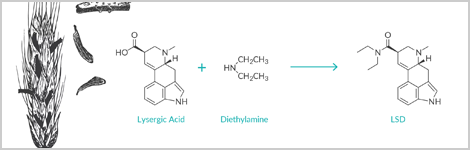
Psilocybin was originally isolated from Psilocybe mexicana in 1958 by Albert Hofmann, the same chemist that synthesized lysergic acid diethylamide (LSD) in 1938. It is biosynthesized from tryptophan through norbaeocystin and baeocystin intermediates. Psilocybin and its active metabolite, psilocin, are categorized as tryptamines, with structures similar to that of the neurotransmitter serotonin (5-HT). Psilacetin, also known as 4-acetoxy DMT, is another presumed prodrug of psilocin that contains an acetoxy group at the four position of the indole ring in place of the phosphoryloxy group in psilocybin (Figure 1). Tryptamines substituted at the four position of the indole ring are closest in structure to psilocin, which contains a hydroxy group in that position. Some derivatives of psilocybin, such as 4-acetoxy MET or 4-methyl-α-ethyltryptamine, combine indole ring modifications and substitutions on the primary amine or the ethylamine chain.
Figure 1. Psilocybin biosynthesis and conversion to psilocin. The synthetic tryptamine 4-acetoxy DMT (psilacetin) is also a presumed prodrug of psilocin. Adapted from Angew. Chem. Int. Ed. 56(40), 12352-12355 (2017) and Drug Metab. Rev. 49(1), 84-91 (2017).
Pharmacology & Mechanism of Action
Psilocin, but not psilocybin, is a partial agonist at the 5-HT2A receptor. It has moderate affinity for additional 5-HT receptors (5-HT1, 5-HT5, 5-HT6, 5-HT7), as well as lower affinity for dopamine D3 receptors and α2-adrenergic receptors (α2-ARs). Psilocybin is not the only psychedelic whose ingestion and metabolism leads to 5-HT2A receptor activity. Like psilocin, LSD and mescaline are also 5-HT2A receptor agonists and share many of the same psychedelic effects as psilocybin.
Psilocybin ingestion induces visual and auditory hallucinations, time distortion, and synesthesia, as well as feelings of spirituality and interconnectedness. The occupancy of cerebral 5-HT2A receptors by psilocin in human volunteers correlates with the intensity of their psychedelic experiences, and psilocybin-induced hallucinations can be blocked by 5-HT2A receptor antagonists, indicating that 5-HT2A receptor activation is responsible for its psychedelic effects. The visual cortex highly expresses postsynaptic 5-HT2A receptors on serotonergic and glutamatergic neurons, and their activation may be sufficient to explain, at a cellular level, the mechanism of the visual hallucinations induced by psilocybin. However, recent research suggests the 5-HT1A receptor may play a role in the effects of psilocybin as well. The 5-HT2A receptor antagonist ketanserin does not block certain psilocybin-induced effects, such as attentional tracking, binocular rivalry, and reductions in arousal and vigilance. In addition, the euphoric feelings of psilocybin can be inhibited by the dopamine D2 antagonist haloperidol, suggesting involvement with the dopaminergic system. Preclinical models have been used to help elucidate the mechanism of psilocybin's effects and to screen for CNS-active derivatives.
Due to the scheduling of psychedelic compounds such as psilocybin and LSD as controlled substances, human research using these compounds dwindled and the head-twitch response assay, introduced in 1967, was widely adopted as a behavioral assessment to approximate human hallucinogen-like effects in rodents. This paroxysmal side-to-side head movement is one of the few behaviors that can reliably distinguish between hallucinogenic and non-hallucinogenic 5-HT2A receptor agonists. A variety of psilocin derivatives have been assessed using the head-twitch response assay, including 4-hydroxy MET, 4-acetoxy DMT (psilacetin), and 4-acetoxy DiPT (Table 1), and have been found to elicit the response.
Metabolism
Psilocybin is dephosphorylated in vivo to psilocin by phosphatases in the intestine and other tissues. It is directly glucuronidated to form psilocin-O-glucuronide primarily by the UDP-glucuronosyltransferase (UGT) isoforms UGT1A10 and UGT1A9. A small amount of psilocin is oxidized to 4-hydroxyindole-3-acetaldehyde (4-HIA), then oxidized again to 4-hydroxyindole-3-acetic acid (4-HIAA) or reduced to 4-hydroxy tryptophol (4-HT). It can also be metabolized by ceruloplasmin or cytochrome oxidase to a deep blue product with possible o-quinone or iminoquinone structures. Psilocin is predominantly excreted as the glucuronidated product but approximately 25% is excreted as psilocin and a minor amount as 4-HIAA. Excretion of psilocin and its metabolites primarily occurs in the urine, with only 15-20% excreted in the bile and feces, within eight hours of an oral dose. However, they can be detected in the urine in lower amounts at least seven days after administration.
Therapeutic Potential
The field of psychedelic therapeutics is growing at a fast pace due to the benefits of these compounds over current treatments. Psilocybin is a rapid-acting antidepressant (RAAD), and the United States FDA has granted breakthrough therapy status for its use in treatment-resistant depression. This status is intended to fast-track drugs that have shown evidence of substantial improvement over current therapeutics in preliminary trials. In addition to treatment-resistant depression, it also has potential applications in the treatment of OCD, substance use disorder, and cluster headaches.
The rapid-acting nature of psilocybin for depression is not the only improvement over current therapeutics. Its effects also persist long after administration, which would eliminate the need for daily dosing. In a double-blind placebo-controlled study involving patients with life-threatening cancer, psilocybin-assisted psychotherapy immediately reduced cancer-related feelings of hopelessness and anxiety and improved patients' quality of life. Remarkably, these effects persisted in the majority of patients for at least 6.5 months after the drug-assisted therapy session. Psilocybin, given two times three weeks apart, also reduced depression in patients with moderate-to-severe major depressive disorder at a level comparable with daily escitalopram.
In addition to its use as an antidepressant, psilocybin has shown promise in open-label studies for use in drug-assisted psychotherapy for patients with OCD and for cessation of alcohol or nicotine use. Further research is warranted, and there is a need for double-blind placebo-controlled trials and trials that control for the effect of psychotherapy. Due to the potential for "bad trips"—negative experiences while under the influence of psilocybin—the administration of psychedelic compounds requires supervision in carefully controlled settings, such as a psychotherapy session. It is unknown, however, whether the psychedelic experience is required for its therapeutic effects.
Evidence from animal studies suggests that the hallucinogenic potential can be decoupled from the antidepressant-like effects. One hypothesis for the antidepressant mechanism of psilocybin is based on the ability of psychedelics, also known as psychoplastogens, to increase neuroplasticity. In a study using mice, Hesselgrave et al. found that the antidepressant-like effect was independent of 5-HT2A receptor activation and the head-twitch response that indicates hallucinogenic potential in rodents. In addition, psilocybin restored synaptic strength in cortico-mesolimbic reward circuits, also independent of 5-HT2A receptor activation. If the psychedelic experience is not required for the therapeutic effects of psilocybin, it would make dosing more manageable by eliminating the need for psychotherapy at the time of dosing. It would also widen the field for finding tryptamine derivatives with improved efficacy in related therapeutic areas.
Available from Cayman
Cayman offers psilocybin, psilocin, and a large variety of tryptamine derivatives as individual compounds to aid in the research of these compounds for therapeutic use. Our Tryptamine Analytical Standards Panel comes preloaded with tryptamine derivatives and metabolites in a convenient 96-well plate format for rapid screening or cataloging. To help accelerate your preclinical research, contact Cayman's Medicinal Chemistry & Structural Biology Services to contract our multidisciplinary team for their expertise in structure-based drug design, hit-to-lead optimization, and process scaling.
Visit our Psychedelic Drug Discovery Resource Center to browse more psychedelic substances and access additional resources for psychedelic drug discovery research.
You May Also Be Interested In
 LSD & Its Structural Derivatives |  Tryptamines Webinar |
 Psychedelic Targets Research & Development |
References
Blair, J.B., Kurrasch-Orbaugh, D., Marona-Lewicka, D., et al. Effect of ring fluorination on the pharmacology of hallucinogenic tryptamines. J. Med. Chem.43(24), 4701-4710 (2000).
de Borhegyi, C. and de Borhegyi-Forrest, S. Mushroom intoxication in Mesoamerica. Toxicology in antiquity. Wexler, P., editor, 2nd edition, Elsevier (2019).
Carod-Artal, F.J. Hallucinogenic drugs in pre-Columbian Mesoamerican cultures. Neurologia30(1), 42-49 (2015).
Corne, S.J. and Pickering, R.W. A possible correlation between drug-induced hallucinations in man and a behavioural response in mice. Psychopharmacologia11(1), 65-78 (1967).
Dinis-Oliveira, R.J. Metabolism of psilocybin and psilocin: Clinical and forensic toxicological relevance. Drug Metab. Rev.49(1), 84-91 (2017).
Dunlap, L.E., Azinfar, A., Ly, C., et al. Identification of psychoplastogenic N,N-dimethylaminoisotryptamine (isoDMT) analogues through structure-activity relationship studies. J. Med. Chem.63(3), 1142-1155 (2020).
Geiger, H.A., Wurst, M.G., and Daniels, R.N. DARK classics in chemical neuroscience: Psilocybin. ACS Chem. Neurosci.9(10), 2438-2447 (2018).
Halberstadt, A.L., Chatha, M., Klein, A.K., et al. Correlation between the potency of hallucinogens in the mouse head-twitch response assay and their behavioral and subjective effects in other species. Neuropharmacology167, 107933 (2020).
Hesselgrave, N., Troppoli, T.A., Wulff, A.B., et al. Harnessing psilocybin: Antidepressant-like behavioral and synaptic actions of psilocybin are independent of 5-HT2R activation in mice. Proc. Natl. Acad. Sci. USA118(17), e2022489118 (2021).
Hill, S.L. and Thomas, S.H.L. Clinical toxicology of newer recreational drugs. Clin. Toxicol. (Phila)49(8), 705-719 (2011).
Hofmann, A., Heim, R., Brack, A., et.al. Psilocybin, a psychotropic substance from the Mexican mushroom Psilocybe mexicana Heim. Experientia14(3), 107-109 (1958).
Horita, A. and Weber, L.J. Dephosphorylation of psilocybin in the intact mouse. Toxicol. Appl. Pharmacol.4, 730-737 (1962).
Kalberer, F., Kreis, W., and Rutschmann, J. The fate of psilocin in the rat. Biochem. Pharmacol.11, 261-269 (1962).
Klein, A.K., Chatha, M., Laskowski, L.J., et al. Investigation of the structure−activity relationships of psilocybin analogues. ACS Pharmacol. Transl. Sci.4(2), 533-542 (2020).
Klein, L.M., Cozzi, N.V., Daley, P.F., et al. Receptor binding profiles and behavioral pharmacology of ring-substituted N,N-diallyltryptamine analogs. Neuropharmacology142, 231-239 (2018).
Kometer, M. and Vollenweider, F.X. Serotonergic hallucinogen-induced visual perceptual alterations. Curr. Top. Behav. Neurosci.36, 257-282 (2018).
Li, N.-X., Hu, Y.-R., Chen, W.-N., et al. Dose effect of psilocybin on primary and secondary depression: A preliminary systematic review and meta-analysis. J. Affect. Disord. 296, 26-34 (2022).
Ling, S., Ceban, F., Lui, L.M.W., et al. Molecular mechanisms of psilocybin and implications for the treatment of depression. CNS Drugs36(1), 17-30 (2022).
Madsen, M.K., Fisher, P.M., Burmester, D., et al. Psychedelic effects of psilocybin correlate with serotonin 2A receptor occupancy and plasma psilocin levels. Neuropsychopharmacology44(7), 1328-1334 (2019).
Moreno, F.A., Wiegand, C.B., Taitano, E.K., et al. Safety, tolerability, and efficacy of psilocybin in 9 patients with obsessive-compulsive disorder. J. Clin. Psychiatry67(11), 1735-1740 (2006).
Nichols, D.E. Psilocybin: From ancient magic to modern medicine. J. Antibiot. (Tokyo)73(10), 679–686 (2020).
Nyberg, H. Religious use of hallucinogenic fungi: A comparison between Siberian and Mesoamerican cultures. Karstenia32(2), 71-80 (1992).
Ross, S., Bossis, A., Guss, J., et al. Rapid and sustained symptom reduction following psilocybin treatment for anxiety and depression in patients with life-threatening cancer: A randomized controlled trial. J. Psychopharmacol.30(12), 1165-1180 (2016).
dos Santos, M.D., Chen, G., Almeida, M.C., et al. Effects of caffeoylquinic acid derivatives and C-flavonoid from Lychnophora ericoides on in vitro inflammatory mediator production. Nat. Prod. Commun.5(5), 733-740 (2010).
Tylš, F., Páleníček, T., and Horáček, J. Psilocybin – summary of knowledge and new perspectives. Eur. Neuropsychopharmacol.24(3), 342-356 (2014).
Wasson, R.G. In search of the magic mushroom. LIFE, 1957.
Contact Info
Cayman Chemical1180 East Ellsworth RoadAnn Arbor, Michigan 48108 USAToll Free: (800) 364-9897(USA and Canada only)Fax: (734) 971-3640


