
News & Announcements
Tunicamycin Analogs Advance Antibiotic Development
Tunicamycin Analogs Advance Antibiotic Development
Article from 2020-10-16
Bacterial resistance to antibiotics, often caused by subinhibitory dosing, has increasingly limited the treatment options for microbial infections. Beyond the discovery of novel antibiotics with improved potency, strategies to overtake this resistance have focused on synergizing the antibacterial properties of known compounds that interfere with pathogen physiology and virulence. The tunicamycin (TUN) family of natural products is one example of antibiotics produced from actinomycetes soil bacteria that has been used against methicillin-resistant S. aureus (MRSA) and to sensitize against β-lactam antibiotics that alone are less effective on MRSA. Examination of TUN’s mechanism of action point to the importance of the fatty acid chains that it displays.
The lipids found in bacteria bear fatty acid chains that are either straight or branched. Gram-negative bacteria generally have straight-chain fatty acids that are unsaturated. Gram-positive bacteria generally have branched-chain fatty acids with either odd- or even-numbered carbon chains that are commonly saturated and have one or more methyl branches at either the ω-1 or ω-2 positions. These fatty acids accumulate in bacterial lipid bilayers but are also found in certain secondary metabolites of bacteria, such as antibiotics or biosurfactants, where incorporation of these branched chains contributes to their structural diversity and biological activity. TUNs possess considerable variability in N-acyl chain arrangement.
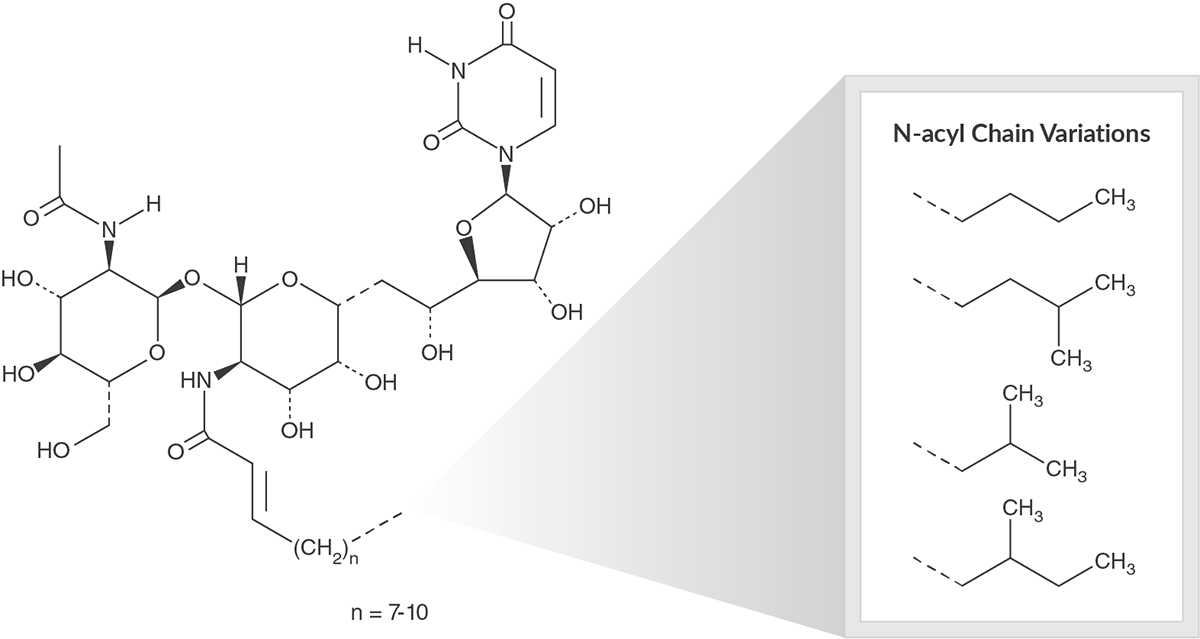
Tunicamycin variants contain medium sized, odd or even chains, and can be either branched or unbranched.
Very little is known about how these variants interact with either the lipid bilayers in which they are embedded or the transferase enzymes they inhibit to prevent bacterial cell wall biosynthesis and eukaryotic protein N-glycosylation. Structure-activity studies have shown that variations in the chain length or branching pattern of the N-acyl chain impacts the biological activity of the TUNs.1 To address the need for materials that would help analyze or control for these differences, Cayman scientists worked with the USDA to develop the following purified tunicamycin congeners with defined N-acyl chain lengths ranging from 14 to 17 carbon atoms.
Tunicamycin 14:1
Tunicamycin 15:1
Tunicamycin 16:1
Tunicamycin 17:1
Clinical development of native tunicamycin into an efficacious antibiotic is impeded by eukaryotic toxicity arising from its potent inhibition of protein N-glycosylation. An unusual fatty acid acyl trans-2,3-double bond has been found to play an important role in the eukaryotic toxicity observed with native tunicamycin.2 Using selective hydrogenation, scientists at the USDA have generated tunicamycin analogs by reducing the N-acyl double bond (TunR1) or both the N-acyl and uridyl double bonds (TunR2) with diminished ability to inhibit eukaryotic protein N-glycosylation while retaining their antibacterial activity.2 Furthermore, these analogs can enhance the antibacterial activity of classic β-lactam antibiotics widely used in human health, veterinary medicine, and agriculture, including monobactams, carbapenems, cephalosporins, and penicillins, that have lost efficacy from pathogenic resistance.3 These modified tunicamycin analogs offer a promising approach to harness antibiotic synergy through combination therapies, potentially reducing the dosages required and helping delay resistance.
Employing tunicamycins with known N-acyl chain lengths will allow researchers to more precisely test their individual properties to help improve antibacterial activity and increase the reproducibility of studies that have previously used the traditional and less-characterized tunicamycin mixture. Alterations to the tunicamycin scaffold offer the opportunity to modify its properties in interesting ways, and tunicamycin analogs resulting from selective hydrogenation and incorporation of novel N-acyl chains represent a promising source of lead compounds for antibiotic drug development.4
Cayman has established a licensing agreement with the USDA Agricultural Research Service to produce and sell TunR1 and TunR2 so that researchers can further study their biological activity. Through this collaboration, Cayman chemists developed and improved the process to make TUN on a multi-gram scale, which allowed for production of TunR1 and TunR2.
Cayman offers natural products to the research community in its dedicated Natural Products laboratory where experts in microbial fermentation, plant extraction, chemical synthesis, and analytical chemistry are constantly developing new procedures and novel products such as TUNs. We are currently manufacturing many other naturally derived antibiotics for research use and have the expertise in house to work with researchers on scale up and/or modification of various classes of bioactive compounds. Our scientists put their knowledge to work to complete the difficult isolation or develop the most reasonable synthesis routes to help make your research possible.
View all our natural products
Have a custom synthesis request?
Learn more about our Chemical Synthesis services
You May Also Be Interested In
 |  |
| Meet the Experts: Natural Products Chemistry | Natural Products: Microbial Metabolites |
References
1. Dong, Y.Y., Wang, H., Pike, A.C.W., et al. Structures of DPAGT1 explain glycosylation disease mechanisms and advance TB antibiotic design. Cell 175(4), 1045-1058 (2018).
2. Price, N.P.J., Hartman, T.M., Li, J., et al. Modified tunicamycins with reduced eukaryotic toxicity that enhance the antibacterial activity of β-lactams. J. Antibiot. (Tokyo) 70(11), 1070-1077 (2017).
3. Price, N.P.J., Jackson, M.A., Singh, V., et al. Synergistic enhancement of beta-lactam antibiotics by modified tunicamycin analogs TunR1 and TunR2. J. Antibiot. (Tokyo) 72(11), 807-815 (2019).
4. Price, N.P.J., Jackson, M.A., Hartman, T.M., et al. Branched chain lipid metabolism as a determinant of the N-acyl variation of Streptomyces natural products. ACS Chemical Biology (2021).
Contact Info
Cayman Chemical1180 East Ellsworth RoadAnn Arbor, Michigan 48108 USAToll Free: (800) 364-9897(USA and Canada only)Fax: (734) 971-3640


