
News & Announcements
Why Does Alkyl Chain Length Matter?
Article from 2020-04-13
Newly identified phytocannabinoids have four- and seven-carbon side alkyl chains
Almost 150 structurally and physiologically distinct cannabinoid compounds are unique to Cannabis. These compounds collectively known as phytocannabinoids are produced by an enzymatic reaction between a resorcinol and an isoprenoid group. The precursor for the most ubiquitous naturally occurring phytocannabinoids is olivetolic acid, which undergoes a condensation reaction leading to the formation of cannabigerolic acid (CBGA) (Figure 1). Specific synthases convert CBGA to cannabichromenic acid (CBCA) or cannabidiolic acid (CBDA), which can be converted to tetrahydrocannabinolic acid (THCA). These carboxylated forms are converted to a corresponding decarboxylated form when exposed to heat. The best-known decarboxylated cannabinoids are cannabidiol (CBD) and Δ9-THC (the principal psychoactive constituent of Cannabis).
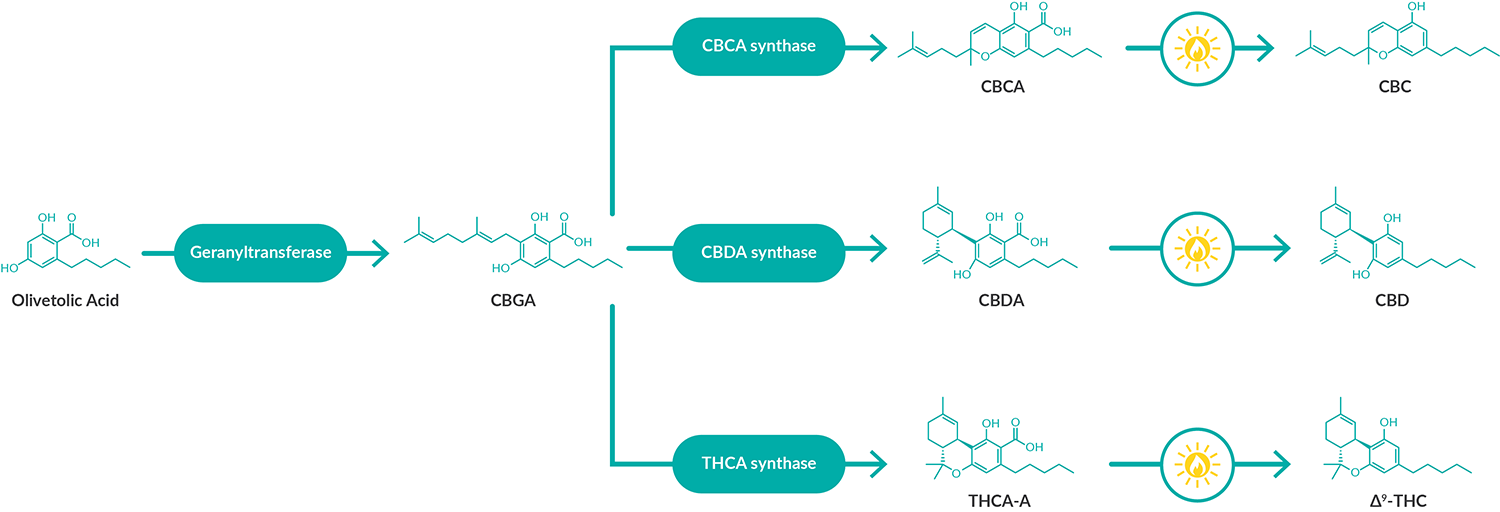
Figure 1. Synthesis and degradation of olivetol series phytocannabinoids.
Alkyl Chain Length Differences
The alkyl side chain on the resorcinol moiety of olivetol cannabinoids is five carbon atoms long. However, other phytocannabinoids such as those derived from varinolic acid contain three carbon atoms on their side chain, and those derived from orcinolic acid contain one carbon atom. You can refer to Cayman’s Phyocannabinoid Guide to see the biosynthesis and degradation pathways of phytocannabinoids derived from the olivetol, varinol, and orcinol series in detail. A recently identified butyl phytocannabinoid series represented by cannabidibutol (CBDB) and Δ9-tetrahydrocannabutol (Δ9-THCB) has a four-carbon alkyl chain (Figure 2). Since evidence of a corresponding biosynthesis enzyme has not been found, these butyl phytocannabinoids are thought to derive from microbial ω-oxidation and decarboxylation of their corresponding five-carbon homologs. Phytocannabinoids with an alkyl side chain longer than five carbon atoms were not thought to occur naturally until cannabidiphorol (CBDP) and Δ9-tetrahydrocannabiphorol (Δ9-THCP), seven-carbon homologs of CBD and Δ9-THC, were identified in a medicinal Cannabis variety, the Italian FM2 (Figure 2). These phytocannabinoids are named for their resorcinol moiety 5-heptyl-benzene-1,3-diol, which is commonly referred to as sphaerophorol.
Figure 2. Newly identified butyl and phorol phytocannabinoids are analogs of CBD and Δ9-THC with differing alkyl side chain lengths.
Side Alkyl Chain Influences Biological Activity
The length of the alkyl side chain is incredibly important for the interaction of Δ9-THC with the human cannabinoid receptors CB1 and CB2 as it directly correlates with receptor binding affinity. Structure-activity relationship studies of Δ9-THC and Δ8-THC homologs demonstrate a minimum of three carbons is necessary to bind the CB1 receptor.1 Maximum activity has been registered with an eight-carbon side chain. Indeed, synthetic analogs of Δ9-THC with a side chain longer than five carbons have shown cannabimimetic properties several times more potent than Δ9-THC itself. For example, JWH 091 a seven-carbon chain homolog was shown to have nearly double the receptor affinity from that of Δ9-THC or Δ8-THC.1 The optimal binding affinity for CB1 lies between five and eight carbons. Any higher number of carbon atoms is associated with a decrease in activity.
Interestingly, the binding activity of Δ9-THCB at human CB1 receptor in vitro was reported to be three-times higher than Δ9-THC (Kis = 15 and 40 nM, respectively) and five-times higher than Δ9-THCV (Ki = 75.4 nM) with no significant differences in CB2 receptor binding affinity.2 The binding activity of Δ9-THCP against human CB1 receptor (Ki = 1.2 nM) was over 30-times more potent than Δ9-THC and comparable to that of the potent full CB1 agonist (±)-CP 55,940 (Ki = 0.9 nM).3 In the cannabinoid tetrad pharmacological test, Δ9-THCP induced hypomotility, analgesia, catalepsy, and decreased rectal temperature indicating a THC-like cannabimimetic activity.3 The presence of these new phytocannabinoids could account for the pharmacological properties of some Cannabis varieties difficult to explain only by the presence of Δ9-THC. Because Δ9-THCP has higher binding affinity for the CB1 receptor and greater cannabimimetic activity than Δ9-THC itself, attention may shift to this newly discovered phytocannabinoid to explore its pharmacological potential to treat a wide range of disorders.
Identifying Impurities
While the binding affinity of CBDB and CBDP to CB1 and CB2 receptors has not been reported, the binding affinity of CBD is known to be poor. If the change in alkyl chain length affects the binding affinity to CB1 and CB2 as it does for Δ9-THCP, then CBDP could potentially be a more potent form of CBD. Knowledge of this becomes particularly important to the production of pharmaceutical-grade CBD as any impurities present could alter its efficacy. Indeed, cannabidivarin (CBDV), the three-carbon alkyl side chain homolog of CBD, and CBDB have both been identified as major impurities in CBD produced by hemp extraction.4 The amount of these two impurities in the final product could be relatively high, up to 1% CBDV and 0.5% CBDB (w/w), which would necessitate chromatographic purification to generate CBD that is suitable for pharmaceutical use. Cayman offers analytical standards for CBDV, CBDB, and CBDP that can be applied to suitable analytical methods to quantify these compounds.
Discover all phytocannabinoids
Medicinal Chemistry & Structural Biology Services
Cayman scientists collaborate with forensic, academic, and industry labs to provide data, research compounds, and analytical reference standards. Our experienced medicinal and organic chemists, structural biologists, and biochemists possess the competencies to accelerate your drug discovery program through pre-clinical stages of development. Contact us to see how we can help you with your next project.
You May Also Be Interested In
 |  |
| Phytocannabinoid Guide: Biosynthesis, Naming, and Numbering Request the Lab Wall Poster | Cayman Currents Issue 34: Phytocannabinoids: What Is on the Horizon? Download or Request a Physical Copy |
References
1. Bow, E.W. and Rimoldi. J.M. The structure-function relationships of classical cannabinoids: CB1/CB2 modulation. Perspect. Medicin. Chem.8, 17-39 (2016).
2. Linciano, P., Citti, C., Luongo, L., et al. Isolation of a high-affinity cannabinoid for the human CB1 receptor from a medicinal Cannabis sativa variety: Δ9-Tetrahydrocannabutol, the butyl homologue of Δ9-tetrahydrocannabinol. J. Nat. Prod.83(1), 88-98 (2020).
3. Citti, C., Linciano, P., Russo, F., et al. A novel phytocannabinoid isolated from Cannabis sativa L. with an in vivo cannabimimetic activity higher than Δ9-tetrahydrocannabinol: Δ9-Tetrahydrocannabiphorol. Sci. Rep. 9:20335 (2019).
4. Citti, C., Linciano, P., Forni, F., et al. Analysis of impurities of cannabidiol from hemp. Isolation, characterization and synthesis of cannabidibutol, the novel cannabidiol butyl analog. J. Pharm. Biomed. Anal. 175:112752 (2019).
Contact Info
Cayman Chemical1180 East Ellsworth RoadAnn Arbor, Michigan 48108 USAToll Free: (800) 364-9897(USA and Canada only)Fax: (734) 971-3640


