
News & Announcements
Lysosphingomyelin: A Sensitive and Specific Biomarker for Niemann-Pick Disease
Article from 2018-08-01
This article was originally published in the August 2018 edition of Matreya’s Newsletter for Glyco/Sphingolipid Research (PDF).
Niemann-Pick disease is a lysosomal storage disorder that results in the accumulation of various lipids. Niemann-Pick disease type B (NPD-B) is caused by a partial deficiency of acid sphingomyelinase activity and results in the accumulation of lysosomal sphingomyelin, predominantly in macrophages. While several biomarkers are currently used to diagnose and monitor this disease, none have proven to be ideal.
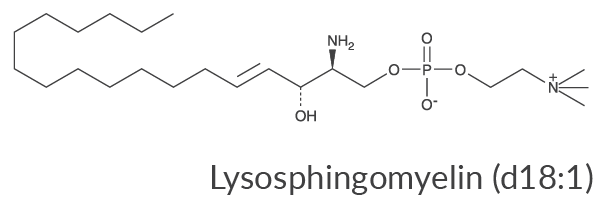
Lysosphingomyelin, the deacylated form of sphingomyelin, has been identified as a highly sensitive and specific biomarker for Niemann-Pick disease. In skin, it is formed by the action of a sphingomyelin deacylase, and it is likely produced by a similar route in other tissues including heart, blood vessels, brain, and the immune system. There is evidence that lysosphingomyelin is metabolized very rapidly in tissues. Notably, sphingomyelin is not significantly elevated in the plasma, whole blood, or urine of NPD-B patients. However, lysosphingomyelin is elevated approximately five-fold in dried blood spots from NPD-B patients and has no overlap with normal controls, making it a potentially useful biomarker of the disease.1 On the other hand, sphingomyelin levels are significantly elevated in the livers and spleens of NPD-B patients, but these levels in plasma overlap with those of normal controls. LC-MS/MS analysis of dried blood spots showed that lysosphingomyelin levels from NPD-B patients were substantially elevated when compared to normal controls, with no overlap in values.1 Thus, lysosphingomyelin can be useful for NPD-B diagnosis or disease monitoring. Lysosphingomyelin may also be a precise and specific biomarker for Niemann-Pick type C.2 Lysosphingomyelin analysis is relatively quick and easy to perform from blood plasma samples, making it useful in a clinical setting.
Available Lysosphingomyelins
L-threo Lysosphingomyelin (d18:1)
D-erythro/L-threo Lysosphingomyelin (d18:1)Lysodihydrosphingomyelin (d18:0)
C16 Sphingomyelin-13C (d18:1/16:0-13C)
More Lysosomal Storage Disorders Research Tools from Cayman
Further Reading
Glucosylsphingosine: A Sensitive and Specific Biomarker for Gaucher Disease
References
1. Chuang, W.-L., Pacheco, J., Cooper, S., et al. Lyso-sphingomyelin is elevated in dried blood spots of Niemann-Pick B patients. Mol. Genet. Metab. 111(2), 209-211 (2014).
2. Giese, A.-K., Mascher, H., Grittner, U., et al. A novel, highly sensitive and specific biomarker for Niemann-Pick type C1 disease. Orphanet. J. Rare Dis. 10, 78 (2015).
Contact Info
Cayman Chemical1180 East Ellsworth RoadAnn Arbor, Michigan 48108 USAToll Free: (800) 364-9897(USA and Canada only)Fax: (734) 971-3640


