
News & Announcements
Alternative Surfactants for Handling Membrane Proteins In Vitro
Alternative Surfactants for Handling Membrane Proteins In Vitro
Article from 2018-05-17
Fluorinated Poly(tris), Lactobionamide, and bis-Glucose Surfactants
Once membrane proteins are extracted from lipid membranes, they are usually held in aqueous solutions as protein/detergent complexes. Because extraction detergents by their nature tend to promote irreversible protein denaturation, these complexes must be transferred to less aggressive surfactants to keep the protein stabilized in proper conformation while remaining soluble. Fluorinated surfactants, which contain variations in the hydrophobic alkyl chain and modifications of the hydrophilic head structure from that of classical detergents, represent one of several promising approaches to develop milder compounds.
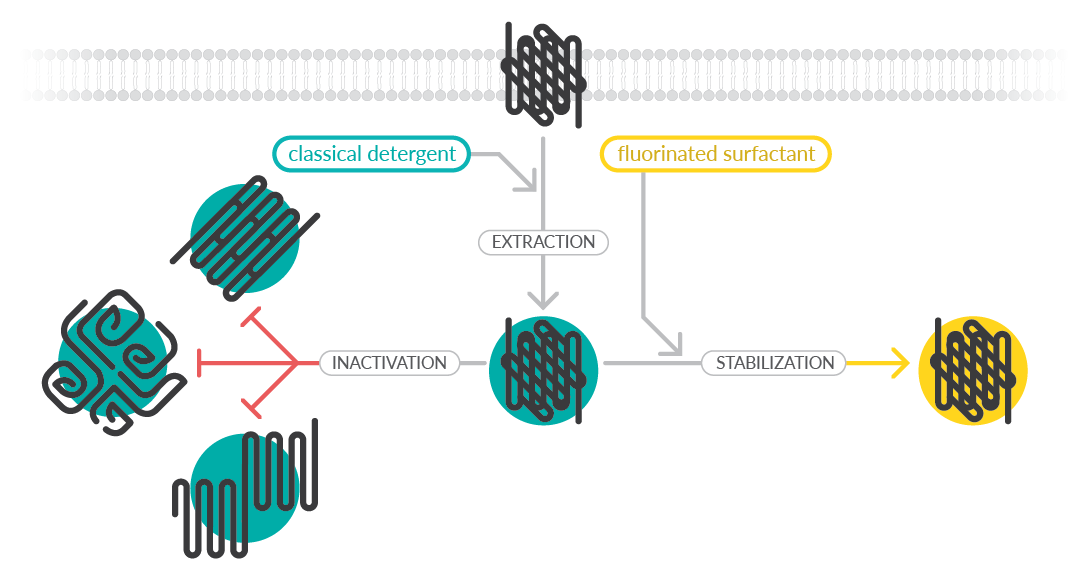
Figure 1. Fluorinated surfactants are substituted for harsher classical extraction detergents after the solubilization step to stabilize membrane proteins in a mild, solubilizing environment.
Fluorinated Surfactants
Fluorinated surfactants are useful for membrane protein stabilization in subsequent purification steps after extraction. They can substitute for conventional detergents to keep membrane proteins water soluble and less prone to aggregation (Figure 1). The structure of fluorinated surfactants resembles that of classical detergents except that their hydrophobic tails contain fluorine atoms, which supply more rigidity and bulk compared to fully hydrogenated alkyl chains. They are both hydrophobic and lipophobic and, thus, insert less easily into lipid membranes, making them inefficient at extracting proteins from lipid membranes. However, they are well-suited for stabilizing membrane proteins once extracted from membranes, since lipids and hydrophobic cofactors within the membrane extract should partition less favorably into fluorinated surfactant micelles. Furthermore, their bulky fluorinated tails cannot penetrate the protein interior to disrupt protein-protein interactions. Fluorinated surfactants typically yield a lower critical micelle concentration (CMC) compared to their hydrocarbon analogs. Because van der Waals interactions between fluorocarbons and hydrocarbons are notably weaker than those among hydrocarbons at the transmembrane surface of membrane proteins, native protein interactions remain preserved.
Additional hydrogenation at the end of the fluorinated tail through the insertion of an ethyl or propyl tip generates hemifluorinated surfactants. This added hydrogenation helps to improve interactions with the hydrogenated transmembrane surface of membrane proteins and may well aid in decreasing membrane protein aggregation. Because they do not disrupt lipids, hemifluorinated surfactants are useful for presenting solubilized proteins back into preformed membranes without needing to first solubilize the membrane to do so.
Poly(tris) and Lactobionamide Surfactants
The first nonionic surfactants developed with either hydrogenated or fluorinated hydrophobic chains had oligomeric polar heads derived from the common buffer component, tris(hydroxymethyl)aminomethane. However, due to the chemically polydisperse nature of this head group, concern rose over batch-to-batch variation. Replacing the poly(tris) oligomer with a monodisperse headgroup, such as a disaccharide moiety, helps to circumvent this issue. Lactose-derived lactobionamide surfactants bear a polar head group like that of the commonly used detergent, n-dodecyl-β-D-maltoside (DDM). Yet, with the addition of a fluorinated (or hemifluorinated) tail, these surfactants have been shown to surpass DDM in their capacity to stabilize fragile protein complexes.
bis-Glucose Surfactants
When comparing the behavior of fluorinated surfactants carrying headgroups of various glucose moieties, it was noted that molecules bearing a single glucose form long, cylindrical micelles. At least two sugars were needed for these surfactants to form small globular micelles for well-defined protein/surfactant complexes. bis-Glucose surfactants have a tetrahedral chiral carbon with two polar headgroups (each glucose moieties) and a long hydrophobic tail. In this way, they resemble neopentyl glycol detergents. They self-assemble into small, homogenous spherical micelles (5-6 nm) that are essential to stabilize membrane proteins.
Potential Applications
Transferring membrane proteins into the stable environment of fluorinated and hemifluorinated surfactants permits the use of certain applications that are otherwise intractable or inefficient in conventional detergents. They do not absorb light at wavelengths above ~245 nm so may be used for optical or fluorescence spectroscopy. They add minimal complexity to membrane protein solution studies such as size exclusion chromatography, analytical ultracentrifugation, and small-angle X-ray or neutron scattering. Because their affinity for the transmembrane surface of proteins is relatively low, they may permit 2D- and 3D-crystallization of membrane proteins. By reducing conformational flexibility, they may also improve distribution on cryo-electron microscopy (EM) grids and vitrification during cryo-EM sample preparation. Since they do not dissolve lipid membranes and are not cytolytic, these surfactants can be used to transfer membrane proteins to lipid vesicles, planar bilayers, or cells without lysing the target membrane or denaturing the protein. The surfactants will then wash away as they equilibrate between solution and membrane. Additionally, they should provide a mild and favorable environment for folding full-length membrane proteins from a denatured state to their native state and the expression of membrane proteins within a cell-free system. Cayman offers several nonconventional detergents that may facilitate success with these applications.
Poly(tris), Lactobionamide, and bis-Glucose Surfactants
| Item No. | Product Name | Polar Head Group + Hydrophobic Tail | CMC |
|---|---|---|---|
| 24778 | DDG | bis-glucose + hydrogenated thio decanoyl tail | 0.54 mM |
| 24780 | DLAC | lactobionamide + hydrogenated decanoyl tail | 1.3 mM |
| 24785 | DDLAC | lactobionamide + hydrogenated dodecanoyl tail | 0.25 mM |
| 24781 | FLAC6 | lactobionamide + fluorinated tail (6 fluorocarbons) | 0.56 mM |
| 24786 | FTAC6 | poly(tris) + fluorinated tail (6 fluorocarbons) | 0.37 mM |
| 24787 | FTAC8 | poly(tris) + fluorinated tail (8 fluorocarbons) | 0.02 mM |
| 24782 | ODG | bis-glucose + hydrogenated thio octanoyl tail | >10 mM |
View complete details on all protein purification tools available from Cayman
Suggested Reading
1. Park, K.-H., Berrier, C., Lebaupain, F., et al. Fluorinated and hemifluorinated surfactants as alternatives to detergents for membrane protein cell-free synthesis. Biochem. J. 403(1), 183-187 (2007).
2. Park, K.-H., Billon-Denis, E., Dahmane, T., et al. In the cauldron of cell-free synthesis of membrane proteins: Playing with new surfactants. N. Biotechnol. 28(3), 255-261 (2011).
3. Popot, J.-L. Amphipols, nanodiscs, and fluorinated surfactants: Three nonconventional approaches to studying membrane proteins in aqueous solutions. Annu. Rev. Biochem. 79(1), 737-775 (2010).
4. Talbot, J.-C., Dautant, A., Polidori, A., et al. Hydrogenated and fluorinated surfactants derived from Tris(hydroxymethyl)-acrylamidomethane allow the purification of a highly active yeast F1-F0 ATP-synthase with an enhanced stability. J. Bioenerg. Biomembr. 41(4), 349-360 (2009).
5. Lebaupain, F., Salvay, A.G., Olivier, B., et al. Lactobionamide surfactants with hydrogenated, perfluorinated or hemifluorinated tails: Physical-chemical and biochemical characterization. Langmuir. 22(21), 8881-8890 (2006).
6. Abla, M., Durand, G., and Pucci, B. Glucose-based surfactants with hydrogenated, fluorinated, or hemifluorinated tails: Synthesis and comparative physical-chemical characterization. J. Org. Chem. 73(21), 8142-8153 (2008).
7. Abla, M., Durand, G., Breyton, C., et al. A diglucosylated fluorinated surfactant to handle integral membrane proteins in aqueous solution. J. Fluorine Chem. 134, 63-71 (2012).
8. Abla, M., Unger, S., Keller, S. et al. Micellar and biochemical properties of a propyl-ended fluorinated surfactant designed for membrane-protein study. J. Colloid Interface Sci. 445, 127-136 (2015).
9. Breyton, C., Flayhan, A., Gabel, F., et al. Assessing the conformational changes of pb5, the receptor-binding protein of phage T5, upon binding to its Escherichia coli receptor FhuA. J. Biol. Chem. 288(42), 30763-30772 (2013).
10. Legrand, F., Breyton, C., Guillet, P., et al. Hybrid fluorinated and hydrogenated double-chain surfactants for handling membrane proteins. J. Org. Chem. 81(2), 681–688 (2016).
11. Boussambe, GNM., Guillet, P., et al. Fluorinated diglucose detergents for membrane-protein extraction. Methods. 147, 84-94 (2018). (PMID: 29857192)
Contact Info
Cayman Chemical1180 East Ellsworth RoadAnn Arbor, Michigan 48108 USAToll Free: (800) 364-9897(USA and Canada only)Fax: (734) 971-3640


