
News & Announcements
Branched Chain Lipid Metabolism as a Determinant of the N-Acyl Variation of Streptomyces Natural Products
Article from 2021-01-21
Neil P. J. Price, Michael A. Jackson, Trina M. Hartman, Gisela Brändén, Margareta Ek, Aaron A. Koch, and Paul D. Kennedy
A collaborative effort between scientists from the USDA and Cayman Chemical Company has unveiled the biosynthetic origins of a critical structural component of the tunicamycin family of antibiotic natural products.
Highlights
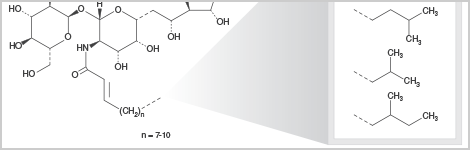
The tunicamycin family of natural products vary in their fatty acyl chain length and branching pattern, the identity of which directly affects their antibacterial properties by altering their ability to bind to the promising antibiotic target MraY, an enzyme essential for bacterial cell wall synthesis.
A combination of genomic studies, mass spectrometry, and deuterium labeling were used to identify the biosynthetic origin of the tunicamycin N-acyl chain as arising from intermediates in the branched-chain fatty acid metabolite pool.
These biosynthetic insights were then leveraged for the production of novel tunicamycin variants containing neo-branched N-acyl chains through precursor-directed biosynthesis.
Taken together, these findings advance our understanding of the biosynthesis of the natural product antibiotic tunicamycin and provide a possible route for the generation of tunicamycin analogs with improved properties, such as the reduced tunicamycins TunR1 and TunR2 which retain antibacterial activity but with reduced toxicity to eukaryotes.
Abstract
Branched-chain fatty acids (BCFA) are encountered in Gram-positive bacteria, but less so in other organisms. The bacterial BCFA in membranes are typically saturated, with both odd- and even-numbered carbon chain lengths, and with methyl branches at either the ω-1 (iso) or ω-2 (anteiso) positions. The acylation with BCFA also contributes to the structural diversity of microbial natural products and potentially modulates biological activity. For the tunicamycin (TUN) family of natural products, the toxicity toward eukaryotes is highly dependent upon N-acylation with trans-2,3-unsaturated BCFA. The loss of the 2,3-unsaturation gives modified TUN with reduced eukaryotic toxicity but crucially with retention of the synergistic enhancement of the β-lactam group of antibiotics. Here, we infer from genomics, mass spectrometry, and deuterium labeling that the trans-2,3-unsaturated TUN variants and the saturated cellular lipids found in TUN-producing Streptomyces are derived from the same pool of BCFA metabolites. Moreover, non-natural primers of BCFA metabolism are selectively incorporated into the cellular lipids of TUN-producing Streptomyces and concomitantly produce structurally novel neo-branched TUN N-acyl variants.
Read this paper
Available Tunicamycins from Cayman
Tunicamycin Mixture
Tunicamycin 14:1
Tunicamycin 15:1
Tunicamycin 16:1
Tunicamycin 17:1
TunR1
TunR2
Cayman's Natural Products laboratory is dedicated to microbial fermentation, plant extraction, chemical synthesis, and analytical chemistry. We are currently manufacturing many other naturally derived antibiotics for research use and have the expertise in house to work with researchers on scale up and/or modification of various classes of bioactive compounds. Our scientists put their knowledge to work to complete the difficult isolation or develop the most reasonable synthesis routes to help make your research possible.
Have a custom synthesis request?
Learn more about our Chemical Synthesis services
You May Also Be Interested In
 |  |
| Tunicamycin Analogs Advance Antibiotic Development | Meet the Experts: Natural Products Chemistry |
 | |
| Natural Products: Microbial Metabolites |
Contact Info
Cayman Chemical1180 East Ellsworth RoadAnn Arbor, Michigan 48108 USAToll Free: (800) 364-9897(USA and Canada only)Fax: (734) 971-3640


