
News & Announcements
Cannabinoid Receptor Wall Poster References
Cannabinoid Receptor Wall Poster References
Article from 2018-03-09
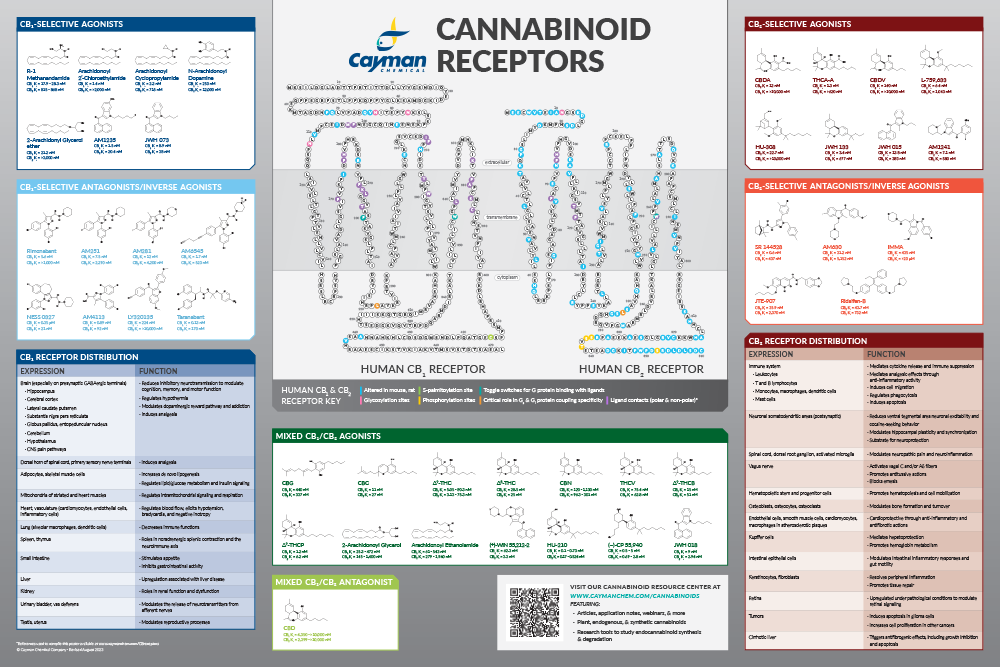
Download or Request a Lab Wall Poster
References Used to Compile Poster
CANNABINOID RECEPTOR STRUCTURE
* Comprehensive list of residues within distance ≤3.5 Å of bound ligands in CB1 crystal structures 5TGZ1, 5XR82, 5XRA2, CB1 cryo-EM structure 8GHV3, 7WV94, and CB2 cryo-EM structures 8GUQ3, 8GUT3, 6PT05.
1. Hua, T., Vemuri, K., Pu, M., et al. Crystal structure of the human cannabinoid receptor CB1. Cell167(3), 750-762 (2016).
2. Hua, T., Vemuri, K., Nikas, S.P., et al. Crystal structures of agonist-bound human cannabinoid receptor CB1. Nature 547(7664), 468-471 (2017).
3. Li, X., Chang, H., Bouma, J., et al. Structural basis of selective cannabinoid CB2 receptor activation. Nat. Commun. 14(1), 1447 (2023).
4. Yang, X., Wang, X., Xu, Z., et al. Molecular mechanism of allosteric modulation for the cannabinoid receptor CB1. Nat. Chem. Biol. 18(8), 831-840 (2022).
5. Xing, C., Zhuang, Y., Xu, T.-H., et al. Cryo-EM structure of the human cannabinoid receptor CB2-Gi signaling complex. Cell 180(4), 645-654 (2020).
BINDING AFFINITIES
Aung, M.M., Griffin, G., Huffman, J.W., et al. Influence of the N-1 alkyl chain length of cannabimimetic indoles upon CB1 and CB2 receptor binding. Drug Alcohol Depend. 60(2), 133-140 (2000).
Bertini, S., Chicca, A., Gado, F., et al. Novel analogs of PSNCBAM-1 as allosteric modulators of cannabinoid CB1 receptor. Bioorg. Med. Chem. 25(24), 6427-6434 (2017).
Bisogno, T., Melck, D., Bobrov, M.Y., et al. N-acyl-dopamines: Novel synthetic CB1 cannabinoid-receptor ligands and inhibitors of anandamide inactivation with cannabimimetic activity in vitro and in vivo. Biochem. J.351(Pt 3), 817-824 (2000).
Brents, L.K., Reichard, E.E., Zimmerman, S.M., et al. Phase I hydroxylated metabolites of the K2 synthetic cannabinoid JWH-018 retain in vitro and in vivo cannabinoid 1 receptor affinity and activity. PLoS One 6(7), e21917 (2011).
Citti, C., Linciano, P., Russo, F., et al. A novel phytocannabinoid isolated from Cannabis sativa L. with an in vivo cannabimimetic activity higher than Δ9-tetrahydrocannabinol: Δ9-Tetrahydrocannabiphorol. Sci. Rep.9(1), 20335 (2019).
Cluny, N.L., Vemuri, V.K., Chambers, A.P., et al. A novel peripherally restricted cannabinoid receptor antagonist, AM6545, reduces food intake and body weight, but does not cause malaise, in rodents. Br. J. Pharmacol. 161(3), 629-642 (2010).
Felder, C.C., Joyce, K.E., Briley, E.M., et al. Comparison of the pharmacology and signal transduction of the human cannabinoid CB1 and CB2 receptors. Mol. Pharmacol. 48(3), 443-450 (1995).
Fong, T.M., Guan, X.-M., Marsh, D. J., et al. Antiobesity efficacy of a novel cannabinoid-1 receptor inverse agonist, N-[(1S,2S)-3-(4-chlorophenyl)-2-(3-cyanophenyl)-1-methylpropyl]-2-methyl-2-{[5-(trifluoromethyl)pyridin-2-yl]oxy}propanamide (MK-0364), in rodents. J. Pharmacol. Exp. Ther.321(3), 1013-1022 (2007).
Franks, L.N., Ford, B.M., Fujiwara, T., et al. The tamoxifen derivative ridaifen-B is a high affinity selective CB2 receptor inverse agonist exhibiting anti-inflammatory and anti-osteoclastogenic effects. Toxicol. Appl. Pharmacol. 353, 31-42 (2018).
Frost, J.M., Dart, M.J., Tietje, K.R., et al. Indol-3-ylcycloalkyl ketones: Effects of N1 substituted indole side chain variations on CB2 cannabinoid receptor activity. J. Med. Chem. 53(1), 295-315 (2010).
Goutopoulos, A., Fan, P., Khanolkar, A.D., et al. Stereochemical selectivity of methanandamides for the CB1 and CB2 cannabinoid receptors and their metabolic stability. Bioorg. Med. Chem.9(7), 1673-1684 (2001).
Guindon, J. and Hohmann, A.G. Cannabinoid CB2 receptors: A therapeutic target for the treatment of inflammatory and neuropathic pain. Br. J. Pharmacol. 153(2), 319-334 (2008).
Guo, W.-z., Wang, Y., Umeda, E., et al. Search for novel anti-tumor agents from ridaifens using JFCR39, a panel of human cancer cell lines. Biol. Pharm. Bull. 36(6), 1008-1016 (2013).
Hanuš, L., Abu-Lafi, S., Fride, E., et al. 2-Arachidonyl glyceryl ether, an endogenous agonist of the cannabinoid CB1 receptor. Proc. Natl. Acad. Sci. USA 98(7), 3662-3665 (2001).
Hanuš, L., Breuer, A., Tchilibon, S., et al. HU-308: A specific agonist for CB2, a peripheral cannabinoid receptor. Proc. Natl. Acad. Sci. USA 96(25), 14228-14233 (1999).
Hollinshead, S.P., Tidwell, M.W., Palmer, J., et al. Selective cannabinoid receptor type 2 (CB2) agonists: Optimization of a series of purines leading to the identification of a clinical candidate for the treatment of osteoarthritic pain. J. Med. Chem. 56(14), 5722-5733 (2013).
Iwamura, H., Suzuki, H., Ueda, Y., et al. In vitro and in vivo pharmacological characterization of JTE-907, a novel selection ligand for cannabinoid CB2 receptor. J. Pharmacol. Exp. Ther.296(2), 420-425 (2001).
Lan, R., Liu, Q., Fan, P., et al. Structure-activity relationships of pyrazole derivatives as cannabinoid receptor antagonists. J. Med. Chem. 42(4), 769-776 (1999).
Lan, R., Gatley, J., Lu, Q., et al. Design and synthesis of the CB1 selective cannabinoid antagonist AM281: A potential human SPECT ligand. AAPS PharmSci. 1(2), E4 (1999).
Makriyannis, A. and Deng, H. Cannabimimetic indole derivatives. Univ. of Connecticut WO01/28557A1, (2001).
Malan, P.T., Jr., Ibrahim, M.M., Deng, H., et al. CB2 cannabinoid receptor-mediated peripheral antinociception. Pain 93(3), 239-245 (2001).
Pertwee, R.G. Pharmacology of cannabinoid receptor ligands. Curr. Med. Chem. 6(8), 635-664 (1999).
Pertwee, R.G. The diverse CB1 and CB2 receptor pharmacology of three plant cannabinoids: Δ9-Tetrahydrocannabinol, cannabidiol and Δ9-tetrahydrocannabivarin. Br. J. Pharmacol. 153(2), 199-215 (2008).
Rinaldi-Carmona, M., Barth, F., Héaulme, M., et al. SR141716A, a potent and selective antagonist of the brain cannabinoid receptor. FEBS Lett. 350(2-3), 240-244 (1994).
Rosenthaler, S., Pöhn, B., Kolmanz, C., et al. Differences in receptor binding affinity of several phytocannabinoids do not explain their effects on neural cell cultures. Neurotoxicol. Teratol. 46, 49-56 (2014).
Ross, R.A., Brockie, H.C., Stevenson, L.A., et al. Agonist-inverse agonist characterization at CB1 and CB2 cannabinoid receptors of L759633, L759656 and AM630. Br. J. Pharmacol. 126(3), 665-672 (1999).
Seely, K.A., Brents, L.K., Radominska-Pandya, A., et al. A major glucuronidated metabolite of JWH-018 is a neutral antagonist at CB1 receptors. Chem. Res. Toxicol. 25(4), 825-827 (2012).
van Rees, B.P., Sivula, A., Thorén, S., et al. Expression of microsomal prostaglandin E synthase-1 in intestinal type gastric adenocarcinoma and in gastric cancer cell lines. Int. J. Cancer 107(4), 551-556 (2003).
Yao, B.B., Mukherjee, S., Fan, Y., et al. In vitro pharmacological characterization of AM1241: A protean agonist at the cannabinoid CB2 receptor? Br. J. Pharmacol. 149(2), 145-154 (2006).
Zagzoog, A., Mohamed, K.A., Kim, H.J.J., et al. In vitro and in vivo pharmacological activity of minor cannabinoids isolated from Cannabis sativa. Sci. Rep.10(1), 20405 (2020).
Zhang, Q., Ma, P., Cole, R.B., et al. In vitro metabolism of indomethacin morpholinylamide (BML-190), an inverse agonist for the peripheral cannabinoid receptor (CB2) in rat liver microsomes. Eur. J. Pharm. Sci.41(1), 163-172 (2010).
 |
Contact Info
Cayman Chemical1180 East Ellsworth RoadAnn Arbor, Michigan 48108 USAToll Free: (800) 364-9897(USA and Canada only)Fax: (734) 971-3640


