
News & Announcements
The HDAC6-Hsp90 Connection
The HDAC6-Hsp90 Connection
Article from 2017-12-07
Histone deacetylases (HDACs) influence gene expression and protein function through the removal of acetyl groups attached to lysine residues. While most HDACs are primarily located in the nucleus where they interact with histones, some are found in the cytoplasm in association with non-histone proteins. One unique member of the HDAC family is HDAC6, an entirely cytoplasmic lysine deacetylase that contains a ubiquitin-binding domain. This domain enables HDAC to escort polyubiquitinated proteins to autophagosomes, coordinating a cell-protective response to clear away cytotoxic misfolded proteins through autophagic degradation. The interaction of HDAC6 with ubiquitinated protein aggregates has been shown to induce the expression of heat shock proteins (Hsps) by triggering the dissociation of a repressive HDAC6/heat shock factor 1(Hsf1)/Hsp90 complex and subsequent activation of Hsf1, a transcription factor essential in the activation of the heat shock protein-encoding genes.1
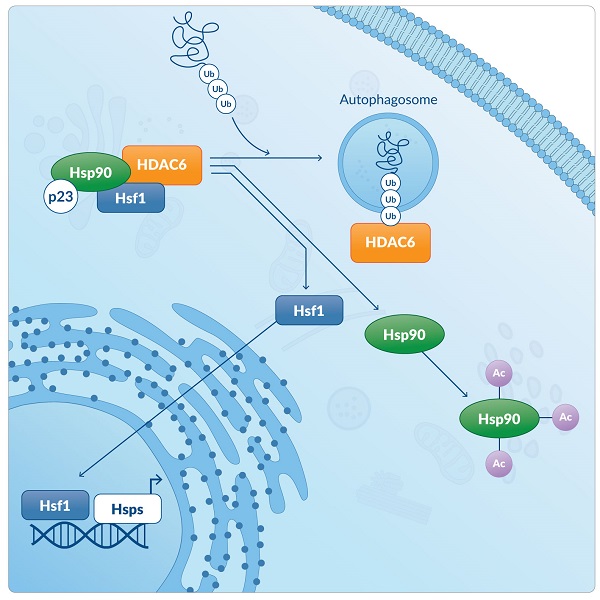
Figure 1. In the presence of HDAC6, Hsp90 binds multiple client proteins, including Hsf1. When HDAC6 is bound to ubiquitinated proteins, Hsp90 and client proteins are released. HDAC6 escorts the misfolded protein to an autophagosome, Hsp90 acetylation (Ac) is enhanced, and Hsf1 undergoes nuclear translocation to induce the expression of other heat shock proteins to serve as chaperones for client proteins.
HDAC6 has also been shown to deacetylate Hsp90 and modulate its chaperone activity. Lys294 on Hsp90 has been identified as at least one functionally important post-translational modification site critical for both co-chaperone and client protein binding.2 Inactivation of HDAC6 causes Hsp90 acetylation and subsequent dissociation from its co-chaperone p23.3 As such, small molecule inhibitors of HDAC6 can promote loss of chaperone Hsp90 activity, which either enhances the proteasomal degradation of its client proteins or disrupts the maturation of the client protein in some other manner.4 A clear relationship has not yet been established between Hsp90 deacetylation and Hsf1 activation of the heat shock response.
It has been speculated that Hsp90 services up to 10% of all cytosolic proteins at some stage in their life cycle.5 This includes cancer-relevant and neurodegeneration-related proteins. Interestingly, HDAC6 itself is a client protein of Hsp90 in leukemic cells.6 Because of its central role in many cellular processes, including disease progression, great interest lies in developing inhibitors of Hsp90 function. Using small molecules to target Hsp90 directly and/or to target its deacetylation via HDAC6 offers two distinct approaches to help define the biological functions of the HDAC6-Hsp90 interaction and potentially intervene in the progression of a broad range of diseases. Cayman offers a collection of potent HDAC6-selective inhibitors as well as Hsp90-specific inhibitors to help in this critical area of research. Our HDAC Fluorometric Activity Assay Kit and HDAC Cell-Based Activity Assay Kit can be used to quantify inhibitor/activator effects on class I and II HDAC activity from various sources. HDAC6 (human recombinant), HDAC6 Polyclonal Antibody, Hsp90α (human recombinant), and Hsp90β (human recombinant) are also available.
View a complete list of Cayman’s Heat Shock Protein research tools.
Download the Heat Shock Protein Research Tools Brochure.
References
1. Boyault, C., Zhang, Y., Fritah, S., et al. Genes Dev.21(17), 2172–2181 (2007)
2. Scroggins, B.T., Robzyk, K., Wang, D., et al. Mol. Cell25(1), 151–159 (2007).
3. Kovacs, J.J., Murphy, P.J., Gaillard, S., et al. Mol. Cell 18(5), 601–607 (2005).
4. Fiskus, W., Ren, Y., Mohapatra, A., et al. Clin. Cancer Res.13(16), 4882–4890 (2007).
5. Echeverría, P.C., Bernthaler, A. Dupuis, P., et al. PLoS ONE6(10), e26044 (2011).
6. Krämer, O.H., Mahboobi, S., and Sellmer, A. Trends Pharmacol. Sci.35(10), 501-509 (2014).
Contact Info
Cayman Chemical1180 East Ellsworth RoadAnn Arbor, Michigan 48108 USAToll Free: (800) 364-9897(USA and Canada only)Fax: (734) 971-3640


