
News & Announcements
International Regulation and Control of Hemp and Cannabinoids
International Regulation and Control of Hemp and Cannabinoids
Article from 2020-10-29
By Keith Williams, Ph.D. and Sebastian Buchert - Analytical Standards Business Development Managers, Cayman Chemical
For a plant that has been used for millennia, controls on the supply of psychoactive and non-psychoactive components extracted from Cannabis are relatively recent, with international regulations starting at the beginning of the 20th century with the Harrison Narcotics Tax Act (1914) and International Opium Conventions (1912 and 1925). Dr. Keith Williams and Sebastian Buchert, Analytical Standards Business Development Managers at Cayman, describe the current regulatory landscape with a focus on how it pertains to the manufacture and distribution of analytical reference standards for phytocannabinoids.
The earliest recorded attempt to control Cannabis was 1378, when Soudoun Sheikouni, the Emir of the Joneima in Arabia, prohibited Cannabis use.1 He instructed that all Cannabis plants in the region be destroyed, and users were punished by having their teeth extracted. In the following centuries, controls were introduced by several individual countries with little international coordination until the International Opium Convention in 1912, which was not globally enacted until 1919 as part of the Treaty of Versailles.2 The current formal controls that now apply originate from the United Nations 1961 Single Convention on Narcotic Drugs.3 Cannabis and its resin were placed under Schedules I and IV, with Δ9-THC (and selected stereoisomers) being controlled via Schedule I of the United Nations 1971 Convention on Psychotropic Substances. This is the primary legislation that is in force globally. However in 2019, the World Health Organisation (WHO) recommended amending the entry for Cannabis and Cannabis resin to exclude preparations of cannabidiol that are not more than 0.2% Δ9-THC.4
| THC Isomers Controlled by the International Narcotics Control Board | ||
|---|---|---|
| THC | THC Isomers | Stereochemical Variants |
| Δ9-THC | Δ6a,10a-THC | 7,8,9,10-tetrahydro-6,6,9-trimethyl-3-pentyl-6H-dibenzo[b,d]pyran-1-ol |
| Δ6a,7-THC | (9R,10aR)-8,9,10,10a-tetrahydro-6,6,9-trimethyl-3-pentyl-6H-dibenzo[b,d]pyran-1-ol | |
| Δ7-THC | (6aR,9R,10aR)-6a,9,10,10a-tetrahydro-6,6,9-trimethyl-3-pentyl-6H-dibenzo[b,d]pyran-1-ol | |
| Δ8-THC | (6aR,10aR)-6a,7,10,10a-tetrahydro-6,6,9-trimethyl-3-pentyl-6H-dibenzo[b,d]pyran-1-ol | |
| Δ10-THC | 6a,7,8,9-tetrahydro-6,6,9-trimethyl-3-pentyl-6H-dibenzo[b,d]pyran-1-ol | |
| Δ9,11-THC | (6aR,10aR)-6a,7,8,9,10,10a-hexahydro-6,6-dimethyl-9-methylene-3-pentyl-6H-dibenzo[b,d]pyran-1-ol | |
As with many natural products, there are challenges to designing and enforcing robust legislation to meet specific local needs. Any such legislation needs to take into consideration the plant material, extracts, and oils, as well as the individual active and inactive compounds from Cannabis. International and country-specific drug law is also covered by multiple authorities, which can result in conflict. Examples of such conflicts include federal versus state legislation in the US, and to a degree, the comparable situation in Europe with the European Union (EU) versus individual countries.
Regulations in this area are evolving rapidly and constantly changing, often focusing on the differentiation of the plant as a determining factor of regulation. In 2018, the acceptance of the Agriculture Improvement Act in the US, often referred to as the Farm Bill, removed hemp and hemp seeds from the statutory definition of marijuana so it is no longer a Schedule I controlled substance regulated by the DEA.5 For this purpose, hemp is defined as any part of the plant containing not more than 0.3% Δ9-THC on a dry weight basis. These changes are enabling US growers to broadly cultivate hemp and alleviating restrictions on the sale, transport, and possession of hemp-derived products, albeit through state-approved licensing.
| Definition of Industrial Hemp (dry weight plant) | |
|---|---|
| Country | Maximum THC Content |
| EU and UK | 0.2% |
| US | 0.3% |
| Canada | 0.3% |
| China | 0.3% |
| South Africa | 0.3% |
| New Zealand | 0.35% |
| Switzerland | 1% |
| Thailand | 1% |
The removal of control status of the plant-derived materials also affects material derived synthetically, but this can be unclear and require additional clarification. Recent and proposed changes include the EU considering declaring cannabidiol (CBD) a narcotic. The United Kingdom’s Food Standards Agency has stated that CBD will not be classified as such, but more likely as a novel food stuff.6 In the US, synthetically derived tetrahydrocannabinols are still scheduled under the DEA Drug Code Number 7370.7
This complexity increases when products are being traded internationally. Different legislative limits can result in a product being legal in one country but controlled in a second. For example, the synthetic material produced in the US outlined above may contravene EU legislation, and although the material could be exported from the US without any regulatory requirements, it is imperative to address the local competent authority to ensure that all appropriate importing regulations and requirements are met.
| Control of CBD Processed Products | ||
|---|---|---|
| Country | Acceptable THC Content | Notes |
| US | 0.3% | Phytocannabinoids found in hemp with ≤0.3% Δ9-THC on a dry weight basis are excluded from DEA regulatory controls |
| EU and UK | 0% | Any detectable THC is likely to render the product a controlled item |
| Japan | 0% | Any detectable THC is likely to render the product a controlled item |
Due to the international regulatory differences, accurate assessment of key components in raw material and the finished product is essential to ensure compliance. Cayman’s Certified Reference Material mixtures and single-component solutions, in combination with robust analytical methodology, allow quantitative analysis of phytocannabinoid compounds to support the international trade in hemp and Cannabis-based products.8
Read More in the Cayman Currents Issue Phytocannabinoids: What Is on the Horizon? |
You May Also Be Interested In
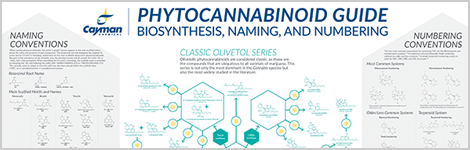
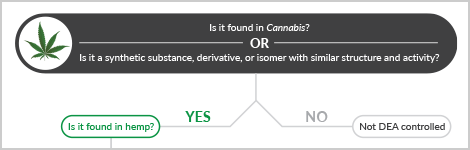
| Phytocannabinoid Guide: Biosynthesis, Naming, and Numbering Request the Lab Wall Poster | Deregulation of Hemp Changes the Status of CBD and Other Cannabinoids |
 |  |
References
1. Lewin, L. Indian hemp cannabis indica. Phantastica: A classic survey on the use and abuse of mind-altering plants. Park Street Press (1998).
2. Chapter VI. Narcotic Drugs and Psychotropic Substances (1912). From: International Opium Convention. Available from: https://treaties.un.org/doc/Treaties/1922/01/19220123%2006-31%20AM/Ch_VI_2p.pdf
3. Single Convention on Narcotic Drugs (1961). In: United Nations Office on Drug and Crime [Internet]. Available from: https://www.unodc.org/pdf/convention_1961_en.pdf
4. WHO scheduling recommendations on cannabis and cannabis-related substances (2020). In: United Nations Office on Drug and Crime [Internet]. Available from: https://www.unodc.org/unodc/en/commissions/CND/Mandate_Functions/current-scheduling-recommendations.html
5. Federal Register 85(163), 2020 Rules and Regulations In: govinfo.org [Internet]. Available from: https://www.govinfo.gov/content/pkg/FR-2020-08-21/pdf/2020-17356.pdf
6. UK cannabinoid industry spots opportunity as EC considers reclassifying CBD a narcotic (2020). In: Foodnavigator.com [Internet]. Available from: https://www.foodnavigator.com/Article/2020/07/15/UK-cannabinoid-industry-spots-opportunity-as-EC-considers-reclassifying-CBD-a-narcotic
7. Orange Book Controlled Substances (2020). In: USDOJ.gov [Internet]. Available from: https://www.deadiversion.usdoj.gov/schedules/orangebook/d_cs_drugcode.pdf
8. Miller, M.G., Goodwin, S.K., and Franckowski, R.E. CRM mixtures improve quantitation accuracy. Application Note, Cayman Chemical (2019).
Contact Info
Cayman Chemical1180 East Ellsworth RoadAnn Arbor, Michigan 48108 USAToll Free: (800) 364-9897(USA and Canada only)Fax: (734) 971-3640


