
News & Announcements
Lipidomics
Article from 2019-05-09
With Cayman Contract Services, your lipidomics study is in the hands of scientists who have several decades of collective experience in lipid synthesis, purification, and characterization. Cayman’s lipid analysis laboratories are equipped with state-of-the-art chromatography/mass spectrometry systems and data analysis software, enabling us to offer targeted and untargeted lipidomics services to meet your specific project needs.
Results You Can Trust
- Expert consultation on best practices for sample collection, pre-shipment processing, and storage to preserve sample integrity
- Optimized sample extraction protocols guided by accepted literature methods (liquid-liquid extraction, solid-phase extraction, targeted immunoaffinity capture)
- Rigorously validated MaxSpec® internal standards that control for variability in recovery of analytes and enable accurate quantitation
- Profile analysis or absolute quantitation of customizable analyte sets
- Timely updates, interactive real-time data review, and comprehensive reporting with strict confidentiality
Discovery Lipidomics (Untargeted Profiling)
Through untargeted approaches we analyze hundreds to thousands of lipid species from biological samples to create a detailed lipid profile. After using general liquid-liquid methods for extraction of most lipids within a sample, they are separated chromatographically using HPLC or UPLC in order to simultaneously detect individual molecular species and identify changes in these lipids between samples. Detection and identification of lipid species is achieved using high-resolution mass spectrometry (HRMS) and tandem mass spectrometry (MS/MS).
Identification and relative quantitation of candidate lipid species is facilitated by the use of data-processing software and publicly available databases. When molecular identification is provided based on the LC-MS/MS data available, Cayman adheres to the recommendations issued by the Lipid Maps® consortium and the Lipidomics Standards Initiative. Data is reported as tables of mass-to-charge ratios (m/z), with ion intensity peak areas normalized to internal standards, and they can be visualized using powerful plotting and graphing tools. Statistical analysis can also be applied to sort out significant changes within complex lipid profiles.
This 2D feature plot (m/z versus retention time) generated using the Lipostar lipidomics software package represents positively identified molecular species, corresponding to different lipid classes, in adipose tissue. The color of each dot indicates the lipid class (see legend at top left corner), and its size correlates with its relative concentration in the sample.
UNTARGETED ANALYSIS
Identify profile changes across all major lipid classes or within a single lipid class.
- Fatty Acyls
- Glycerolipids
- Glycerophospholipids
- Sphingolipids
- Sterol Lipids
Targeted Lipidomics and Absolute Quantitation
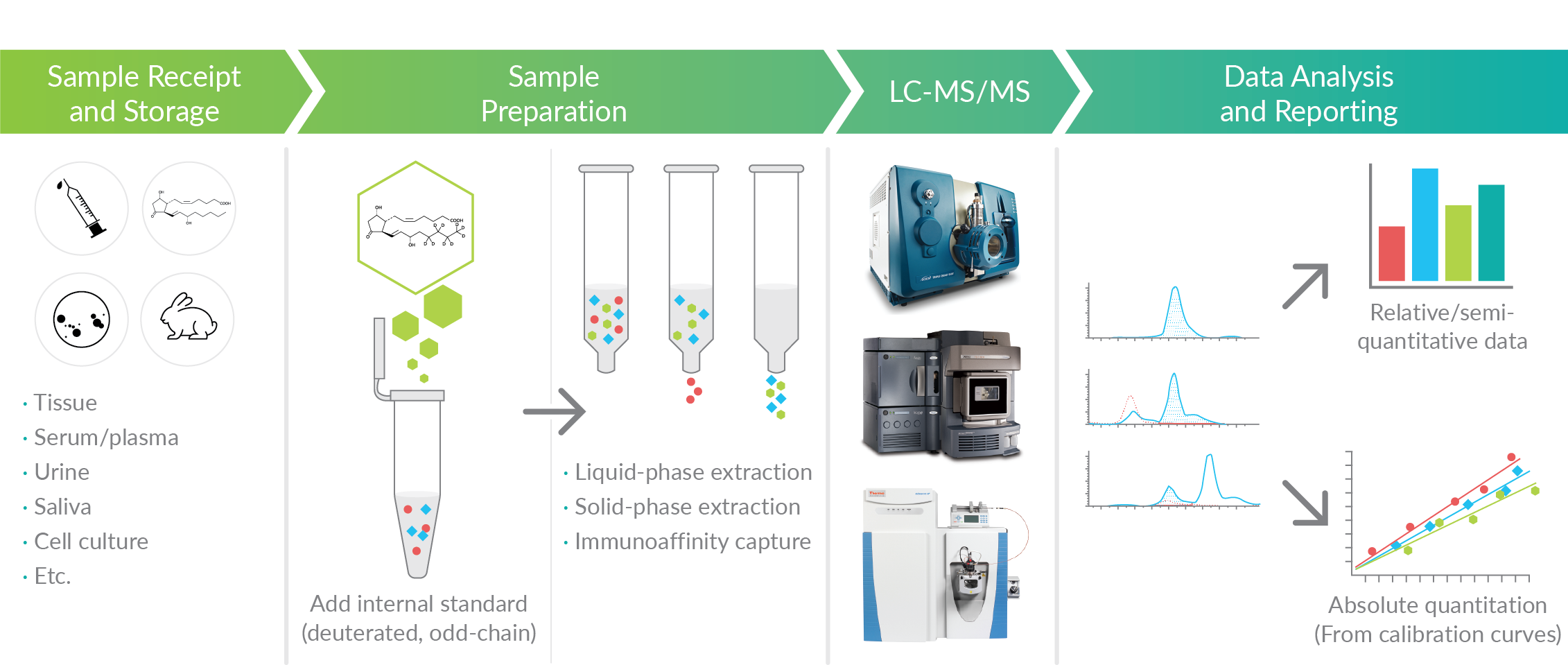
Targeted lipidomics enables the focused analysis of a known collection of lipids. Precise method development allows for the inclusion of equal amounts of isotope-labeled or odd-chain internal standards selected from customizable lipid panels. Lipids from each sample are extracted using standardized protocols and analyzed by LC-MS/MS using analyte-specific collision-induced mass transitions from the molecular ion (or, in some cases, from a known adduct) to a characteristic fragment ion. Analyte concentrations are determined from calibration curves prepared from authentic standards, when available, or surrogate standards when necessary. This approach is especially useful for quantifying lipids present at low levels in samples, such as endogenous bioactive lipids (e.g., prostaglandins, leukotrienes, or endocannabinoids). Standard statistical analysis tools can reveal changing trends in lipid species among experimental groups, which can be visualized with a heat map or other available graphical tools.
Heat map generated from relative quantitation by LC-MS/MS of oxylipins in the spleens of mice.
Visualization tools like this one help find changing trends within complex sets of data.
TARGETED LIPID PANELS
Maximize data from precious samples with established targeted lipid panels offering the sensitivity, efficiency, and specificity needed to identify and quantify biologically relevant lipids.
- Eicosanoids and Oxylipins
- Eicosanoids derived from arachidonic acid
- Oxidized mediators derived from linoleic acid, eicosapentaenoic acid, and docosahexaenoic acid
- Sphingolipids
- Sphingoid bases, ceramides, monohexosylceramides, dihexosylceramides, and sphingomyelins
- Endocannabinoids and Endocannabinoid-like Lipids
- N-acylethanolamides, acylglycerols, N-acyltaurines, N-acylglycines, N-acylserines, N-acyldopamines
- Urinary Lipid Metabolites
- Indicative of the production, metabolism, and excretion of eicosanoids and other bioactive lipids
- Cholesterol Esters
- Cholesterol esterified with saturated or unsaturated acyl chains
- Short-Chain Fatty Acids
- Fatty acids with up to six carbons, many of which are produced by gut microbiota
- Phospholipids
- Specific acyl chains (e.g., 20:4) or oxidized acyl chains (e.g., 20:4-OH, 20:4-OOH)
About Sample Preparation and Standards
INTERNAL STANDARDS
An adequate mix of internal standards (usually heavy isotope-labeled lipids, sometimes odd-chain lipids) is added as soon as the extraction begins, to control for variability in the recovery of analytes during extraction. Using the ratio of each analyte to its internal standard minimizes possible differences between extraction efficiencies across samples. Internal standards are also essential to build isotope-dilution calibration curves, allowing for absolute quantitation of analytes.
SAMPLE EXTRACTION
Total lipids are usually extracted from any sample type using mixtures of chloroform, methanol, and water (classic protocols originally published by Folch and by Bligh and Dyer).1,2 Alternatively, a simple methyl tert-butyl ether-based extraction for high-throughput lipid extraction can be used.3 Solid-phase extraction (SPE) using reversed-phase cartridges will separate analytes based on hydrophobicity, resulting in substantial enrichment in free fatty acids.
Interference from unknown molecules or contaminants can be circumvented with immunoaffinity extraction (IAE) using agarose beads bound to antibodies targeted to recognize your analyte of interest. This approach allows the analysis of only those lipids recognized by available immobilized antibodies. It is also possible to obtain a fuller profile from a challenging matrix by performing IAE and then using its flow-through fluid to perform SPE to analyze compounds not retained by the antibodies used. The use of internal standards minimizes the problem of diminishing recoveries when this double extraction protocol is used.
IAE selectively extracts LTC4 (RT, 2.52 min), removing an unwanted isobaric coeluting interference (RT, 2.40 min), which is not removed during SPE extraction.
References
1. Folch, J., Lees, M., and Sloane Stanley, G.H. A simple method for the isolation and purification of total lipids from animal tissues. J. Biol. Chem.226(1), 497-509 (1957).
2. Bligh, E.G. and Dyer, W.J. A rapid method of total lipid extraction and purification. Can. J. Biochem. Physiol.37(8), 911-917 (1959).
3. Matyash, V., Liebisch, G., Kurzchalia, T.V. et al. Lipid extraction by methyl-tert-butyl ether for high-throughput lipidomics. J. Lipid Res. 49(5), 1137-1146 (2008).
Learn More
Meet our scientists: Meet the Expert: Lipidomic Profiling Services
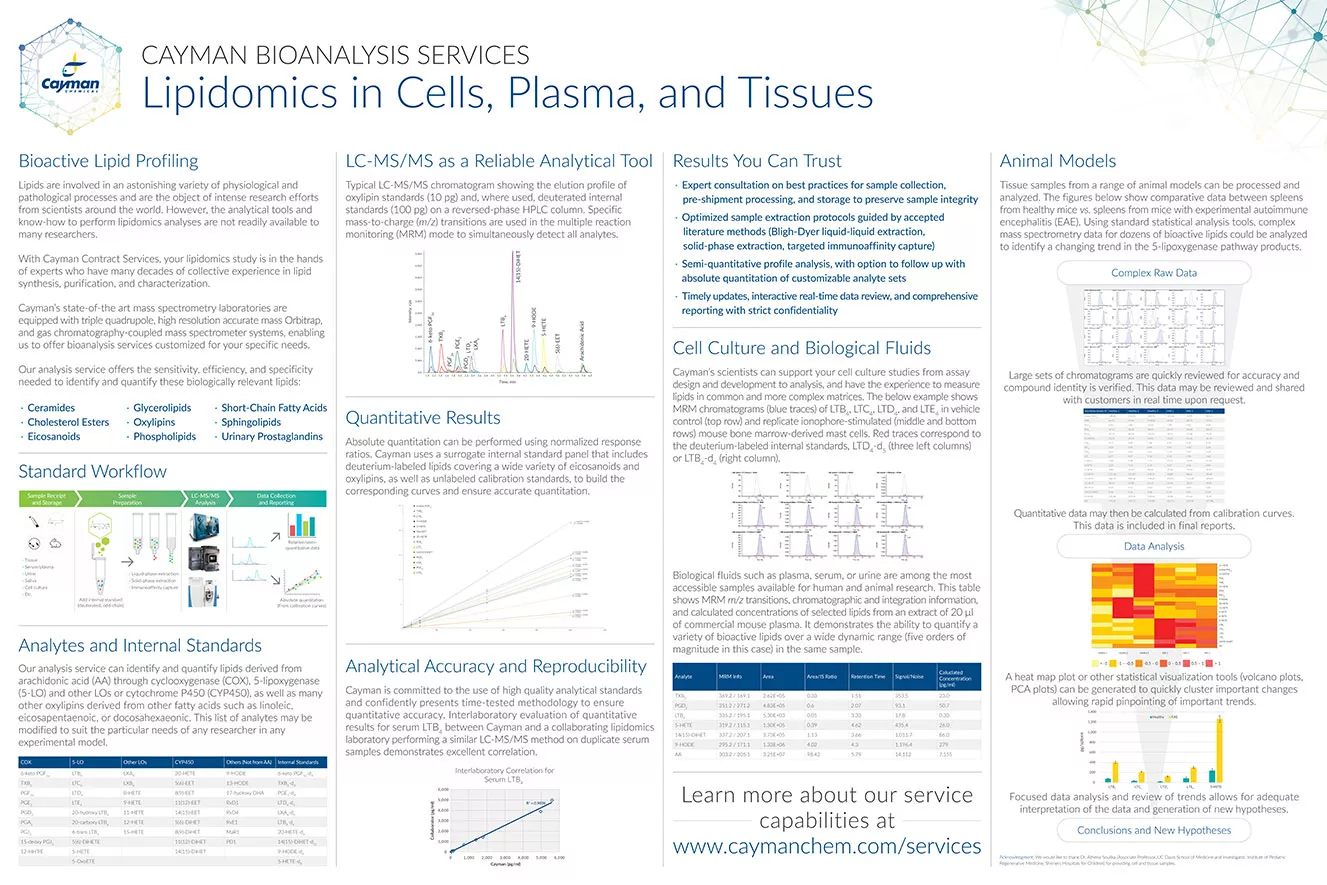
View our Poster: Lipidomics in Cells, Plasma, and Tissues
Browse our IAE Tutorial: Immunoaffinity Extraction and Bioactive Lipid Profiling
Read Recent Co-Authored Publications:
CD8+ T cells regulate tumor ferroptosis during cancer immunotherapy
Revising the structure of a new eicosanoid from human platelets to 8,9-11,12-diepoxy-13-hydroxy-eicosadienoic acid
Need Custom Lipid Synthesis?
Our growing team of more than 70 skilled and experienced chemists has broad synthetic proficiencies that include lipids, their bioconjugates and stable isotope derivatives. We specialize in multi-step organic synthesis, purification, and characterization of complex fatty acid metabolites, glycerophospholipids, sphingolipids, and sterols.
Ask Us About a Pilot Study
Tell us about your study
- Untargeted or Targeted?
- If targeted, which panel do you need?
- Sample type?
- Sample number?
- Anticipated start date?
- Confidential Disclosure Agreement or Master Service Agreement required?
Email us at contractresearch@caymanchem.com
Call us at (888) 526-5351
Contact Info
Cayman Chemical1180 East Ellsworth RoadAnn Arbor, Michigan 48108 USAToll Free: (800) 364-9897(USA and Canada only)Fax: (734) 971-3640


