
News & Announcements
Making a Splash: Nitazenes and Orphines, the Latest Wave of Opioid NPS Webinar Highlights
Article from 2025-07-15
Nitazenes and orphines are two classes of synthetic opioids that are proliferating in illicit drug markets. Danielle St. Germaine, a synthetic organic chemist in the Forensic Chemistry Division at Cayman Chemical, discussed the history, pharmacology, naming, and fragmentation of nitazenes and provided a brief glimpse of orphines in this recent webinar. We have summarized the key insights from the webinar here.
| |
Nitazenes
Nitazene History
Nitazenes are the informal name for a class of opioids known as the 2-benzyl benzimidazoles. A class-wide ban on fentanyl analogs in 2018 prompted the pursuit of new analogs that would circumvent regulatory control measures. Since then, the market has proliferated with nitazene analogs.
Nitazenes were originally developed in the 1950s at the Swiss company CIBA as potential opioid analgesics. Derived from benzimidazole, many nitazene analogs were found to be potent analgesics. Despite sharing little structural similarity with morphine, some nitazenes, such as etonitazene, were found to be magnitudes of order more potent than morphine.
Structure
The nitazene core is comprised of a benzimidazole functional group, where the 1-position is the nitrogen that can be substituted with ethylamino groups, and the 2-position being the carbon located between the two nitrogens that can be substituted with the benzyl substituent.
The opioid activity of nitazenes depends on its substituents. The nitazene scaffold has three major sites for modification: the ethylamino, the benzyl, and the benzimidazole core.
Structure-Activity Relationships
Modeling studies suggest the ethylamino substituent mimics the piperidine ring in morphine, and the benzimidazole core aligns with the benzofuranyl ring system. These studies also suggest that para-alkoxy substituents on the benzyl ring increase the rigidity of the compound, enhancing its specificity for the μ-opioid receptor, which mediates the perceived euphoria and respiratory depression associated with opioids.
Indeed, the potency of etonitazene is attributed to the two ethyl substituents on the ethylamino group and an ethoxy substituent at the para position of the benzyl group.
Nitazene Presence in Illicit Markets
Nitazenes have been sold on direct-to-consumer websites, either as correctly identified substances or as mislabeled compounds, and detected in counterfeit tablets as well as identified as co-drugs in fentanyl-, heroin-, and cocaine-containing samples.
Pharmacology of Nitazenes & Metabolites
We collaborated with the Stove group at Ghent University to study the pharmacological profile of circulating nitazenes and their presumed metabolites using cell-based assays to determine μ-opioid receptor activation. All 12 nitazenes assayed were more potent than morphine, and five were more potent than fentanyl, indicating the high potency and risk of overdose associated with nitazenes. Amongst the most potent nitazenes were etonitazene and its metabolite N-desethyl etonitazene and isotonitazene and its metabolite N-desethyl isotonitazene.
| | |||
Etonitazene | N-desethyl etonitazene | Isotonitazene | N-desethyl Isotonitazene |
Isotonitazene, containing an isopropoxy group at the para position on the benzyl substituent, is 10-times more potent than fentanyl at the μ-opioid receptor. Intriguingly, its metabolite, N-desethyl isotonitazene, was not only active at the μ-opioid receptor but was more potent than the parent compound isotonitazene in these assays.
The McCorvy research group studied the effects of N-desethyl isotonitazene in mice and found that it extended the length of respiratory depression and recovery time compared with fentanyl. It was also more potent, completely halting respiration at 4 μg/kg compared to 11 μg/kg for fentanyl. Mice that were given N-desethyl isotonitazene required nearly 300 minutes to fully recover respiration after naloxone administration, compared to 30 minutes for fentanyl.
Nitazene Nomenclature
One of the challenges with new emerging scaffolds is establishing simple and easy-to-use naming conventions. With nitazenes, there are no strict, definitive rules. Instead, new and emerging analogs are named based on observed trends.
The term nitazene typically indicates the presence of a 5-nitro benzimidazole core, two ethyl substituents on the ethylamino group, and a benzyl group at the 2-position of the benzimidazole.
Benzylic Group Substitutions
When there is a substituent on the benzylic group, the substituent abbreviation precedes the nitazene suffix. These substituents are typically found at the para position, as it increases specificity for the μ-opioid receptor.
Alkoxy Substituents
Alkoxy groups have a shorthand for each chain: meto- for methoxy, eto- for ethoxy, proto- for propoxy, isoto- for isopropoxy, and so forth.
Substituent | Methoxy -OCH3 | Ethoxy -OCH2CH3 | Propoxy -OCH2CH2CH3 |
Compound Name | Metonitazene | Etonitazene | Protonitazene |
Alkyl Substituents
Occasionally, nitazene names are already commonplace on direct-to-consumer sites and web forums, and those names are adopted. An example is menitazene, where the methyl group was abbreviated to Me.
When propyl nitazene emerged, consideration was taken for the prefix pro-, which is also a common abbreviation or propoxy. The proposed name pronitazene could be mistaken for the presence of a propoxy group, instead of a propyl group. This compound though has already been assigned the name protonitazene. To avoid this ambiguity, it was decided to use the full name of alkyl chains moving forward to clearly differentiate alkyl nitazenes from alkoxy nitazenes. Hence, this compound was assigned the name propylnitazene.
| Substituent | Methyl | Propyl |
| Compound Name | Menitazene | Propylnitazene |
Benzimidazole Group Modifications
If the nitro group on the benzimidazole is eliminated, des (meaning "without") precedes the suffix nitazene to indicate the nitro group is absent.
If the nitro group is substituted for a different functional group, the location and substituent abbreviation precedes the des-modified nitazene suffix as in 5-methyl etodesnitazene.
Substituent | Propoxy | 5-methyl |
| Compound Name | Protodesnitazene | 5-methyl Etodesnitazene |
Ethylamino Group Modifications
Modifications to the ethylamino group adopt rules derived from tryptamine nomenclature.
When one of the ethyl chains is removed from the ethylamino group, N-desethyl precedes the suffix nitazene. The use of a single 'N' indicates that the ethylamino group is monosubstituted.
If both ethyl substituents are substituted for a methyl group, N,N-dimethyl precedes the suffix nitazene. The use of two ‘N’s’ indicates that the ethylamino group is disubstituted.
Substituent | -CH2CH3 removed | Dimethyl |
Compound Name | N-desethyl Etonitazene | N,N-dimethylamino Etonitazene |
If a heterocyclic amine is substituted, N-pyrrolidino is used for the 5-membered heterocyclic ring and N-piperidinyl is used for the 6-membered heterocyclic ring at that position.
| Substituent | Piperidine | Pyrrolidine |
| Compound Name | N-piperidinyl Etonitazene | N-pyrrolidino Etodesnitazene |
Despite the standardization of nitazene naming in forensic communities, other, more ambiguous names are commonplace on direct-to-consumer sites, where nitazenes are often referred to as simply zenes.
| Standardized Naming | Informal Designation |
| N-Pyrrolidino analogs | Nitazepyne, nitazepine |
| N-Piperidinyl analogs | Nitazepipne |
| Fluetonitazene | F-Etonitazene |
| Etodesnitazene | Etazene, etazen |
| 5-methyl Etonitazene | Etomethazene |
Synthesis
The nitazene scaffold is relatively simple and easy to manipulate, making them attractive to clandestine chemists. There are two direct pathways to synthesize nitazenes from inexpensive commercially available starting materials.
Route A:
This method involves the coupling of an aniline with an ethylene diamine to form a dianilino intermediate, followed by a coupling with a benzylic carboxylic acid. This is followed by a cyclization reaction that forms the final product. Following this route installs the benzimidazole substituent R1 in the 5 position.
Route B:
The second method is similar but occurs in reverse order. The benzimidazole is formed through coupling and cyclization, then alkylated with an ethylamino substituent with an appropriate leaving group. Due to tautomerization, the double bond on the benzimidazole can shift between N1 and N3, which allows the alkylation reaction to occur on either side of the benzimidazole. This forms a mixture of the 5-R1 (A) and 6 R1 (B) substituted final products.
EI-MS Fragmentation of Nitazenes
Nitazenes have a distinctive EI-MS fragmentation pattern, typically characterized by a large base peak, one or more (or none at all) smaller peaks, and several low-intensity signals at baseline. The presence or absence of the molecular ion depends on the compound's specific structure. Many nitazenes have similar fragmentation patterns, making them difficult to differentiate. Distinctions are often found at baseline and require adjusting the threshold to assess the low-abundance fragments.
Four General Pathways for Nitazene Fragmentation
There are four main types of cleavage pathways in nitazenes: α-cleavage, phenylic cleavage, benzylic cleavage, and 4-center elimination.
Click to Expand:
α-cleavage
- occurs at the bond between the two methylenes in the amino ethyl chain, forming amine (I) and benzimidazole (III) ion intermediates.
- α-cleavage of the amine (I)
- This pathway is most often responsible for the base peak*
- This pathway is most often responsible for the base peak, which is the tertiary iminium ion (I) of the disubstituted amine.*
*N-desethyl analogs are the exception - 4-center elimination removes one of the substituents to form a secondary iminium ion (II).
- The abundance of these ions is due to their stability. Tertiary iminium ions are more stable than secondary iminium ions.
- The masses of the iminium ions (I, II) gives information about the substitution at the amine.
- α-cleavage of the benzimidazole (III)
- The mass of the benzimidazole ion and its subsequent 4-center elimination phenoxonium (IV) gives information about substitution on the benzimidazole and benzyl groups.
Phenylic cleavage (V)
- Phenylic cleavage occurs at the bond between the aryl group and the methylene at the 2-position on the benzimidazole, forming a phenylic ion (V).
Benzylic cleavage (VI)
- Benzylic cleavage occurs at the bond between the benzimidazole and the methylene at the 2-position of the benzimidazole, forming a benzylic ion (VI).
4-Center Elimination (VII)
- 4-center elimination is only possible in alkoxy benzylic ions where R > CH3, resulting in the loss of part of the chain.
- The alkyl chain on the benzyl ethoxy ion (VI) has 4 atoms: 1 oxygen, 2 carbons, and 1 hydrogen that participate in a concerted mechanism to eliminate ethylene, forming a hydroxybenzyl ion (VII).
- The methoxybenzyl ion (VIII) has only 3 atoms: 1 oxygen, 1 carbon, and 1 hydrogen and therefore cannot participate in 4-center elimination.
Each of the intermediates from α-, phenylic-, and benzylic cleavage can undergo a subsequent 4-center elimination to form secondary fragments.
Major Takeaways for Interpreting Nitazene Spectra
Amine group:
- Spectra with a large base peak ion of 58, 84, 86, or 98 likely indicates α-cleavage of a disubstituted amino analog.* Those that can undergo 4-center elimination have a diagnostic secondary peak yielding specific patterns for substitution:
- A large base peak at m/z = 58 (IX) indicates N,N-dimethyl substitution on the amino portion of the nitazene.
- A base peak of m/z = 86 (I) in the presence of m/z = 58 (II) indicates N,N-diethyl substitution on the amino group.
- A base peak of m/z = 84 (X) in the presence of m/z = 55 (XI) indicates a N-pyrrolidino analog.
- A base peak of m/z = 98 (XII) in the presence of m/z = 55 (XI) and or m/z = 70 (XIII) indicates a N-piperidinyl analog.
- If a peak of 86 is observed without the secondary peak of 58, a different substitution pattern is possible, such as an N-propyl, N-methyl substitution.
- *N-desethyl analogs are an exception: the α-cleavage of the amine is not the base peak.
Benzimidazole group:
- α-cleavage yielding the benzimidazole ion gives information about the substitution on both the benzimidazole and benzyl groups. The 4-center elimination of the benzimidazole fragment (III, XIV, XVI) forms the corresponding oxonium ion (IV, XV, XVII) in alkoxy-benzyl substituted analogs. If present, these fragments are found close to the baseline, especially benzimidazoles substituted with nitro groups. Only nitro, methyl, and hydrogen substituents have been observed in circulation at this time.
- The stabile nitro radical is often lost from nitro-substituted analogs, explaining the <1% abundance of those fragments containing nitro groups. Those analogs with non-nitro substitution (-H, -CH3) can be observed in greater abundance than their nitro-substituted counterparts.
Benzyl group:
- Phenylic cleavage (minor pathway) – this minor pathway can form a phenylic ion (V), however, these fragments were almost non-existent in those nitazenes that were analyzed.
- Benzylic cleavage (major pathway)
- Benzylic cleavage forms benzylic ions (XVIII, VIII). Those ions that have 4 atom centers can undergo subsequent 4-center elimination to the second most common ion m/z = 107 (VII).
- Recall that 4-center elimination is only possible in alkoxy benzylic ions where R > CH3, therefore, methoxy analogs will only give the benzyl ion m/z = 121 (VIII) and not the phenolic ion m/z = 107 (VII)
- If m/z = 107 is present, combing the baseline for additional peaks can help determine the substitution on the alkoxy chain. Common peaks include m/z = 135 (R = ethyl), m/z = 149 (R = propyl), m/z = 163 (R = butyl) and so on.
- As R increases, so does the number of regioisomers. Thus, other methods of identification may be required, such as retention time or NMR analysis.
- A competing 4-center elimination pathway prevents the ethyl iminium ion m/z = 58 (II) from becoming the base peak. Instead, a loss of azetidine m/z = 57 (XIV) results in benzimidazole ion (XV).
- The benzylic cleavage (VI) is often the base peak, which is less abundant than tertiary amino counterparts.
Orphines
Orphine History
Orphine analogs are the next opioid scaffold that is emerging in forensic samples. Orphines are the informal name for a class of opioids known as piperidinylbenzimidazolones. They were originally developed by the research lab of Dr. C. Janssen in the 1960s for their anesthetic and antitussive properties. One of these compounds, benzitramide, is an opioid analgesic that was marketed in Europe until 2004, when it was withdrawn due to multiple overdoses.
To identify safer analgesics, the μ-opioid receptor activity of the orphine scaffold was reinvestigated in 2018, and in 2020, brorphine emerged on direct-to-consumer sites and appeared in seized case samples.
Orphine Naming
In 2022, other brorphine analogs emerged on direct-to-user sites and were named in similar fashion, substituting the bror- suffix for the corresponding halogen substituent. Substituting bromine for iodine yields iodorphine, the chlorine analog is referred to as chlorophine, and the fluorine analog fluorphine. The unsubstituted analog is simply referred to as orphine.
| | | | | |
Substituent | Iodine | Chlorine | Fluorine | None |
Compound Name | Iodorphine | Chlorphine | Fluorphine | Orphine |
Recently, efforts have been underway to align cyclorphine and SR-17018, two emerging orphines, with the orphine naming convention.
SR-17018 contains the chlorphine scaffold, however, it is missing the benzyl methyl substituent and has two additional chlorines at the 5- and 6 position on the benzimidazolone. Based on these features, it was renamed to 5,6-dichloro desmethylchlorphine. In similar fashion, cychlorphine contains the chlorphine scaffold, which has been alkylated with an N-propionitrile chain. Hence, it was renamed to N-propionitrile chlorphine.
Forensic Tools & Resources
Reference StandardsCayman has a wide range of reference standards for nitazenes and orphines. | |
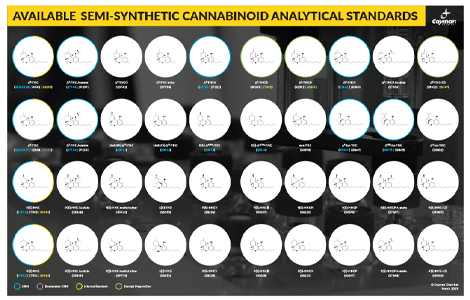 | Nitazene SnapshotThis NPS Snapshot summarizes the structures of the various semi-synthetic cannabinoids as well as key historical dates and known pharmacology. |
 | NPS DashboardWe keep up-to-date on the CFSRE's Quarterly Scope Recommendations in this NPS dashboard. We align CFSRE recommendations with reference standards available from Cayman to help analysts easily find reference standards to fit their scope of testing. |
 | Cayman Spectral LibraryOur spectral library is a free-of-charge, searchable GC-MS spectral database containing 70EV EI MS data of hundreds of Cayman's emerging forensic drug standards. |
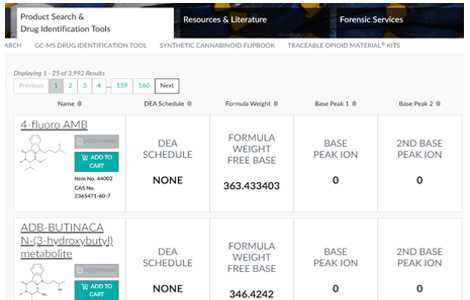 | GC-MS Drug IdentificationSearch unknowns by formula weight, base peak, or 2nd base peak ion. Try the GC-MS Drug Identification Tool Unknown Assistance Need help identifying your unknown? Send your data to techserv@caymanchem.com. |
Contact Info
Cayman Chemical1180 East Ellsworth RoadAnn Arbor, Michigan 48108 USAToll Free: (800) 364-9897(USA and Canada only)Fax: (734) 971-3640


