
News & Announcements
Pharmacology of Hexahydrocannabinols and Other Semi-Synthetic Cannabinoids
Article from 2024-06-26
Semi-synthetic cannabinoids rapidly emerged in the United States in response to legislative reforms that loosened Cannabis restrictions in 2018. Often marketed as "legal" alternatives to Δ9-THC, semi-synthetic cannabinoids have been widely sought after for both medicinal and recreational purposes and may be consumed by vaping, ingestion, or combustion. Though structurally similar to naturally occurring phytocannabinoids like Δ9-THC and CBD, semi-synthetic cannabinoids exhibit small structural differences that can alter the compound's inherent properties, including its psychoactivity, potency, and metabolism.
To date, little is known about the pharmacological, metabolic, and toxicity profiles of these semi-synthetic cannabinoids, highlighting an urgent need for continued research in this field.
A Brief History of Semi-Synthetic Cannabinoids
Although semi-synthetic cannabinoids only recently became a topic of mainstream interest, scientists studying the individual properties of phytocannabinoids prepared semi-synthetic cannabinoids as early as the 1940s.1,2 Semi-synthetic cannabinoids are distinct from fully synthetic cannabinoids like JWH 018, which appeared in herbal blends known as "Spice" or "K2" in the early 2000s.3 Fully synthetic cannabinoids do not rely on any plant-derived precursors for their synthesis and often have little structural resemblance to phytocannabinoids (Figure 1). In contrast, semi-synthetic cannabinoids are synthesized from precursors found in Cannabis, and many are themselves present in Cannabis (albeit at small amounts) and share many structural similarities with phytocannabinoids such as Δ9-THC and CBD.
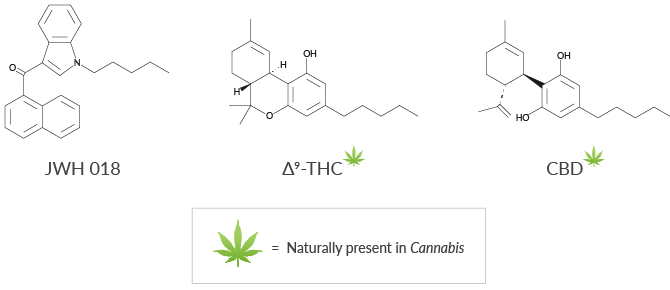
Figure 1. Structural differences between the fully synthetic cannabinoid JWH 018 and the phytocannabinoids Δ9-THC and CBD.
Semi-synthetic cannabinoids became commercially available in the United States as "legal" alternatives to Δ9-THC after passage of the 2018 Farm Bill, officially known as the Agriculture Improvement Act of 2018. The Farm Bill legalized production of hemp, which was defined as Cannabis containing less than 0.3% Δ9-THC by dry weight.4,5 There immediately arose some confusion on how this statement could be interpreted. Some states interpret this literally, such that only Δ9-THC needs to be considered in determining compliance with this regulation. Other states interpret this to mean that other cannabinoids that "contain" Δ9-THC, such as Δ9-THCA-A, which is the carboxylic acid form of Δ9-THC, need to also be factored into this definition to meet federal guidelines. Federal protocols for reporting total THC content meets the latter definition of hemp, and is calculated using the following formula:
Total Δ9-THC = Δ9-THC + (Δ9-THCA-A x 0.877)
(0.877 is used to denote the difference in molecular weight for the conversion of Δ9-THCA-A and Δ9-THC)
The Hemp-Derived Precursor: CBD
However, other phytocannabinoids, like CBD, are abundant in hemp. This created a legal loophole that prompted manufacturers to look for novel cannabinoids that could be synthesized from hemp-derived precursors to evade regulation from federal laws, as long as the total weight percent of Δ9-THC remained less than 0.3%.
CBD is a phytocannabinoid that is abundant in Cannabis, and hemp-derived CBD is a readily accessible precursor for the synthesis of semi-synthetic cannabinoids.4,5 CBD is an isomer of Δ9-THC, with a 1,3-resorcinol in place of the tricyclic benzopyran that defines the THC molecular structure (see Figure 1 above).
There are two endocannabinoid receptors, CB1 and CB2.5 The CB1 receptor is the main cannabinoid receptor responsible for the psychoactive effects of Δ9-THC.5-7 While Δ9-THC is a potent CB1 receptor agonist (Ki = 5.05-80.3 nM), CBD is a weak CB1 antagonist (Ki = 4,350->10,000 nM).8 Accordingly, CBD is not intoxicating and has minimal psychoactive effects. It is widely sought after for medicinal properties and is believed to aid in the relief of inflammation, chronic pain, anxiety, and depression without the psychoactive effects of Δ9-THC.
Δ8-THC
Δ8-THC was the first commercially available CBD-derived semi-synthetic cannabinoid marketed as a "legal" alternative to Δ9-THC.9 It is produced from CBD through an acid-catalyzed reaction and isomerization of the Δ9-THC intermediate (Figure 2). It is a positional isomer of Δ9-THC, containing a double bond between carbons 8 and 9 instead of between carbons 9 and 10. Δ8-THC is reported by users to have similar psychoactive effects to Δ9-THC, albeit with reduced potency.9,10 While it is often indicated Δ8-THC is naturally present in Cannabis, one recent study determined that it was either not found or only found at very low levels upon examination of 32 different Cannabis samples.11 As such, any Δ8-THC isolated from Cannabis is likely to have formed during processing of plant material post-extraction.
Figure 2. Synthesis of Δ8-THC from CBD.
Both Δ8- and Δ9-THC bind the CB1 receptor, though Δ8-THC binds with somewhat less affinity (Ki = 28.5-251 nM) compared with Δ9-THC, which could explain, in part, the reduced psychoactivity of Δ8-THC.9 Indeed, Vanegas et al. compared the cannabimimetic activity of Δ8-THC with Δ9-THC using the tetrad test and showed that Δ8-THC had cannabimimetic activity in a CB1-dependent manner but required higher doses than Δ9-THC.12
Hexahydrocannabinols (HHCs)
Hexahydrocannabinols (HHCs) appeared next on commercial markets.9 HHCs are produced from CBD after the conversion to Δ8-THC (or Δ9-THC) followed by catalytic hydrogenation, producing a mixture of HHCs comprised of the 9(S)- and 9(R)-HHC diastereomers (Figure 3).13,14 These compounds retain some psychoactivity but avoid classification as THCs, and thus, any THC-related regulations.
Figure 3. Synthesis of HHCs from CBD.
The cannabimimetic activity of 9(S)- and 9(R)-HHC was recently characterized by Russo et al. using the tetrad test, four behavioral assessments that evaluate locomotion, catalepsy, analgesia, and hypothermia as indicators of cannabinoid activity, in mice.5 9(R)-HHC displayed far greater cannabimimetic activity compared to 9(S)-HHC, which displayed minimal activity. 9(R)-HHC binds to the CB1 receptor (Ki =15 nM), which was equivalent to that of Δ9-THC in this study. 9(S)-HHC bound to the CB1 receptor with reduced affinity (Ki = 176 nM), which could explain, in part, its observed reduced cannabimimetic activity.13
Furthermore, in a recent paper co-authored by Cayman scientists, cannabinoid receptor functional assays were performed to determine the CB1 receptor activation of 9(R)- and 9(S)-HHC relative to Δ9-THC (EC50 = 4.79 nM). Both compounds acted as CB1 receptor agonists, with EC50 values of 9.39 and 68.3 nM, respectively, supporting the observations that 9(R)-HHC is more potent than 9(S)-HHC.15
Online users generally support these findings, with users reporting that HHC-containing products feel similar to Δ9-THC, albeit milder and with reduced potency.
H2-CBD and H4-CBD
Direct hydrogenation of CBD produces a mixture of two partially reduced dihydrocannabidiol (H2-CBD) epimers, 1,2-dihydrocannabidiol and 8,9-dihydrocannabidiol, where 8,9-dihydrocannabidiol is the primary epimer produced in published synthetic routes (Figure 4).16-18
Figure 4. Synthesis of H2-CBD and H4-CBD from CBD.
There is limited data available on the cannabinoid pharmacology of H2-CBDs. 8,9-Dihydrocannabidiol binds weakly to the cannabinoid CB1 receptor (Ki > 1 μM).19 Given its lack of intoxicating effects, widespread availability from hemp-derived CBD, and inability to be converted to THC through any feasible synthetic or metabolic route, 8,9-dihydrocannabidiol is an intriguing pharmaceutical candidate.20 Indeed, 8,9-dihydrocannabidiol reduced both the frequency and severity of seizures in a rat seizure model, suggesting at least one possible therapeutic application.
Further reduction of H2-CBD leads to the formation of a fully hydrogenated diastereomer mixture of 1(R)- and 1(S)-tetrahydrocannabidiol (H4-CBD), which binds to the CB1 receptor (Ki = 145 nM).19,21 However, both 1(R)- and 1(S)- tetrahydrocannabidiol were considered inactive at the CB1 receptor in functional activity assays.15 Some anecdotal reports from users in online forums suggest that H4-CBD does have some intoxicating properties, highlighting an important need for continued research into structure-activity relationships for these emerging semi-synthetic cannabinoids.
Modifications to Increase Semi-Synthetic Cannabinoid Potency
Much like most pharmaceutical compounds and drugs of abuse, chemical modifications to semi-synthetic cannabinoids have been pursued to increase their potency. High-potency semi-synthetic cannabinoids are desirable to some users, though for other users, high-potency products can elicit undesirable effects. Hence, accurate reporting of the identity and concentration of these products is critical.
Semi-Synthetic Cannabinoids with Variable Alkyl Chain Length
The length of the alkyl chain is an important determinant in the potency of cannabinoids.9 Δ9-THCB, -THCH, and -THCP are minor phytocannabinoids that have been recently identified in hemp and a medicinal Cannabis variety.7 While Δ9-THC contains a five-carbon pentyl chain, Δ9-THCB, -THCH, and -THCP contain four-carbon butyl, six-carbon hexyl, and seven-carbon heptyl chains, respectively (Figure 5).
Δ9-THCB and -THCP both bind to the CB1 receptor with greater potency than Δ9-THC and in functional activity assays, Δ9-THCP and -THCH had equivalent potency to Δ9-THC (EC50s = 3.27 and 4.70 nM, respectively), which is in accordance with users in online forums who report that these semi-synthetic cannabinoids produce similar effects to Δ9-THC.15
Figure 5. Comparison of alkyl chain length between Δ9-THC, Δ9-THCB, Δ9-THCH, and Δ9-THCP.
Although these minor cannabinoids have been identified in Cannabis, they are present in low amounts. Commercially available Δ9 and Δ8-THCB, -THCH, and -THCP products are likely synthetically produced from their corresponding variable alkyl chain CBD precursors CBDB, CBDH, and CBDP.9 These Δ8-THC semi-synthetic cannabinoids also have CB1 receptor activity (EC50s = 5.29 and 12.2 nM for Δ8-THCP and -THCH, respectively).15
Like other semi-synthetic cannabinoids that act as precursors, Δ9-THCB, -THCH, and -THCP can be hydrogenated to produce hexahydrocannabutol (HHCB), hexahydrocannabihexol (HHCH), and hexahydrocannabiphorol (HHCP), respectively.22,23 In functional activity assays, 9(R)- and 9(S)-HHCP had EC50 values of 6.19 and 69.5 nM, respectively, at the CB1 receptor, suggesting that they likely have some cannabimimetic activity.15
Acetylated Semi-Synthetic Cannabinoids
Acetylation is a chemical reaction wherein the hydrogen atom of a hydroxyl group (-OH) is replaced with an acetyl group (O-Ac). This modification introduces an ester, acetate (Ac), into the compound and is a commonly employed strategy in medicinal chemistry to produce ester prodrugs, which have increased lipophilicity and hence, membrane permeability and potency.24
Acetylated semi-synthetic cannabinoids do not naturally occur in Cannabis. However, many hemp-derived semi-synthetic cannabinoids and naturally occurring phytocannabinoids are used as precursors to synthetically produce their acetylated counterparts, likely using an acetic anhydride reaction.25 This modification is introduced to the phenol ring present in Δ9-THC, (R/S)-HHC, and other structurally similar semi-synthetic cannabinoids.
Acetylated cannabinoids are typically named using a shorthand convention (Table 2). The name of the parent compound is used as the base, and the letter "-O" or, less frequently, "-OAc", is added after to indicate that it has been acetylated. Occasionally, the epimer is also indicated on these commercially available products.
In 2020, the DEA clarified their position on the legality of semi-synthetic cannabinoids, including acetylated semi-synthetic cannabinoids, stating that "all synthetically derived tetrahydrocannabinols (THC) remain schedule I controlled substances". However, there is still much debate around the legality of these compounds, with some state legislatures taking measures to ban semi-synthetic cannabinoid and recent calls for amendments to the 2018 Farm Bill Act that would close these loopholes.
View all acetylated semi-synthetic cannabinoids
Although pharmacological data is lacking, acetylated semi-synthetic cannabinoids (Figure 6) are reported by some users in online forums to be more potent than their analogous non-acetylated or naturally occurring form.25,26 However, as cannabinoids are already strongly lipophilic compounds, it is unclear as to what extent the acetate modification enhances the potency of these compounds.
Figure 6. Structural comparison of parent compounds and acetylated semi-synthetic cannabinoids. Δ9- and Δ8-THC and their corresponding acetylated products are shown as representative compounds.
As semi-synthetic acetylated cannabinoids can be considered prodrugs that are converted to the parent compound after the ester bond is cleaved, these compounds are metabolized like their non-acetylated parent compounds.9 As such, it is not possible to use metabolic fragmentation patterns as a specific marker for consumption of semi-synthetic acetylated cannabinoids. Instead, analytical methods must rely on detection of the non-transformed parent compound as a specific marker for consumption of these products.
Impurities in Semi-Synthetic Cannabinoids
The unregulated semi-synthetic cannabinoid market poses some risks to consumers.9,27 Not only are there concerns that the identity and concentration of products containing semi-synthetic cannabinoids are not accurately reported, but there are also concerns over the presence of impurities in these products.
The reactions employed in the conversion of hemp-derived CBD to hydrogenated or acetylated semi-synthetic cannabinoids are associated with some risks. These reactions can lead to the production of many side products, which may be undeclared.27
Hydrogenation is often performed in the presence of toxic heavy metal catalysts such as platinum or palladium, and there are some concerns that these toxic catalysts may be present in commercially available semi-synthetic cannabinoid products.26
Acetylated semi-synthetic cannabinoids are structurally similar to vitamin E acetate, which is used as an additive mixture in vaping mixtures. It produces the toxic gas ketene when vaporized and has been implicated in lung injury associated with e-cigarette or vaping product use-associated lung injury (EVALI).26 Indeed, previous studies have detected ketene in vaped condensates from commercial Δ8-THC acetate products.2
Future Directions
Little is known about the pharmacological, metabolic, and toxicity profiles of these semi-synthetic cannabinoids, highlighting an urgent need for continued research in this field. Cayman has produced a broad range of reference materials and analytical standards to help researchers provide insight into these unanswered questions. We can assist in the interpretation of unknown fragmentation patterns. If you are having trouble identifying or finding a compound of interest, please contact our technical support department.
You May Also Be Interested In
 Designer Drug Scene Webinar Highlights |  The Latest Research Insights on Hexahydrocannabinol Metabolism The Latest Research Insights on Hexahydrocannabinol Metabolism |
References
1. Pertwee, R.G. Cannabinoid pharmacology: The first 66 years. Br. J. Pharmacol. 147(Suppl 1), S163-S171 (2006).
2. Munger, K.R., Jensen, R.P., and Strongin, R.M. Vaping cannabinoid acetates leads to ketene formation. Chem. Res. Toxicol. 35(7), 1202-1205 (2022).
3. Seely, K.A., Prather, P.L., James, L.P., et al. Marijuana-based drugs: Innovative therapeutics or designer drugs of abuse? Mol. Interv. 11(1), 36-51 (2011).
4. Ujváry, I. Hexahydrocannabinol and closely related semi-synthetic cannabinoids: A comprehensive review. Drug Test. Anal. 16(2), 127-161 (2024).
5. Russo, F., Vandelli, M.A., Biagini, G., et al. Synthesis and pharmacological activity of the epimers of hexahydrocannabinol (HHC). Sci. Rep. 13(1), 11061 (2023).
6 Banister, S.D., Arnold, J.C., Connor, M., et al. Dark classics in chemical neuroscience: Δ9-Tetrahydrocannabinol. ACS Chem. Neurosci. 10(5), 2160-2175 (2019).
7. Citti, C., Linciano, P., Russo, F., et al. A novel phytocannabinoid isolated from Cannabis sativa L. with an in vivo cannabimimetic activity higher than Δ9-tetrahydrocannabinol: Δ9-Tetrahydrocannabiphorol. Sci. Rep. 9(1), 20335 (2019).
8. Pertwee, R.G. The diverse CB1 and CB2 receptor pharmacology of three plant cannabinoids: Δ9-Tetrahydrocannabinol, cannabidiol and Δ9-tetrahydrocannabivarin. Br. J. Pharmacol. 153(2), 199-215 (2008).
9. Zawatsky, C.N., Mills-Huffnagle, S., Augusto, C.M., et al. Cannabidiol-derived cannabinoids: The unregulated designer drug market following the 2018 Farm Bill. Med. Cannabis Cannabinoids 7(1), 10-18 (2024).
10. Tagen, M. and Klumpers, L.E. Review of delta-8-tetrahydrocannabinol (Δ8-THC): Comparative pharmacology with Δ9-THC. Br. J. Pharmacol. 179(15), 3915-3933 (2022).
11. Wang, Y.-H., Avula, B., ElSohly, M.A., et al. Quantitative determination of Δ9-THC, CBG, CBD, their acid precursors and five other neutral cannabinoids by UHPLC-UV-MS. Planta Med. 84(4), 260-266 (2018).
12. Vanegas, S.O., Reck, A.M., Rodriguez, C.E., et al. Assessment of dependence potential and abuse liability of Δ8-tetrahydrocannabinol in mice. Drug Alcohol Depend. 240, 109640 (2022).
13. Nasrallah, D.J. and Garg, N.K. Studies pertaining to the emerging cannabinoid hexahydrocannabinol (HHC). ACS Chem. Biol. 18(9), 2023-2029 (2023).
14. Schirmer, W., Auwärter, V., Kaudewitz, J., et al. Identification of human hexahydrocannabinol metabolites in urine. Eur. J. Mass Spectrom. (Chichester) 29(5-6), 326-337 (2023).
15. Janssens, L.K., Van Uytfanghe, K., Williams, J.B., et al. Investigation of the intrinsic cannabinoid activity of hemp-derived and semisynthetic cannabinoids with β-arrestin2 recruitment assays—and how this matters for the harm potential of seized drugs. Arch. Toxicol. (2024).
16. Navarrete, C., García-Martín, A., Rolland, A., et al. Cannabidiol and other cannabinoids in demyelinating diseases. Int. J. Mol. Sci. 22(6), 2992 (2021).
17. Nelson, K.M., Bisson, J., Singh, G., et al. The essential medicinal chemistry of cannabidiol (CBD). J. Med. Chem. 63(21), 12137-12155 (2020).
18. Millimaci, A.M., Trilles, R.V., McNeely, J.H., et al. Synthesis of neocannabinoids using controlled Friedel-Crafts reactions. J. Org. Chem. 88(18), 13135-13141 (2023).
19. Ben-Shabat, S., Hanuš, L.O., Katzavian, G., et al. New cannabidiol derivatives: Synthesis, binding to cannabinoid receptor, and evaluation of their antiinflammatory activity. J. Med. Chem. 49(3), 1113-1117 (2006).
20. Mascal, M., Hafezi, N., Wang, D. et al. Synthetic, non-intoxicating 8,9-dihydrocannabidiol for the mitigation of seizures. Sci. Rep. 9(1), 7778 (2019).
21. Docampo-Palacios, M.L., Ramirez, G.A., Tesfatsion, T.T., et al. Saturated cannabinoids: Update on synthesis strategies and biological studies of these emerging cannabinoid analogs. Molecules 28(17), 6434 (2023).
22. Adams, R., Loewe, S., Smith, C.M., et al. Tetrahydrocannabinol homologs and analogs with marihuana activity. XIII. J. Am. Chem. Soc. 64(3), 694-697 (1942).
23. Tanaka, R. and Kikura-Hanajiri, R. Identification of hexahydrocannabinol (HHC), dihydro-iso-tetrahydrocannabinol (dihydro-iso-THC) and hexahydrocannabiphorol (HHCP) in electronic cigarette cartridge products. Forensic Toxicol. 42(1), 71-81 (2024).
24. Zhang, R., Qin, X., Kong, F., et al. Improving cellular uptake of therapeutic entities through interaction with components of cell membrane. Drug Deliv. 26(1), 328-342 (2019).
25. Holt, A.K., Poklis, J.L., and Peace, M.R. ∆8-THC, THC-O acetates and CBD-di-O acetate: Emerging synthetic cannabinoids found in commercially sold plant material and gummy edibles. J. Anal. Toxicol. 46(8), 940-948 (2022).
26. Kruger, D.J., Amila, K., Kaplan, S.M., et al. A content analysis of social media discussions on THC-O-acetate. Cannabis 6(2), 13-21 (2023).
27. Geci, M., Scialdone, M., and Tishler, J. The dark side of cannabidiol: The unanticipated social and clinical implications of synthetic Δ8-THC. Cannabis Cannabinoid Res. 8(2), 270-282 (2023).
Contact Info
Cayman Chemical1180 East Ellsworth RoadAnn Arbor, Michigan 48108 USAToll Free: (800) 364-9897(USA and Canada only)Fax: (734) 971-3640


