
News & Announcements
Post-Translational Modification Through Carbamylation
Post-Translational Modification Through Carbamylation
Article from 2017-07-24
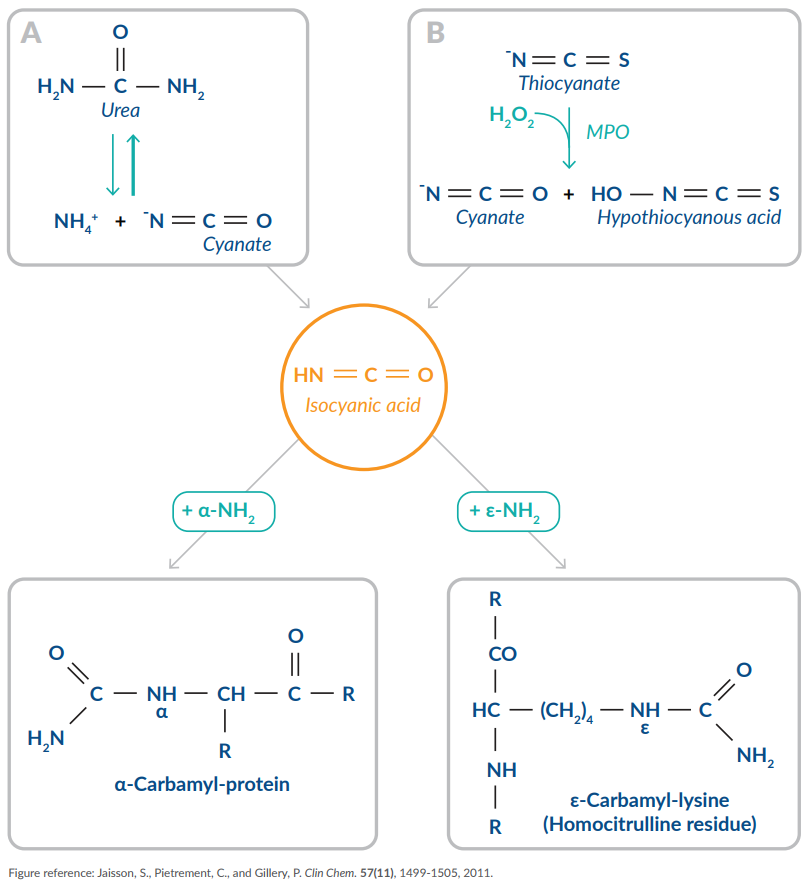
Carbamylation is a non-enzymatic and irreversible post-translational modification (PTM) that mainly results from interaction between isocyanic acid and amino groups of proteins. When this occurs on lysine residues within polypeptide chains, ε-carbamyl-lysine (i.e., homocitrulline) is generated. Isocyanic acid is mainly produced from the spontaneous decomposition of urea into ammonium and cyanate, a reactive species that is rapidly converted to isocyanic acid (Figure 1A). Reactive cyanate may also be generated from thiocyanate metabolism. Neutrophil-derived myeloperoxidase (MPO) catalyzes the oxidation of thiocyanate in the presence of hydrogen peroxide (Figure 1B). This occurs at sites of inflammation and atherosclerotic plaque, where thiocyanate is abundant in blood and is especially elevated in smokers.1,2
PROTEIN CARBAMYLATION IN DISEASE
From inflammation to aging, many disease states show an involvement of carbamylated protein accumulation in their pathology. Chronic kidney disease, characterized by increased levels of urea and elevated cyanate concentrations, and atherosclerosis are the most documented.1-3 The protein carbamylation associated with vascular dysfunction during end-stage renal disease has been shown to promote the conversion of low-density lipoprotein into a ligand for macrophage scavenger receptor A1 recognition, the accumulation of cholesterol, and the formation of foam cells.3 Additionally, autoantibodies to carbamylated proteins have been identified in the sera of rheumatoid arthritis patients,4 and a significant enrichment in carbamylation of airway proteins has been documented in asthmatics.5 Also, the accumulation of carbamylated matrix proteins, like collagen and elastin, is linked to age-related structural and functional tissue damage.6
CARBAMYLATION VS. CITRULLINATION
With just one additional methylene group, the homocitrulline residues formed by carbamylation are structurally similar to the citrulline residues formed by peptidyl arginine deiminase (PAD) activity during the citrullination of arginine (Figure 2). Because citrulline residues on proteins can indicate many of the same disease states as the presence of homocitrulline residues,7 the ability to differentiate between citrullinated and carbamylated proteins is, though challenging, key to understanding the role of these PTMs in physiological and pathological processes.
AVAILABLE BIOMARKERS
Several biomarkers have been suggested to evaluate the extent of protein carbamylation in biological samples. Theoretically, any lysine-containing protein can be carbamylated depending on the accessibility of its amino group, but the most common disease markers are for proteins found in blood. Carbamylated albumin is considered an important biomarker for mortality risk in chronic kidney disease, while carbamylated fibrinogen has been shown to be a strong neutrophil chemoattractant associated with chronic inflammatory diseases.8 Cayman offers a collection of key carbamylated proteins, including bovine serum albumin, fetal calf serum, and human fibrinogen. A citrullinated version of core histones and a carbamylated version of core histones are also available to help parse the contribution of citrullination vs. carbamylation in the development of neutrophil extracellular traps, which are a part of the inflammatory response.7
Pan-protein carbamylation can also be determined by detecting the presence of homocitrulline residues on proteins. Cayman developed an Anti-Carbamylation (Homocitrulline) Polyclonal Antibody to detect carbamylated proteins from any species. This antibody is highly specific and does not cross react with unmodified proteins or citrullinated proteins under all applications tested, including Western blot, immunoprecipitation, ELISA, and mass spectrometry. Because this antibody enables global detection of homocitrullines on proteins, it will greatly aid in the discovery of novel proteins modified by carbamylation, and the identification of pathophysiological processes mediated by this PTM.
References
1. Verbrugge, F.H., Tang, W.H.W., and Hazen, S.L. Protein carbamylation and cardiovascular disease. Kidney Int.88(3), 474-478 (2015).
2. Gajjala, P.R., Fliser, D., Speer, T., et al. Emerging role of post-translational modifications in chronic kidney disease and cardiovascular disease. Nephrol. Dial. Transplant. 30(11), 1814-1824 (2015).
3. Wang, Z., Nicholls, S.J., Rodriquez, E.R., et al. Protein carbamylation links inflammation, smoking, uremia and atherogenesis. Nat. Med.13(1), 1176-1184 (2007).
4. Shi, J., Knevel, R., Suwannalai, P., et al. Autoantibodies recognizing carbamylated proteins are present in sera of patients with rheumatoid arthritis and predict joint damage. Proc. Natl. Acad. Sci. USA108(42), 17372-17377 (2011).
5. Wang, Z., DiDonato, J.A., Buffa, J., et al. Eosinophil peroxidase catalyzed protein carbamylation participates in asthma. J. Biol. Chem. 291(42), 22118-22135 (2016).
6. Gorisse, L., Pietrement, C., Vuiblet, V., et al. Protein carbamylation is a hallmark of aging. Proc. Natl. Acad. Sci. USA113(5), 1191-1196 (2016).
7. Pruijn, G.J.M. Citrullination and carbamylation in the pathophysiology of rheumatoid arthritis. Front. Immunol.6, 192 (2015).
8. Binder, V., Bergum, B., Jaisson, S., et al. Impact of fibrinogen carbamylation on fibrin clot formation and stability. Thromb. Haemost.117(5), 899-910 (2017).
Contact Info
Cayman Chemical1180 East Ellsworth RoadAnn Arbor, Michigan 48108 USAToll Free: (800) 364-9897(USA and Canada only)Fax: (734) 971-3640


